The federal government is directing $7 million to a package of eight renewable-energy initiatives across Canada's Arctic and near-Arctic regions, including a project in the Northwest Territories to test power generation from the Mackenzie River.
Announcement and regional breakdown
Environment Minister Julie Dabrusin announced the investments on July 29 in Whitehorse. The funding is split among community-scale wind, solar and hybrid projects, feasibility studies and applied research delivered by Indigenous organisations, municipalities and northern institutions.
Highlights include planning and construction support for a proposed wind development in Baker Lake, Nunavut, and a research award to Yukon University. Locally, the only Northwest Territories recipient is Big River Services Centre in Fort Providence.
Projects and funding allocations
The announced awards include a mix of procurement-ready installations and earlier-stage engineering and feasibility work. Key allocations reported by the government are:
- $1.4 million for planning and construction work on a future wind-power development in Baker Lake, which includes wind testing in Chesterfield Inlet and Whale Cove. The contract was awarded to Inuit-owned Nunasi Corporation and involves portable wind-speed measurement equipment to assess viability.
- $729,434 to the Hamlet of Chesterfield Inlet for solar panels on the Noel Nuvak Arena, installing a 134-kilowatt rooftop array.
- $410,625 for engineering of a hybrid renewable-and-diesel microgrid in Arviat, contracted to Kivalliq Alternative Energy Ltd., a part-owner by the Kivalliq Inuit Association. This project remains in pre-procurement and construction stages.
- $260,000 for a 15-kilowatt solar installation on the Hamlet of Resolute Bay’s garage.
- $99,000 to the Kitikmeot Heritage Society for a pollution study tied to constructing a cultural research campus in Cambridge Bay.
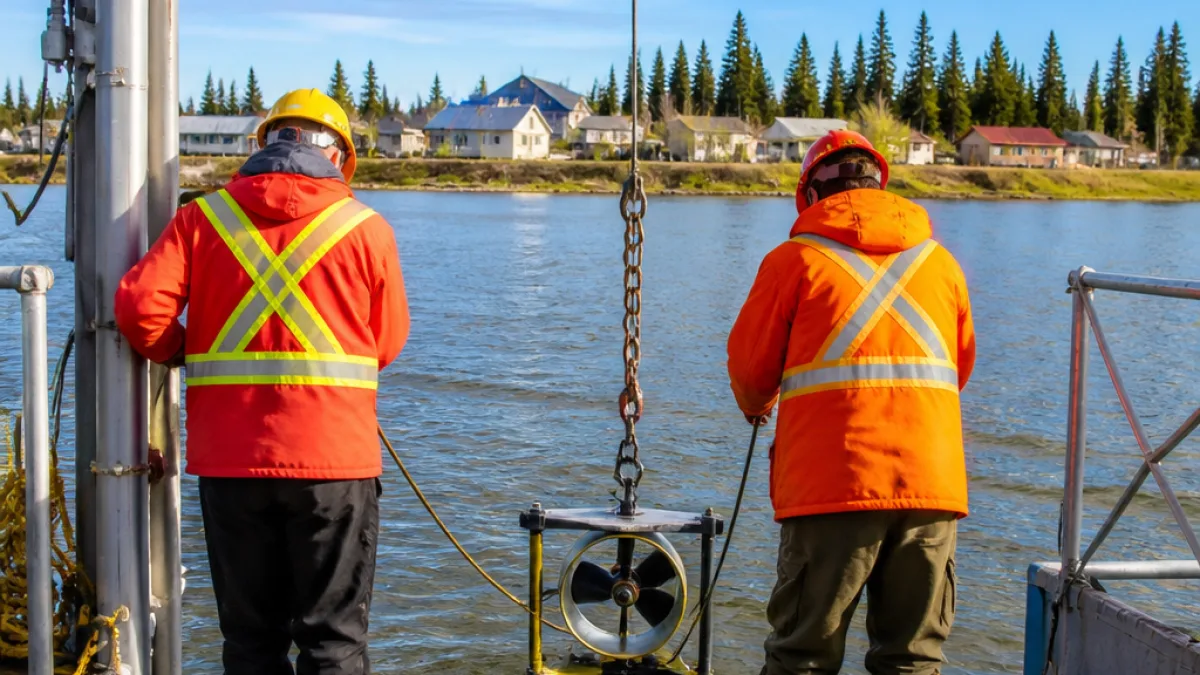
- $766,090 to Big River Services Centre in Fort Providence, N.W.T., to test power generation from the Mackenzie River.
- $2.8 million to Yukon University in Whitehorse to support community-led renewable generation research, including training and power-system modelling enhancements.
- $42,500 to Northern Vision Development, based in Whitehorse, for a feasibility study on biomass heating for downtown buildings.
| Community/Recipient | Project | Amount |
|---|---|---|
| Baker Lake (Nunasi Corporation) | Wind development planning and wind-speed testing | $1,400,000 |
| Chesterfield Inlet | 134 kW solar array on Noel Nuvak Arena | $729,434 |
| Arviat | Engineering for hybrid renewable–diesel microgrid | $410,625 |
| Resolute Bay | 15 kW solar system for municipal garage | $260,000 |
| Cambridge Bay (Kitikmeot Heritage Society) | Pollution study linked to cultural research campus | $99,000 |
| Fort Providence (Big River Services Centre) | Testing power generation from the Mackenzie River | $766,090 |
| Whitehorse (Yukon University) | Research on community-led renewable projects and training | $2,800,000 |
| Whitehorse (Northern Vision Development) | Feasibility study for biomass heating | $42,500 |
Why the funds matter in the North
Northern communities have historically relied on diesel for electricity and heat. Projects that add solar, wind, biomass or river-based generation aim to reduce diesel dependence, which carries high fuel and transport costs and contributes to greenhouse-gas emissions.
The awards in this tranche range from studies and engineering work to full installations and applied research. Several are led by Indigenous organisations or municipal governments, signalling local control over planning and delivery — an emphasis Ottawa highlighted in its announcement.
“Investments like the ones announced today reduce reliance on diesel and support Indigenous leadership in shaping the energy future of their communities,”
The federal support for Yukon University is framed around capacity-building and modelling, which officials say will help communities plan how to integrate renewables into existing systems.
Local context: Fort Providence testing
In Fort Providence, the $766,090 award to Big River Services Centre will fund trials to determine whether the Mackenzie River can provide reliable power generation for the community. River-based generation is not widespread in Arctic communities and, if feasible, could offer a local, low-carbon supplement to existing systems.
The project in Fort Providence is notable because it is the only Northwest Territories initiative named in this announcement. Details on timelines, technical approach and subsequent procurement were not provided in the funding summary.
Next steps and what to watch for
- Local organisations and municipalities will move into design, procurement and construction phases where funds were earmarked for implementation.
- Engineering and feasibility studies will produce technical reports that could guide future capital investments and community consultations.
- Training and modelling work in Whitehorse aims to build northern capacity for planning and operating hybrid power systems.
Officials in affected communities and the recipients named will be the next source of specific timelines and technical details as projects progress from planning to delivery.
Nathan Erasmus, NEXO RADAR