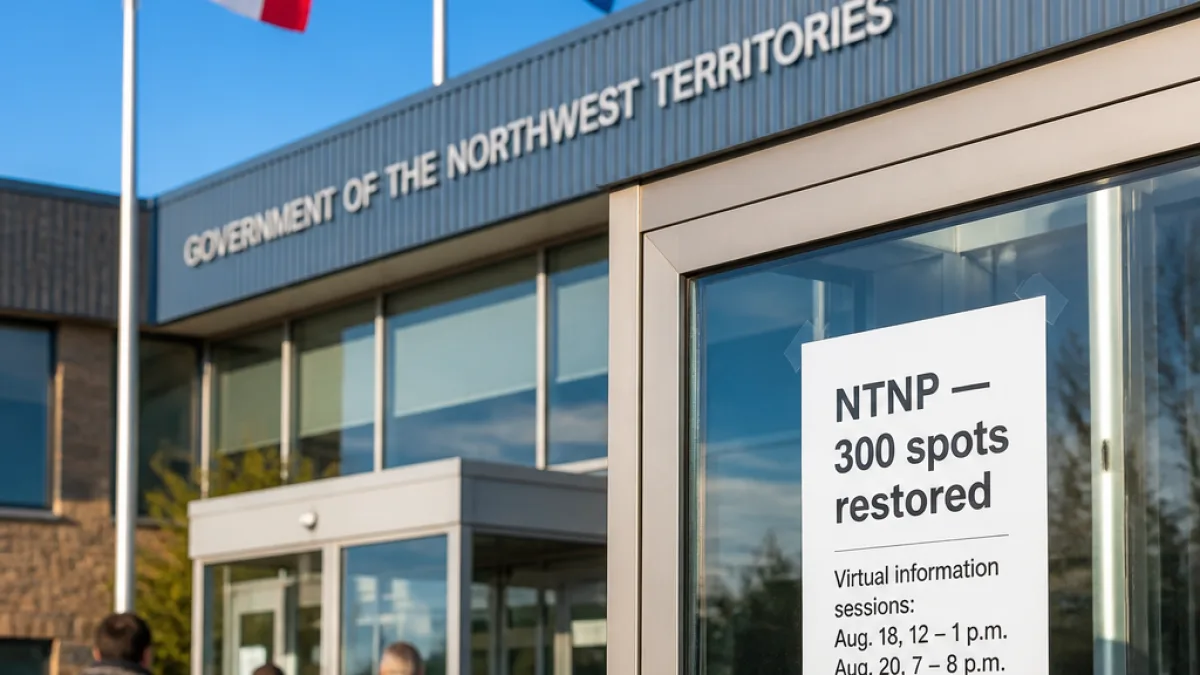
The federal government has reinstated a cap of 300 spots for the Northwest Territories Nominee Program (NTNP) for 2026, the Government of the Northwest Territories said Friday. The change restores the number of provincial nominee allocations the territory had been using to help employers recruit foreign workers for permanent residency.
Background to the change
The nominee program lets employers in the Northwest Territories nominate foreign workers for permanent residency when they can demonstrate there are no suitably qualified local workers. The territory has relied on the program to address persistent labour shortages in remote communities and in sectors that struggle to recruit locally.
After filling an initial allotment of 300 spots by early summer 2024, the GNWT lobbied Ottawa to increase the cap to 500. Instead, the federal government reduced the NWT’s allocation to 150 spots for 2025 — a number the territory reported it filled. For the current year, Ottawa originally assigned 197 spots to the NWT program before reversing course on Friday and restoring the cap to 300.
| Year | Initial federal allocation | Territorial note |
|---|---|---|
| 2024 | 300 | All spots filled by early summer |
| 2025 | 150 | Territory said it filled the spaces |
| 2026 | Initially 197 → now 300 | Additional draw planned |
Territorial priorities and a new selection system
In a media release, the GNWT said the return to 300 spots reflects ongoing advocacy to make sure Ottawa recognises the territory’s immigration priorities and its particular labour market realities.
“ensure the territory’s immigration priorities and unique labour market needs are reflected in its allocation numbers.”
Earlier this year the territory moved to a new points-based system to assess and rank candidates for the nominee program. The change was intended to better align nominations with the NWT’s economic needs by scoring applicants on factors such as work experience, language and other criteria the territory deems relevant.
Immediate practical impacts
With the restored spots, the GNWT said it will hold an additional expression-of-interest (EOI) draw on Aug. 26 for applications submitted by Aug. 24. That draw gives employers and prospective nominees another opportunity this year to be selected under the program.
The territory also scheduled two virtual information sessions to walk employers and applicants through the updated rules and the new selection process. Sessions are set for Aug. 18 at 2 p.m. and Aug. 20 at 10 a.m. People interested in attending were directed to register by emailing [email protected].
- Additional expression-of-interest draw: Aug. 26 (for EOIs submitted by Aug. 24)
- Virtual information sessions: Aug. 18 at 2 p.m.; Aug. 20 at 10 a.m.
- Contact for registration: [email protected]
What this means locally
For employers in resource, tourism, health and construction sectors — many of which operate in communities with small labour pools — the increased allocation provides more flexibility to nominate foreign workers when local hires are not available. For workers abroad, the additional draw and the points-based ranking offer another pathway to permanent residency in Canada and stable employment in the North.
At the same time, changes to allocation numbers from Ottawa demonstrate the fragility of relying on federal nominee spots as a long-term labour strategy. The NWT’s pushback and the subsequent restoration of allocations suggest the territory will continue to press for predictable and adequate nomination levels to match its workforce needs.
The territory did not announce any immediate adjustments to employer eligibility criteria beyond the points-based assessment introduced earlier this year. Employers and potential nominees should consult the GNWT’s immigration pages or attend the scheduled sessions to confirm up-to-date requirements and deadlines.
As the NWT prepares for another round of selections, the restored allotment for 2026 should translate into more nominations and, for some communities, a quicker fill of critical positions that have gone unfilled because of recruitment constraints.
Local officials and affected employers now face the task of ensuring potential candidates are informed of the new system and that nominations submitted ahead of the Aug. 24 cut-off are complete and competitive under the new scoring regime.