
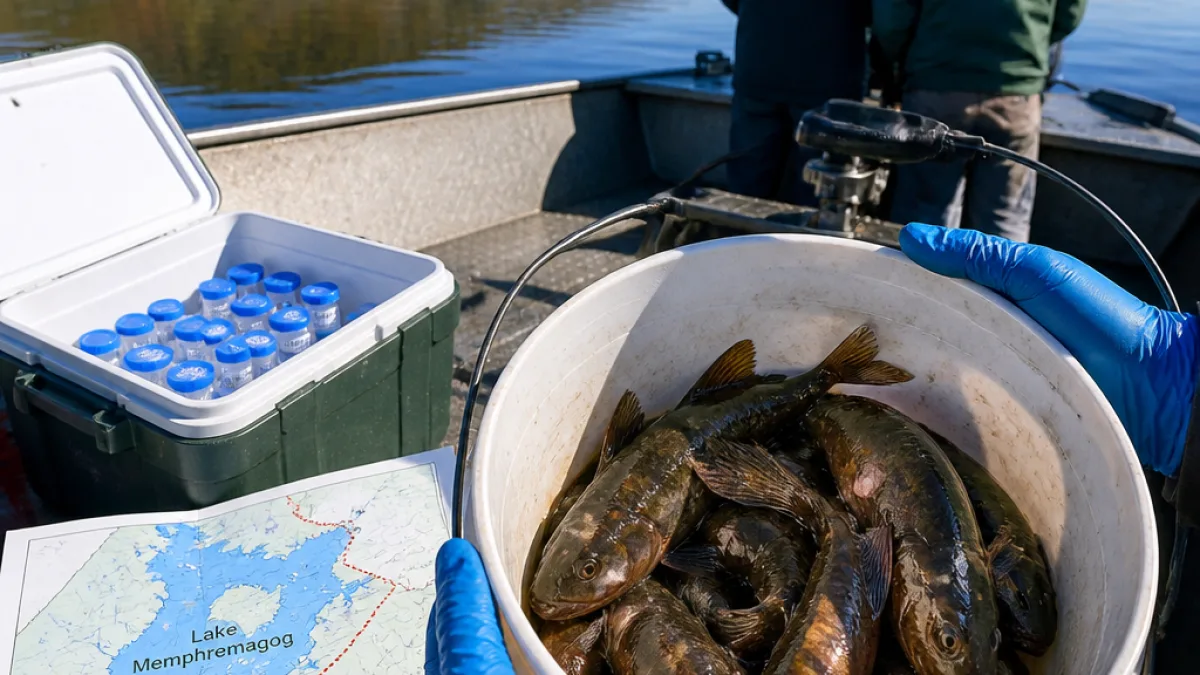
Fishermen and scientists in the Maritimes are awaiting DNA results that could confirm whether a recently described transmissible melanoma in brown bullhead catfish has moved hundreds of kilometres from its originally reported site near the Quebec–Vermont border.
Field sampling follows familiar sightings
Veteran angler Scott Young, who has spent four decades fishing New Brunswick lakes and rivers, told researchers he has long seen brown bullhead catfish with dark spots. In May, he brought University of Cambridge postdoctoral researcher Zoe Clarke onto his boat to collect specimens so lab tests could determine whether those lesions are the same contagious cancer recently identified by researchers in another watershed.
Clarke said she expects results from a DNA sequencing laboratory in the coming weeks. If those tests confirm the connection, it would indicate the tumour lineage first described in Lake Memphremagog has been detected well outside that basin.
“How the heck did this happen? Why is it here? That’s the kind of thing that we’re going to be devoting a lot of our energy to over the next few years.”
The quote came from Clarke, a member of the Cambridge Transmissible Cancer Group, who is leading efforts to determine the genetic identity of the tumours found on the New Brunswick catfish.
What researchers already know
Between 2014 and 2018, scientists investigating raised black growths on brown bullhead in Lake Memphremagog—a transboundary lake that straddles the Quebec–Vermont border—noted those lesions were skin cancers. A paper published last month by a University of Vermont team in Nature reported that the melanoma in those catfish is transmissible—meaning the tumour cells themselves appear to spread between fish rather than arising independently in each animal.
That discovery positioned the catfish melanoma as the fourth distinct naturally occurring transmissible cancer known in animals, joining lineages documented in dogs, Tasmanian devils and several filter-feeding molluscs.
| Known transmissible cancer lineages | Representative hosts |
|---|---|
| Canine transmissible venereal tumour | Dogs |
| Devil facial tumour disease | Tasmanian devils |
| Transmissible neoplasia in bivalves | Clams and mussels |
| Melanoma reported in brown bullhead | Brown bullhead catfish |
Why confirmation matters
Scientists warn the phenomenon is unusual and could have substantial ecological consequences because transmissible cancers have the potential to reduce host populations markedly. The Vermont-led research found the tumours to be genetically identical clones rather than independent mutations, suggesting cell-to-cell transmission.
For researchers and resource managers, determining whether the same tumour lineage occurs in New Brunswick is a first step in mapping the distribution and assessing risk. Clarke said follow-up work will focus on how the cancer moves through freshwater systems and what ecological or human-mediated pathways might facilitate its spread.
Local implications and unanswered questions
At present, the scientific community has several open questions that local stakeholders are watching closely:
- How widely distributed is the transmissible melanoma across watersheds beyond Memphremagog?
- What routes—natural fish movements, connected waterways, or human activity—could explain occurrence in distant locations?
- What are the potential population-level impacts on brown bullhead and any implications for ecosystem health?
Researchers involved in the initial work have emphasised that these findings are a call for monitoring rather than immediate alarm. The next weeks of DNA sequencing and subsequent analyses will help determine whether the spotted New Brunswick fish are indeed part of the same transmissible lineage.
What residents and anglers should know
Brown bullhead catfish are a common freshwater species in eastern Canada and the United States. Until laboratory confirmation, officials have not issued new public-health or fisheries advisories related to the tumours. Researchers typically recommend reporting unusual fish lesions to provincial fisheries biologists or university teams studying wildlife disease so samples can be collected and analysed.
As this research progresses, collaboration between Canadian and U.S. institutions will be essential to trace the pattern of occurrence and to design monitoring that informs management actions should they become necessary.
For now, the scientific teams are waiting on sequencing data that will either link the New Brunswick lesions to the Memphremagog lineage or indicate a separate origin—each outcome carrying different implications for how the phenomenon is managed and studied in the region.