The federal government has awarded close to $7 million to eight renewable-energy projects across the three territories, a funding package intended to bolster local power systems, reduce reliance on fossil fuels and support long-term economic opportunities in remote communities.
Funding spread across Yukon, Nunavut and N.W.T.
Nunavut received the largest share of projects, accounting for five of the funded initiatives. The Yukon secured two projects, and the Northwest Territories received one award. The grants come through federal programs that support clean-energy transitions in isolated and northerly communities.
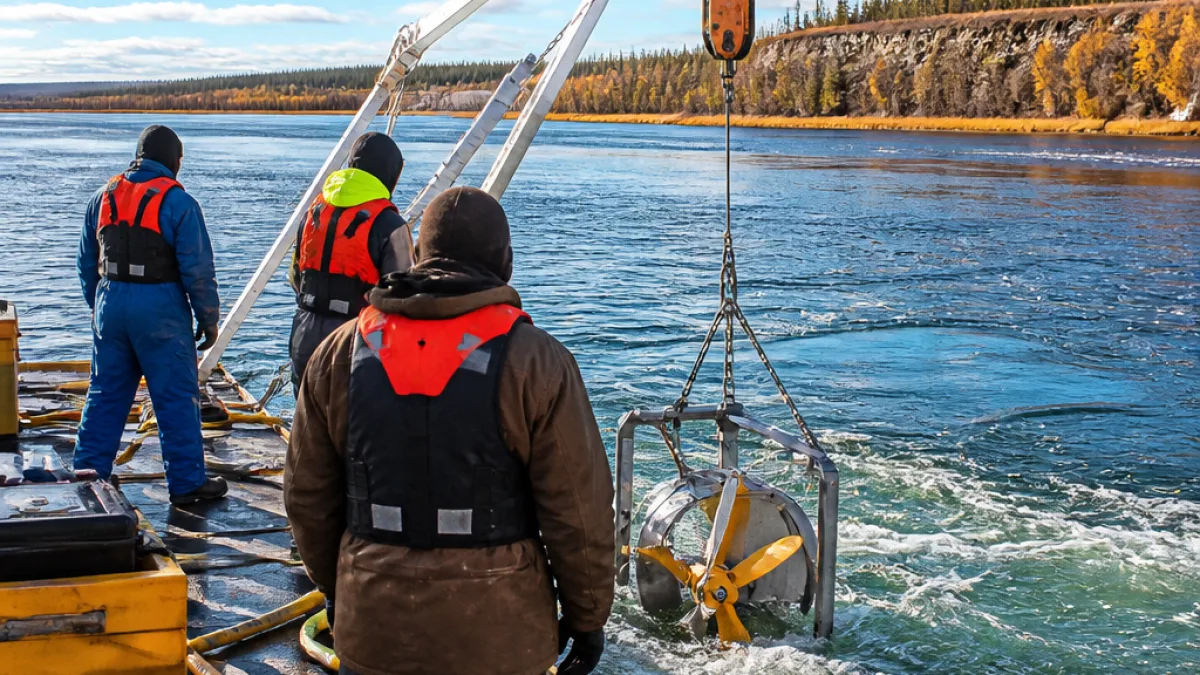
In the N.W.T., the recipient is Big River Services Centre LP, which will use a contribution of $766,090 for preliminary testing of a hydrokinetic turbine demonstration in the Mackenzie River near Fort Providence. The work will assess the potential for extracting energy directly from river currents without the need for new dams or extensive shoreline infrastructure.
Nunavut projects emphasise solar and assessments
Nunavut’s funded projects include both capital installations and technical studies. Two capital projects focus on solar arrays: the Hamlet of Chesterfield Inlet will receive $729,434 to install a 134-kW roof-mounted solar array at the Noel Nuvak Arena, while the Municipality of Resolute Bay will receive $260,000 for a 15-kW solar net-metering system on a municipal garage.
The territory’s other awards support resource assessments and engineering studies designed to evaluate renewable technologies for northern conditions. Recipients include the Nunasi Corporation, Kivalliq Alternative Energy Ltd. and the Kitikmeot Heritage Society.
Yukon gets study and modelling support
In the Yukon, Yukon University was approved for $2,807,398 to advance community-led renewable energy generation and to support modelling for the territory’s grid system. A smaller award of $42,500 was granted to Northern Vision Development LP to examine the feasibility of a biomass-fired district heating system in downtown Whitehorse.
Program delivery and objectives
Most of the contributions — seven projects — will be financed through Natural Resources Canada’s Clean Energy for Rural and Remote Communities (CERRC) program. One project will receive funds through NRCan’s Smart Renewables and Electrification Pathway. Both initiatives aim to evaluate and deploy technologies that can lower northern communities’ dependence on diesel and other fossil fuels.
- Support on- and off-grid renewable installations.
- Conduct engineering and feasibility studies adapted to northern conditions.
- Strengthen long-term local economic and energy resilience.
Officials have framed the investments as targeted steps to enable local authorities, Indigenous organisations and community operators to trial technologies before committing to larger capital projects.
| Territory | Number of projects | Notable award |
|---|---|---|
| Nunavut | 5 | $1,440,245 to Nunasi Corporation for wind speed testing and mobile resource assessments |
| Yukon | 2 | $2,807,398 to Yukon University for community-led renewable generation and modelling |
| Northwest Territories | 1 | $766,090 to Big River Services Centre LP for hydrokinetic testing near Fort Providence |
Local implications in the Northwest Territories
Hydrokinetic turbines, the technology slated for testing near Fort Providence, offer a different approach to harnessing river energy than large-scale dams. They extract power from flowing water with minimal structural change to river channels and can be suited to northern river dynamics and environmental constraints. The N.W.T. award is modest compared with some of the other allocations, reflecting the preliminary nature of the demonstration work.
For communities that face high diesel costs and logistical challenges, small-scale renewable demonstrations can provide essential data on capacity, seasonal performance and maintenance requirements. They also help local operators and governments weigh trade-offs between reliability, cost and environmental impact before larger deployments.
As these projects move from study to implementation phases, communities and regional authorities will need to address permitting, environmental assessment and operations planning — matters that are often complex in northern jurisdictions. The federal funding represents an initial step in broader efforts to chart feasible decarbonisation pathways for Canada’s North.
Further details about timelines, technical partners and subsequent stages of each project were not included in the initial announcement.