NASA has engineered a fresh lease on life for Voyager 2, freeing nearly 10 watts of electrical power by reassigning which systems use energy and where waste heat is directed. The coordinated change, carried out on 9 July, should keep the probe’s last three science instruments working for at least one more year despite inevitable decay in its radioisotope power sources.
How the manoeuvre works
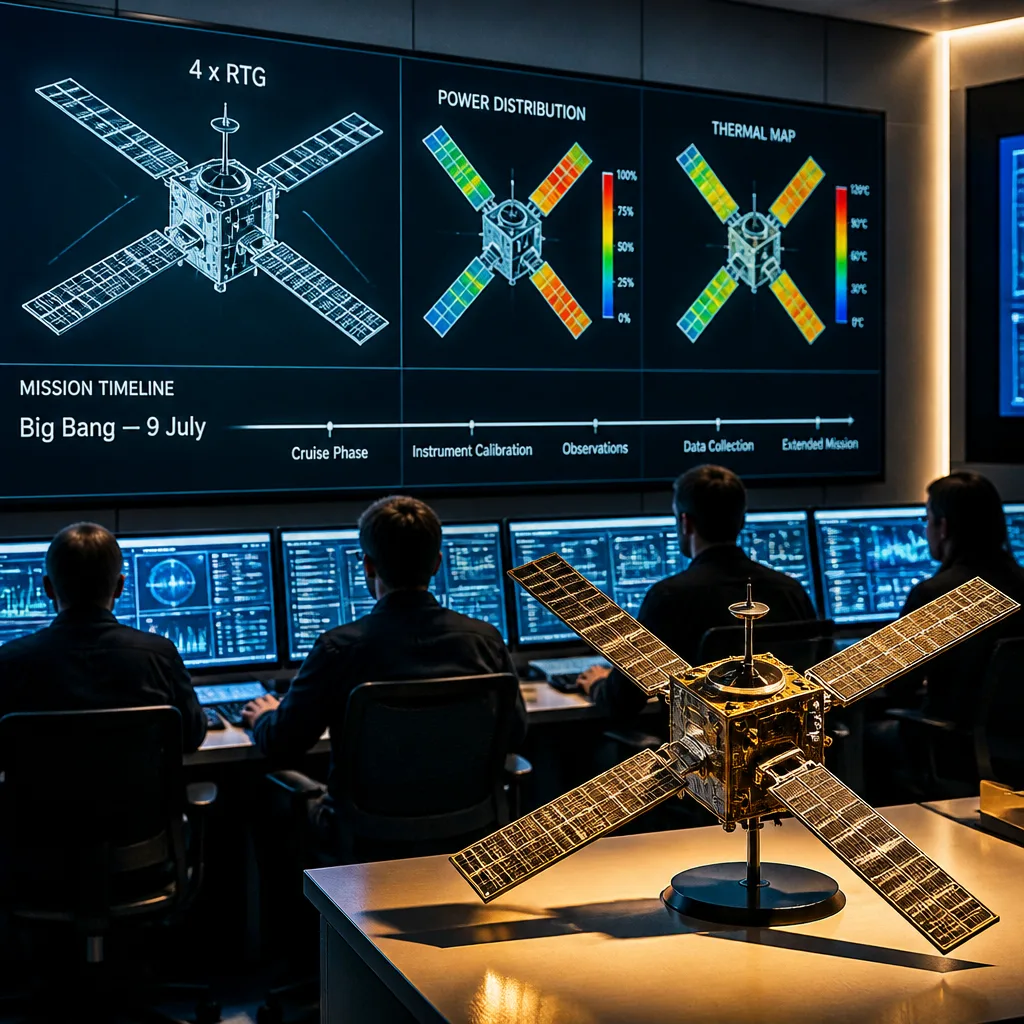
The operation — informally called the “Big Bang” — did not alter the probe’s radioisotope thermoelectric generators (RTGs). Instead, controllers changed the pattern of electrical demand and thermal management onboard. Spacecraft designers rely on RTGs because they produce electricity without moving parts and independent of sunlight: heat from decaying plutonium-238 passes through thermoelectric materials to generate power. But those generators weaken continuously as the fuel decays and thermoelectric elements age.
NASA’s engineers planned and tested the sequence through the first half of 2026, then executed a simultaneous swap of six devices. That combination of changes created a net power saving close to 10 watts, a substantial margin considering the probes lose roughly 4 watts of available power each year.
“These are not nuclear reactors,”
The distinction matters: the RTGs provide steadily declining power and cannot be refuelled or repaired. With decades of prior cutbacks — cameras and many instruments were powered down after planetary encounters — mission teams have repeatedly retired systems that no longer serve the interstellar objectives. The Big Bang is a further step in that long process of prioritization and adaptation.
What the gain means for science
The recovered power should allow Voyager 2 to operate its three remaining science instruments for at least another year. Without this multi-device reconfiguration, mission teams anticipated losing at least one instrument before the end of 2026.
That extra operational time matters for a probe that has been transmitting data for almost half a century. Launched on 20 August 1977, Voyager 2 has crossed the heliopause into interstellar space and continues to return unique measurements about the outer reaches of the Sun’s influence and the surrounding interstellar medium. Each additional set of observations contributes to long-term baselines that cannot be recreated by newer spacecraft yet.
Mission engineers emphasise that the Big Bang approach is about trade-offs: turning off heaters and other loads to protect only the critical sensors, and rerouting heat so sensitive components remain within operable temperature ranges despite being allowed to run colder than during their original planetary-phase design tests.
- Operation name: “Big Bang”
- Date executed: 9 July 2026
- Estimated freed power: approximately 10 watts
- Typical annual RTG decline: about 4 watts per year
- Operational benefit: at least one additional year for three instruments
Broader context and constraints
Voyager 2’s success at squeezing more life from ageing hardware offers a practical lesson for long-duration missions that depend on finite power budgets. The probe cannot generate new electricity; there is no way to add solar arrays or replace RTGs while it coasts beyond the Solar System. Consequently, managers must choose which systems remain powered as the energy supply dwindles.
The manoeuvre does not change the underlying reality that the RTGs' output will continue to fall. NASA estimates each Voyager loses only a few watts per year, but after nearly five decades those watts become decisive for whether an instrument can operate. The Big Bang approach — a coordinated reduction in demand and reallocation of heat — exploits the remaining margin most effectively.
For Canada and other nations with interests in deep-space science, the episode underlines the value of designing missions with flexible power and thermal strategies, and of developing long-term plans to prioritise instruments as reality forces trade-offs. It also extends a remarkable human achievement: spacecraft launched during the 1970s remain sources of live scientific data and engineering innovation in 2026.
| Item | Value |
|---|---|
| Launch date | 20 August 1977 |
| RTGs per spacecraft | 3 |
| Annual power decline (approx.) | 4 watts |
| Power freed by reconfiguration | ~10 watts |
| Execution date of swap | 9 July 2026 |
The Big Bang is one more creative step in a long campaign to keep Voyager 2 talking to Earth. As the probe approaches the limit of what its decaying power sources can support, such engineering ingenuity determines whether the last scientific instruments stay alive — and for how long.