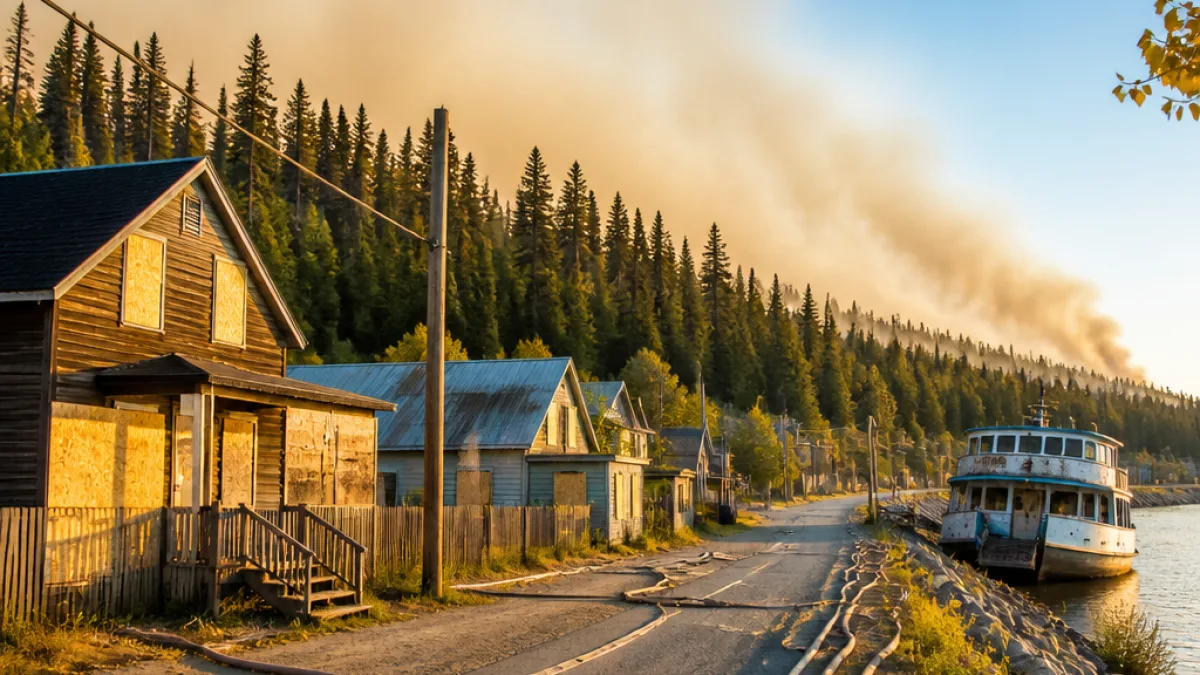
WRIGLEY, N.W.T. — With smoke easing and flames holding about 5 kilometres from town for the past week, the chief of Pehdzéh Kı̨ First Nation is demanding clear answers from the territorial government on what must happen for residents to return to Wrigley.
Chief seeks specifics from government
Chief Jamie Moses has been in contact with Premier R.J. Simpson and Environment and Climate Change Minister Jay Macdonald to identify the outstanding barriers keeping roughly 130 residents from coming home, he said in a social media post.
"We need to know exactly what is preventing everyone from coming home,"
Residents were moved out of the hamlet almost a month ago after wildfires threatened the area. Last week crews added a high-volume suppression system to expanded firebreaks around Wrigley. Cooler temperatures and some light rain have eased fire activity and improved conditions, according to Moses.
Evacuation situation and essential services
Unlike larger communities where municipal authorities normally make evacuation decisions, the structure of responsibility in Wrigley is more complex. Moses and a small number of local emergency personnel have remained on site; however, the remaining essential workers were evacuated on July 18 for their own safety.
The combination of an active wildfire, the need to maintain protective infrastructure and a separate transport problem — a broken ferry — has left the community without a clear timeline for re-entry, Moses said.
What we know about conditions and constraints
- Fire activity near Wrigley has been subdued in recent days after a period of cooler temperatures and light rain.
- A high-volume suppression system was installed on expanded firebreaks around the community last week.
- The wildfire edge has remained about 5 kilometres from the community for roughly a week.
- Remaining essential workers were evacuated on July 18; most residents have been away for almost a month.
- The ferry serving the community is reported to be broken, adding a transportation barrier to returning residents.
Logistics and community impacts
The prolonged evacuation and transport interruption raise immediate practical concerns for families and local institutions. With limited local capacity and a small population, disruptions to supply lines, medical access and housing arrangements can have outsized impacts in northern communities. The broken ferry complicates any plan to move people or equipment back into the hamlet even if fire risk continues to lessen.
Moses’s request to the territorial government centres on clear, specific criteria: what assessment or repairs must be completed before officials will endorse a return, and which agencies are responsible for carrying out those steps. In small, remote communities, those criteria typically include safety from active fire, functionality of emergency and health services, and reliable transportation links.
Questions for territorial authorities
Territorial authorities have not yet published a public timeline tied to those conditions. The chief says he wants the government to plainly identify the outstanding barriers so community members can plan their next steps.
| Item | Known status |
|---|---|
| Community population | About 130 |
| Distance of fire from town | Approximately 5 km for about a week |
| Essential workers | Evacuated on July 18 |
| Firebreak measures | High-volume suppression system installed last week |
| Ferry service | Reported to be broken |
What residents are likely to want to know next
People impacted by the evacuation will be watching for three key updates from the government and emergency management teams: an assessment showing fire risk has dropped to an acceptable level; confirmation that essential and emergency services can operate safely; and a plan to restore reliable transport so residents can return and supplies can resume.
For residents of northern communities, those factors determine not only whether people can go home, but when schools, health services and local businesses can resume normal operations. The coming days may bring further clarification if territorial officials provide the specific conditions Moses is seeking.
Until then, the chief and evacuated residents remain in limbo, waiting for a clear, actionable plan that will allow families to return to Wrigley with confidence.