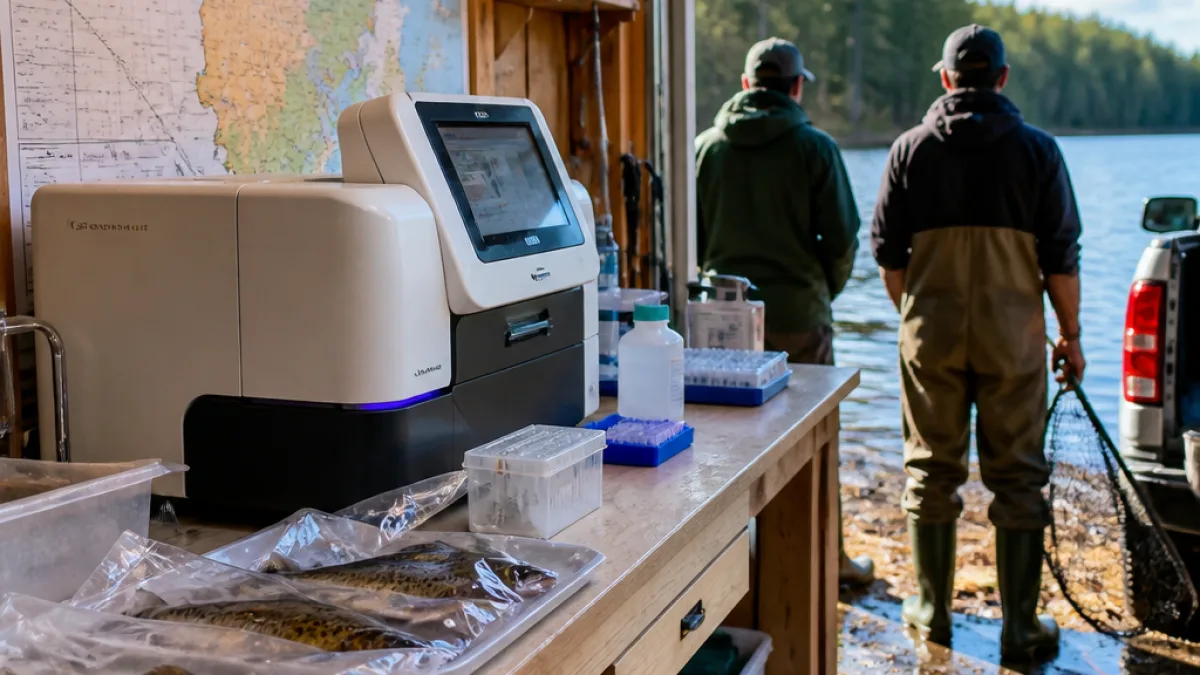
Anglers and biologists in New Brunswick are waiting for DNA results that could confirm the presence of a newly identified, contagious form of melanoma in local brown bullhead catfish.
Field collections and a troubling hypothesis
Scott Young, who has fished New Brunswick lakes and rivers for four decades, has long noticed brown bullhead with dark spots. This spring he helped University of Cambridge postdoctoral researcher Zoe Clarke collect spotted specimens from provincial waters as part of a study to test whether those lesions are the same transmissible cancer recently reported hundreds of kilometres away.
Clarke said genome sequencing results, expected in the coming weeks, should indicate whether the lesions are the same clone of melanoma identified in a Lake Memphremagog population that straddles the Quebec–Vermont border. If confirmed, it would mean the contagious tumour has a broader geographic range than previously known.
“How the heck did this happen? Why is it here?”
Clarke added that determining how and why the cancer appears in new locations will be a research priority for years to come.
The discovery that started concern
Between 2014 and 2018, scientists studying brown bullhead in Lake Memphremagog documented raised black growths on fish. That skin disease was later shown to be melanoma. A research paper published last month by a team at the University of Vermont reported the melanoma was transmissible — the first known naturally occurring contagious cancer in fish or in a freshwater ecosystem.
Researchers described the tumours as near-identical clones rather than independent cancers arising separately in individual fish. That pattern echoes other transmissible cancers previously documented in the animal kingdom, where cancer cells themselves act as infectious agents passed between hosts.
Where transmissible cancers have been found
| Host | Environment / Region | Notes |
|---|---|---|
| Dogs | Worldwide (canine transmissible venereal tumour) | Historic, sexually transmitted among dogs |
| Tasmanian devils | Tasmania | Devastating effect on some local populations |
| Shellfish (clams, mussels) | Various marine regions | Several lineages reported |
| Brown bullhead catfish | Lake Memphremagog; under investigation in New Brunswick | First freshwater fish transmissible cancer reported |
Potential implications for New Brunswick
Scientists warn that transmissible cancers can pose a risk to host populations. If the same melanoma lineage is present in New Brunswick, it could have consequences for local catfish populations and the aquatic ecosystems they inhabit.
At this stage, researchers are focused on confirming whether the lesions seen by anglers like Young are genetically identical to the tumours described in the Lake Memphremagog study. Beyond identification, key questions include how the disease spreads across watersheds and what environmental or human factors may facilitate that spread.
What officials and the public should know
- DNA sequencing is presently under way to compare New Brunswick samples to the Memphremagog melanoma lineage.
- Researchers will need time to determine pathways of spread and potential impacts on fish populations.
- There is no indication from the published research that the melanoma affects humans; the phenomenon so far is documented within specific animal hosts.
Dr. Julie Dragon, co-lead on the University of Vermont study and an associate professor of microbiology and molecular genetics, said genome sequencing showed the tumours were clone copies of one another. That genetic uniformity is what allowed researchers to classify the disease as transmissible.
Next steps and broader questions
If the New Brunswick samples match the transmissible lineage, the focus will shift to surveillance and understanding mechanisms of transmission. That could include examinations of fish behaviour, water connectivity between lakes and rivers, and potential roles for human-mediated movement of fish or equipment.
Clarke said the team intends to devote substantial effort to untangle the origins and dispersal of the melanoma. For anglers, Indigenous communities, conservation groups and provincial authorities, the coming months of laboratory analysis will be closely watched for answers about the scope of this unusual and potentially worrying biological phenomenon.
Until results are released, scientists emphasise the importance of reporting unusual fish lesions to local fisheries offices and taking routine precautions such as cleaning gear between water bodies to reduce the chance of moving pathogens or other organisms.
Further announcements from the research teams are expected as sequencing data are analysed and interpreted.