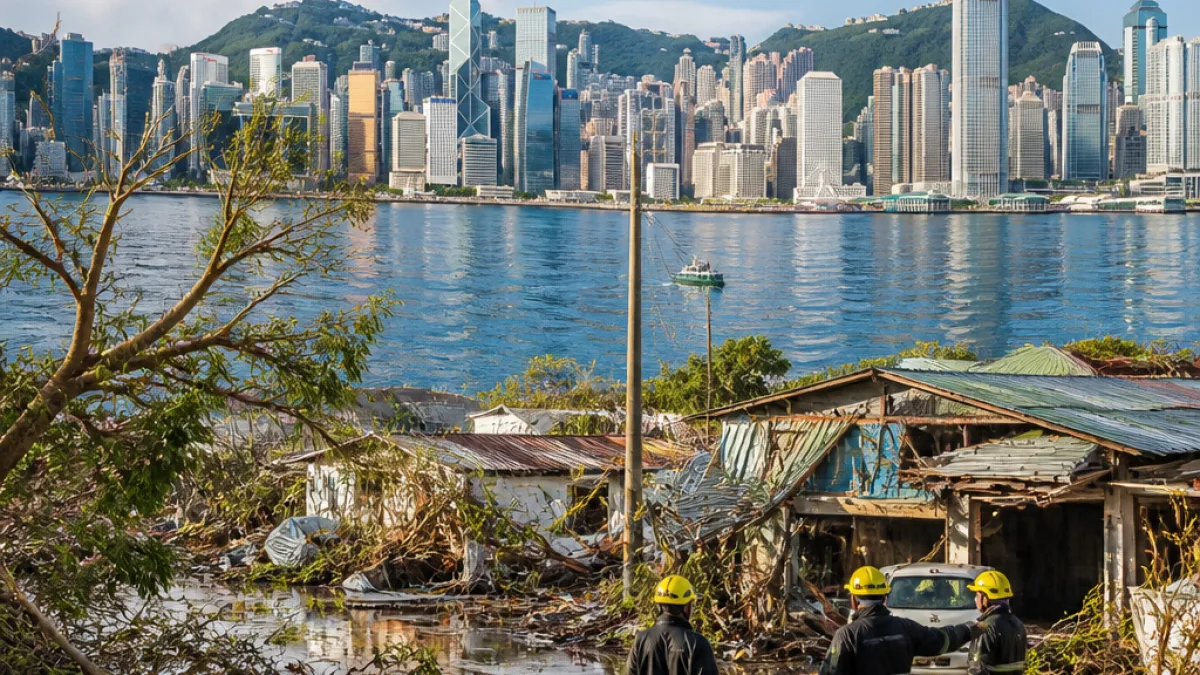
Typhoon Noul’s unusual path produced a stark contrast across Hong Kong early Sunday, with the Northwest New Territories absorbing powerful gusts and heavy rain while much of Hong Kong Island experienced an unusually tranquil night.
Uncommon trajectory, concentrated impact
Meteorological authorities kept the Increasing Gale or Storm Signal No. 9 in force for roughly six hours — a key marker of the storm’s severity. Officials noted the landfall came from the east, a rare occurrence last seen in the territory with Typhoon Molave in 2009. The event also triggered a southwest gale warning, an alert that had not been issued since Severe Tropical Storm Merbok in 2017.
Unlike most tropical cyclones that sweep in with a more typical directionality, this system’s path pushed strong northwest-to-southwest winds into urban districts such as Tuen Mun, Yuen Long, Tin Shui Wai and Tai Po. Residents in those neighbourhoods reported sustained, violent conditions through the early morning hours.
Scenes from neighbourhoods
Across social feeds, locals posted video and photographic evidence of localized damage. Clips showed torrential downpours and trees bending under sustained pressure. One striking image captured a rosy trumpet tree (Tabebuia rosea) near Fanling Centre nearly flattened by the gusts.
“Usually we don't feel much during typhoons, but Noul delivered the full force of the storm to us,”
That reflection came from a Yuen Long resident who said the winds intensified even after the observatory reduced its warning to Signal No. 8 in the afternoon. Another person in Yuen Long described the wind as a constant howl that left the household fearful for their windows.
In Tin Shui Wai, a resident reported being awakened at about 3 a.m. by pounding winds and continuous booming sounds that prevented a return to sleep. In Tai Po, people compared the nighttime noises to a horror-movie soundscape, reporting sharp, high-pitched wails outside window frames that left them unsettled.
Contrasting calm on the island
By contrast, many on Hong Kong Island said they slept through the storm. One island resident described the experience as "the most comfortable typhoon in years," noting they did not wake at any time overnight.
The divergent experiences underscore how a single storm system can deliver highly variable effects across a dense urban region, depending on the cyclone’s track, local topography and wind orientation.
What happened with warnings
Authorities’ decision to hoist Signal No. 9 for an extended period indicated expectations of severe conditions, particularly for exposed coastal and northwestern districts. That signal is reserved for intense gales and is used sparingly. The subsequent downgrade to Signal No. 8 in the afternoon suggested weakening or shifting conditions, but residents in the hardest-hit neighbourhoods said the winds remained forceful even as the public alert level dropped.
Local impacts and community response
While the story of Noul in Hong Kong is still emerging in detail, the immediate local effects included:
- Uprooted or badly bent trees in multiple neighbourhoods;
- Powerful winds that left residents awake and anxious through the night;
- Wide sharing of home video and photos documenting the storm’s local force.
At this stage there have been no official casualty figures or damage assessments in the source material. Residents’ firsthand reports, however, point to a night of heightened concern in the northwest districts while other parts of the city reported little disturbance.
| Area | Reported conditions |
|---|---|
| Tuen Mun, Yuen Long | Violent winds, localized damage, trees bent |
| Tin Shui Wai | Woken by booming sounds, sustained gusts |
| Tai Po | Sharp, screeching noises outside windows, frightened residents |
| Hong Kong Island | Relatively calm, many reported sleeping through the night |
As clean-up and assessment proceed, the contrast between districts is a reminder that even in a compact metropolis, a storm’s effects may be far from uniform. For residents in the northwest, the priority will be inspecting homes for damage, checking for downed trees or blocked roads, and following official updates on any further weather advisories.
For communities and authorities alike, Noul will likely prompt reviews of preparedness measures for atypical storm tracks and the resilience of infrastructure in the zones that bore the brunt of the winds.
— Northwest Territories correspondent