
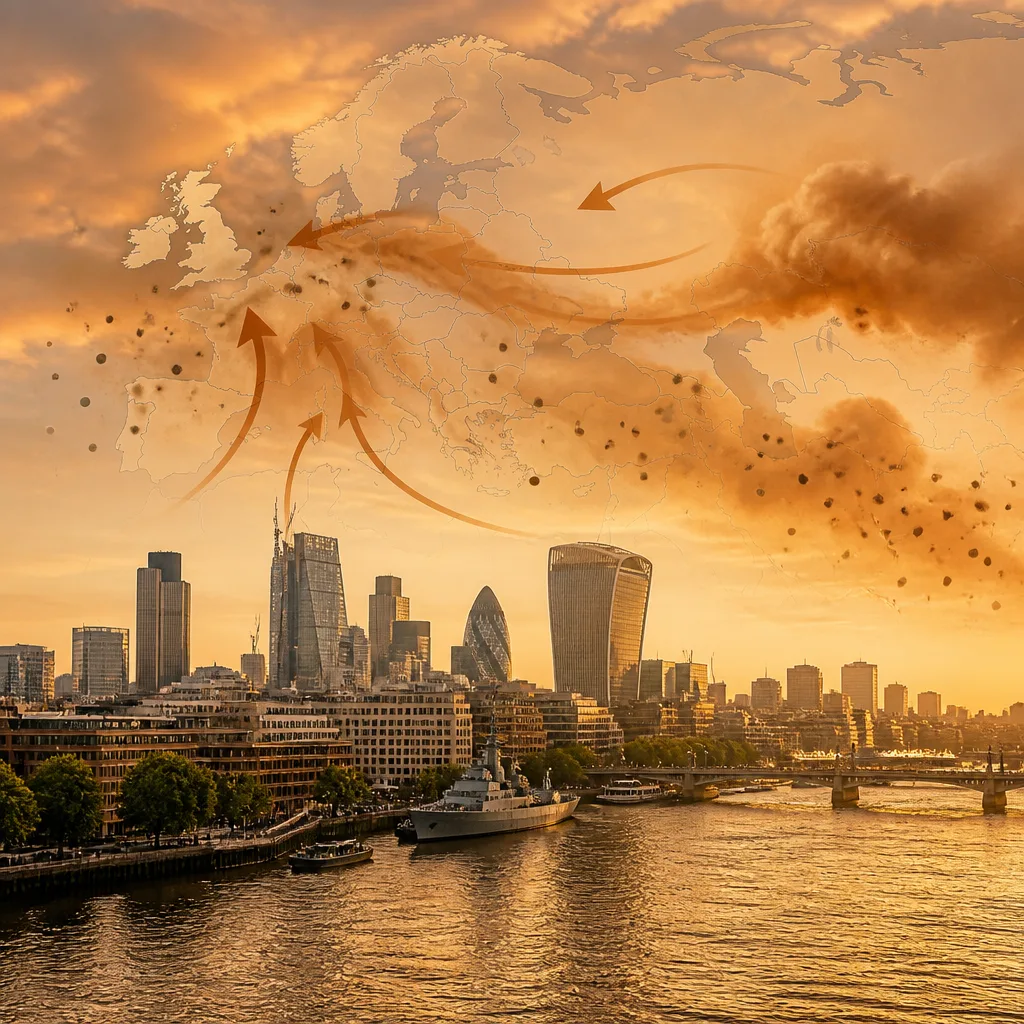
Smoke from major wildfires in southern Europe and beyond is contributing a growing portion of the United Kingdom’s particle pollution, according to researchers tracking plume transport and air-quality measurements. Scientists warn the transboundary nature of wildfire smoke complicates efforts to attain legal limits for airborne particles and could increase the long-term health burden on the UK population.
Wildfires far afield affecting UK air quality
Teams at the University of Edinburgh and the UK Centre for Ecology & Hydrology have modelled and observed the movement of smoke from large fires and agricultural burning around the world. Their analysis indicates that wildfires — including those thousands of kilometres away — account for roughly 10 per cent of the UK’s particle pollution.
Dr Mark Parrington, a senior scientist at the EU’s Copernicus Atmosphere Monitoring Service, highlighted the immediate impacts of major blazes in southwestern Europe last summer. He pointed to intense smoke emissions from fires in Gironde and Ávila, which led to sharply degraded air quality in cities such as Bordeaux and Madrid, with local PM2.5 readings far exceeding air-quality guidance.
“Recent wildfires in south-western Europe produced large quantities of smoke, which caused significant degradation [of] air quality across southern France and central regions of Spain,” said Dr. Parrington.
Long-range transport and time lags
Research led by Damaris Tan at the University of Edinburgh used global simulations of burning to show that large fires anywhere in the northern hemisphere can elevate particulate concentrations in the UK. The timing of impacts varies with the location of the fires and atmospheric conditions; in some cases the influence can persist for months.
“Time lags on the scale of months are possible,” Tan said. “It depends on the location of the wildfires relative to the UK and the meteorology, but it took over three months for the effects of 2018 wildfires to become negligible to 2019 concentrations in the UK.”
Professor Mathew Heal, who collaborated on the study, said the presence of transported smoke adds a complicating factor for policymakers seeking to meet statutory particle limits. He suggested that the UK may need to achieve greater-than-expected reductions in domestic emissions to offset the growing contribution from wildfires.
Sources and scale of contributions
The researchers noted that the geographic origin of wildfire-derived pollution varies year to year. In 2019, almost half of the wildfire-sourced particulate matter reaching the UK was traced to fires in Russia. That year-to-year variability underscores the difficulty in predicting future impacts as fire regimes change under a warming climate.
| Aspect | Finding |
|---|---|
| Contribution to UK particle pollution | ~10% |
| Notable source regions | Southwestern Europe (Gironde, Ávila), Russia |
| Possible persistence | Effects may last months; >3 months observed after 2018 fires |
Implications for health and policy
Although wildfire smoke may not always affect the UK as acutely as in countries closer to intense fire activity, the research team warned it still adds to the nation’s chronic exposure to fine particles (PM2.5), which are linked to cardiovascular and respiratory disease. Because smoke contributions can be sizeable and episodic, they can undermine domestic air-quality improvement plans and complicate compliance with legally binding targets.
Scientists emphasised that projected changes in fire frequency and intensity make the issue of imported smoke relevant for long-term planning. The study authors urged that policymakers factor in transboundary wildfire emissions when setting and assessing air-quality policies, noting that achieving required reductions in local emissions may not be sufficient if wildfire activity increases elsewhere.
- Wildfires in Europe can produce smoke plumes that travel to the UK and beyond.
- About 10 per cent of UK particle pollution is attributed to wildfires and agricultural burning worldwide.
- Large fires in different hemispheric locations can affect UK air quality for months.
As wildfire seasons lengthen across the northern hemisphere, scientists say better international monitoring and integration of wildfire emissions into air-quality planning will be essential to protect public health and to provide realistic expectations about the prospects of meeting air-quality standards.