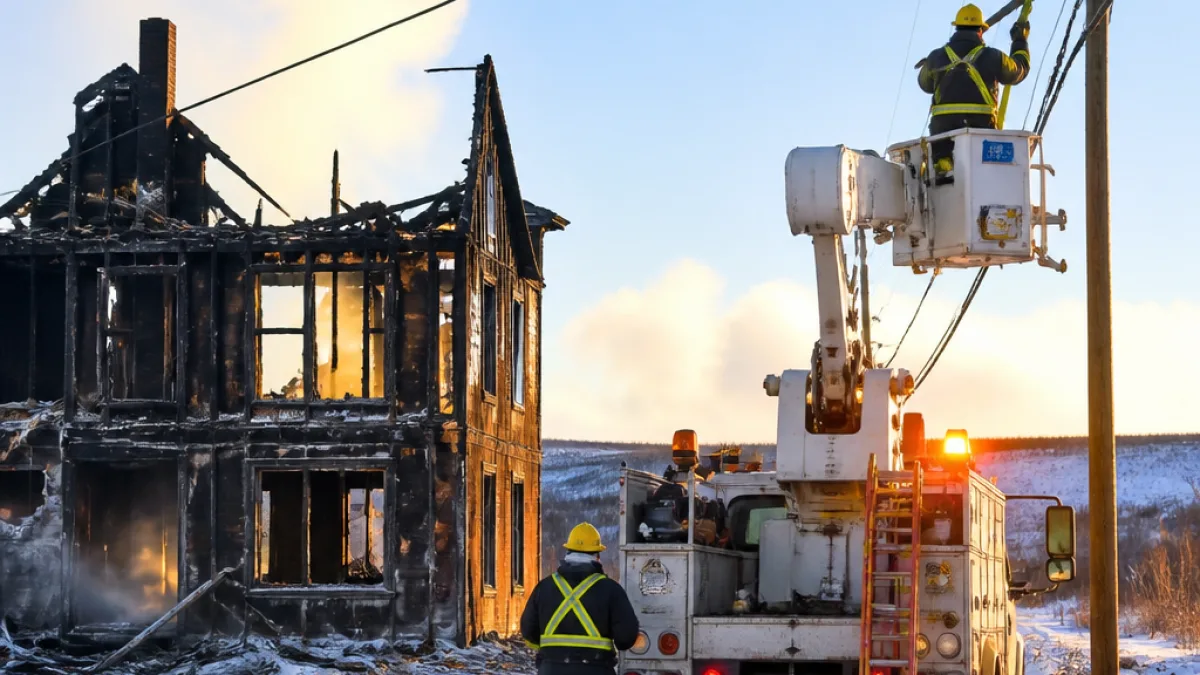
An abandoned house in Fort Good Hope, N.W.T., burned to the ground early Saturday as the community wrestled with an abrupt drop in temperature and heavy rainfall that prompted an Environment and Climate Change Canada orange alert for parts of the territory.
Fire, outages and sudden cold
Neighbours said the unoccupied building went up in flames and knocked out electricity for several homes in the small community on the Mackenzie River. Northwest Territories Power Corporation (NTPC) confirmed a line crew was being dispatched to carry out repairs before service could be fully restored.
Local resident Tommy Kakfwi, a former chief of Fort Good Hope, told CBC News he had been without power for about six hours on Saturday morning. He said the house that burned had been undergoing repairs by a young man but was empty at the time of the blaze.
"There was a young man that was doing some repairs to it. Now there's nothing to repair. It just went right to the ground,"
The RCMP had not released a public confirmation of the fire at the time of reporting. NTPC communications manager Doug Prendergast said the outage affected four customers and crews were on their way to make necessary fixes.
Unseasonable weather compounds the impact
The fire occurred as the Sahtu and Beaufort Delta regions were under an orange alert for heavy rain and even snow. Temperatures in the area plunged sharply over the span of a few days — from near 30 C earlier in the week to roughly 3 C by Saturday, according to Environment and Climate Change Canada.
Pictures submitted to local media showed snow on the ground in Norman Wells, underscoring how uncommon snowfall in late July is for observers across the territory.
Kakfwi said he had started his woodstove to keep his family warm while power was out and expressed concern about food in the freezer. "My ice cream’s melted!" he remarked.
Local response and practical concerns
In communities like Fort Good Hope, where many homes rely on electric power for refrigeration and other essentials, even short outages can have immediate consequences. NTPC's swift dispatch of a line crew reflects the priority given to restoring service in isolated communities.
Residents should take the following precautions when a rapid temperature change and outages coincide:
- Keep refrigerators and freezers closed to preserve food where possible.
- Have alternative heating plans — safe woodstoves, fuel supplies or community warming centres — ready in case outages persist.
- Report outages promptly to NTPC and alert local authorities if vulnerable people are affected.
Wider context: climate and infrastructure
While single events cannot be directly attributed to long-term climate trends without study, sudden swings in temperature and intense precipitation pose increasing operational challenges for northern infrastructure. Power lines, evacuation routes and emergency services in remote communities must all adapt to more variable conditions.
For Fort Good Hope, the immediate priorities are restoring electricity and assessing the fire scene. Neighbours and community members have already reported the dramatic loss of the abandoned house and are coping with colder-than-normal conditions for late July.
| Item | Detail |
|---|---|
| Location | Fort Good Hope, N.W.T. |
| Outage impact | Four residences without power; line crew dispatched |
| Temperature change | From about 30 C to around 3 C in several days |
| Weather alert | Orange alert for heavy rain and snow (Sahtu and Beaufort Delta) |
Authorities have not indicated any injuries related to the fire. RCMP and NTPC statements are expected as investigations and repair work continue. For residents in affected areas, staying informed through official channels and following guidance from emergency services remains important as crews restore power and assess weather-related risks.
Coverage will be updated as officials release further details.