Belledune, N.B. — One of Canada’s last operational coal‑fired power stations has taken a concrete step toward a low‑carbon future after NB Power announced new agreements to source sustainably manufactured pellets from within the country.
What NB Power announced
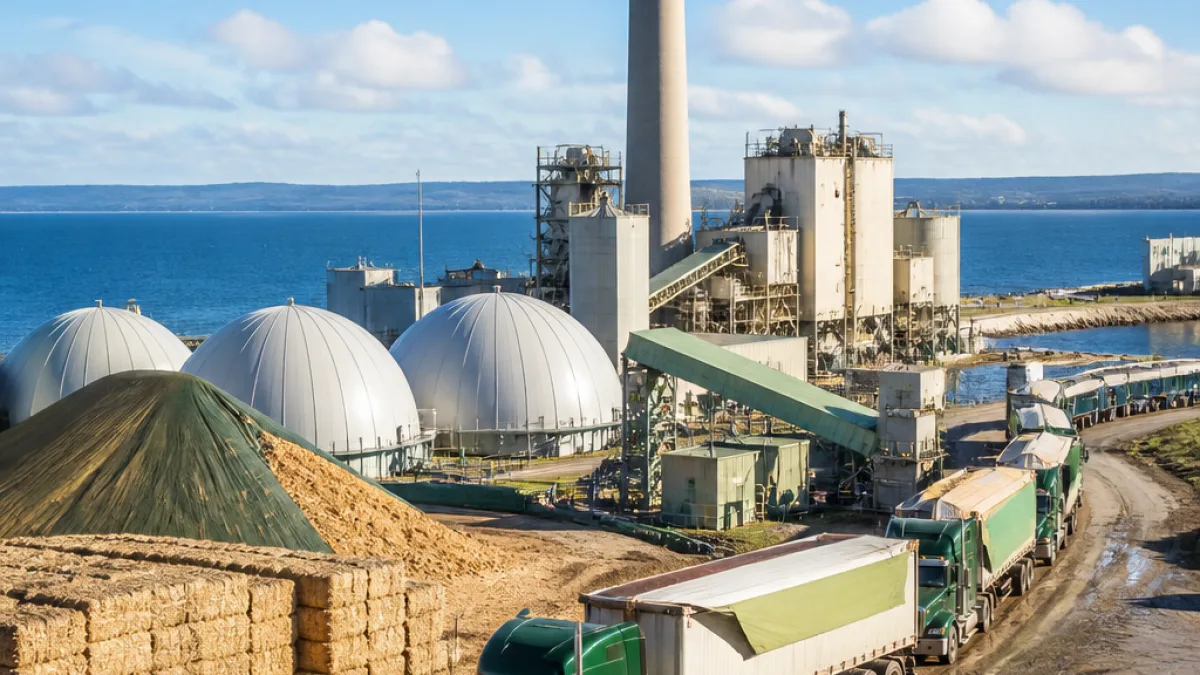
The Crown‑owned utility said Thursday it has reached supply deals with domestic producers to provide the majority of the biomass fuel required to replace coal at the Belledune Generating Station in northeast New Brunswick. The pellets will be produced from forestry residues — such as branches and other wood scraps left on the forest floor — and agricultural hemp.
With the supply chain secured, NB Power said it can commence equipment upgrades at the plant to accommodate the new fuel. The utility’s public timeline indicates the Belledune conversion will be finished between 2028 and 2030.
Why the move matters
The shift away from imported coal to locally produced pellets responds both to environmental policy and to long‑term reliability planning for the province. The federal government requires the phase‑out of traditional coal‑fired electricity generation by 2030, and Belledune is among only eight remaining coal plants across Canada.
Provincially, the Belledune station supplies about 15 per cent of New Brunswick’s electricity. Securing a domestic biomass supply aims to maintain generation capacity while lowering the plant’s carbon intensity compared with burning coal.
"These milestones give us confidence in the path forward as we continue working to maintain reliable service for customers while preparing for a future without coal," NB Power chief executive Lori Clark said in a statement.
Local industry and supply chain
NB Power says the pellets will be manufactured from residues of routine forestry operations. The utility also noted agreements include agricultural hemp as a feedstock. The announcement described a key supply relationship as a partnership that links a pellet producer, a forestry company and First Nations partners, but did not list further names in the release.
Shifting to a domestic supply chain is likely to support local jobs in forestry, pellet manufacturing and logistics, and to reduce reliance on imported coal. It also introduces a need for new handling, storage and boiler adaptations at the Belledune site.
- Local economic benefits: potential for employment and new business for forest and agricultural producers.
- Energy reliability: aiming to preserve about 15 per cent of the province’s generation capacity.
- Environmental compliance: move toward meeting federal 2030 coal‑phase‑out requirements.
Technical and timeline details
To use pellets, the generating station will require upgrades to its fuel handling and boiler systems so the wood‑based biomass can be fed into a high‑efficiency boiler and converted into steam to spin turbines. NB Power said the secured fuel supply allows it to begin these equipment changes.
| Item | Detail |
|---|---|
| Plant | Belledune Generating Station |
| Provincial share of supply | About 15% of New Brunswick's electricity |
| Target conversion completion | 2028–2030 |
| Fuel | Wood residues and agricultural hemp pellets (domestically produced) |
Regional and national context
Belledune is one of a shrinking number of coal‑fired plants in Canada. The country had a broader shift away from coal in recent years: Ontario eliminated coal generation in 2014, and Alberta completed a phase‑out by 2024. Remaining coal facilities are concentrated in Nova Scotia and Saskatchewan, alongside New Brunswick’s Belledune.
NB Power’s announcement places the Belledune project among the higher‑profile transitions where utilities are adapting existing thermal plants to alternative fuels rather than retiring capacity entirely. That approach is intended to balance emissions reductions with the need for reliable baseload or dispatchable generation.
Next steps and local impact
NB Power will move from planning to implementation now that contracts for pellet supply are in place. The immediate tasks will centre on engineering works, equipment procurement and construction to modify the plant for biomass firing. The timing of those activities will determine when employment and contracting opportunities materialize for local firms.
For ratepayers and residents, the practical outcomes to watch for are uninterrupted electricity service during upgrades and, over the longer term, a plant that burns a domestic, renewable feedstock instead of imported coal.
As the work proceeds, NB Power has signalled ongoing public updates. The involvement of regional forestry operations and Indigenous partners suggests the project will have economic and land‑use implications across parts of New Brunswick’s forestry sector.