
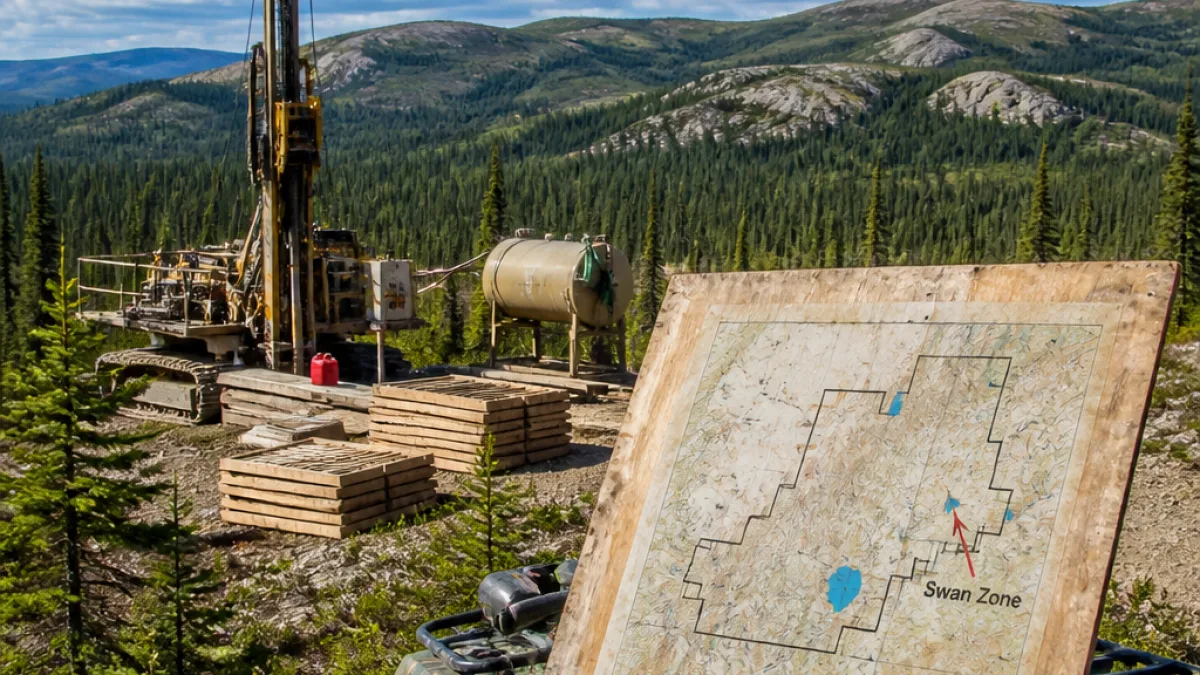
Trailbreaker Resources Ltd. has wrapped up its first-ever diamond drilling at the Highlands Zone and shifted its drill rig to the Swan Zone, a porphyry-style copper‑gold‑silver target at the company’s wholly owned Atsutla Gold Project in northwestern British Columbia, the company announced July 27.
What the company is doing on the ground
The Atsutla property covers roughly 300 square kilometres and holds multiple targets across different geological settings. Trailbreaker said the Highlands campaign consisted of four diamond drill holes totalling 883.40 metres, testing about 500 metres of strike and extending to a vertical depth of some 412 metres.
Following that program, the drill has been mobilized to the Swan Zone, located about 26 kilometres from the Highlands Zone and hosted in a separate batholith. While the Highlands campaign focused on vein-hosted high‑grade gold with associated silver and copper, the Swan Zone is being explored as a porphyry system with a broad multi‑element footprint.
Why Swan draws attention
Trailbreaker describes the Swan target as occurring within the Cretaceous Glundebery batholith. The company has compiled multiple layers of data over recent years — geological mapping, soil geochemistry, induced polarisation (IP) surveys and airborne magnetics — to refine drill targets.
At Swan, the principal soil anomaly spans roughly 1.5 km by 1.5 km and is multi‑element, including gold, copper, silver, arsenic, molybdenum, antimony and bismuth. That geochemical footprint coincides with a chargeability anomaly measuring about 2.1 km by 1.4 km, making the area a sizable target for porphyry-style mineralisation.
“The Swan Zone continues to be one of the most compelling targets in Trailbreaker’s portfolio. Over the past five years we have developed this prospect from a new discovery and have added layers of data through systematic exploration,”
Daithi Mac Gearailt, Trailbreaker’s chief executive officer, said the Highlands program was completed on schedule and on budget and he expects the Swan drilling to follow a similar path.
Project snapshot
| Attribute | Value |
|---|---|
| Project ownership | 100% Trailbreaker Resources |
| Project area | 300 km² |
| Distance between Highlands & Swan | 26 km |
| Highlands drilling | 4 holes, 883.40 m total |
| Swan soil anomaly | 1.5 km × 1.5 km |
| Swan chargeability anomaly | 2.1 km × 1.4 km |
Local context and potential impacts
Exploration drilling in remote regions of northwestern B.C. often carries both economic promise and environmental considerations. Porphyry systems, if eventually advanced to development, can underpin large‑scale mines with long lives and significant employment, but they also raise questions about land access, water management and effects on local ecosystems.
Trailbreaker’s public statements to date describe an incremental exploration approach: layering geochemistry and geophysics with targeted drilling. That incremental method is typical in early‑stage exploration, where companies seek to demonstrate continuity and scale before committing to larger infill programs.
What comes next
- Drilling at Swan will target the areas where the soil and IP anomalies overlap.
- Results from the Highlands holes have been completed as a program but the company has not provided assay details in the release summarising the move to Swan; readers should expect follow‑up releases with assay results and interpretations.
- Trailbreaker emphasised the methodical development of the Swan prospect over the last five years, indicating further data integration and possible follow-up drilling will come if early results warrant it.
Trailbreaker’s announcement is a reminder that the northern interior of British Columbia continues to be a focus for junior explorers seeking porphyry and high‑grade vein systems. For communities and stakeholders, the timelines and findings that follow this round of drilling will shape conversations about any future development at Atsutla.
— Reporting from northwestern British Columbia.