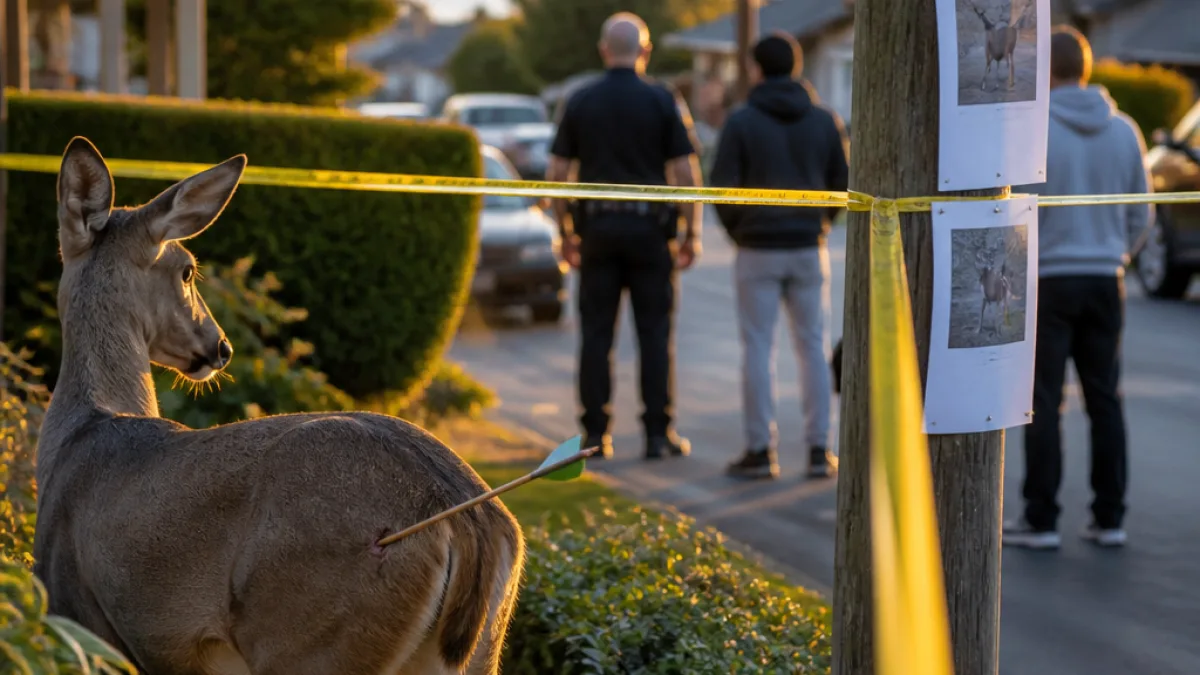
Reports of deer in the Nanaimo area being shot with arrows or crossbow bolts stretch back two decades, and conservation officers say the pattern has resurfaced in the past year. The British Columbia Conservation Officer Service (BCCOS) has repeatedly warned residents about the dangers posed when hunting gear is used in or near residential neighbourhoods.
Longstanding incidents and recent cases
Media accounts show the first documented local reports of deer shot with arrows in Nanaimo date to December 2006, when conservation officers cautioned the public about a bowhunter targeting deer near Departure Bay. Similar incidents were reported in 2010, with multiple deer struck by crossbow bolts and arrows in residential areas including Departure Bay, Hammond Bay and the Fairwinds area of Nanoose Bay.
An account from the Jan. 11, 2011 edition of the News Bulletin noted at least five deer were shot with arrows over a one-month period in the north end of the city. Witnesses told reporters those animals initially survived but often fled into forest and brush, preventing conservation officers from assessing their condition.
The most recent investigations relate to incidents in late 2025 and early 2026. BCCOS said it began probing reports of deer being shot in the Nanoose Bay area after an incident in November 2025, when a deer was found dead with an arrow. Following that, three more animals were discovered alive but pierced by arrows and had to be euthanized by conservation officers. In January 2026 BCCOS described the matter as ongoing.
"Dangerous hunting practices in residential areas creates a public safety risk to the community," BCCOS told Black Press.
Public safety and wildlife welfare concerns
Conservation officers have emphasised two linked concerns: the welfare of the deer and the danger to people when hunting occurs near homes and public spaces. BCCOS asked residents to be vigilant and to check security cameras for footage that might show unknown vehicles or people in affected areas.
- Unknown total: The exact number of deer wounded or killed by arrows in the region since 2006 is not known.
- Investigations but no arrests: Multiple investigations over the years have not produced public records of arrests related to these shootings.
- Community impact: Incidents have occurred across several neighbourhoods, affecting residents' sense of safety and prompting conservation staff to issue public warnings.
Timeline of documented incidents
| Year | What was reported |
|---|---|
| 2006 | First documented media reports: bowhunter targeting deer near Departure Bay |
| 2010 | Multiple deer shot with crossbows/arrows in Departure Bay, Hammond Bay, Fairwinds (Nanoose Bay) |
| 2011 | At least five deer shot with arrows in north end over one month; many animals fled and could not be assessed |
| 2025 | November: deer found dead with an arrow in Nanoose Bay; subsequent wounded deer discovered |
| 2026 | January: BCCOS investigating ongoing deer poaching in Nanoose Bay |
Local conservation and enforcement agencies face challenges when wounded animals bolt into dense cover, making assessment and evidence collection difficult. That dynamic has repeatedly limited officers' ability to determine the full scope of harm and to pursue prosecutions.
For residents, the repeated incidents highlight the need for vigilance. BCCOS recommended checking private security footage and reporting suspicious activity to authorities. The service has also underscored that hunting or discharging weapons in residential zones not only risks animal welfare but may also contravene public safety laws.
There have been no publicly disclosed arrests connected to the series of shootings dating back to 2006. Conservation officers continue to investigate when new reports surface and rely on community tips and footage to identify those responsible.
As the investigation into the recent Nanoose Bay cases continues, conservation and municipal authorities have urged anyone with information — including homeowners with camera systems near greenspaces and forested lots — to contact BCCOS to assist in efforts to protect wildlife and neighbourhood safety.