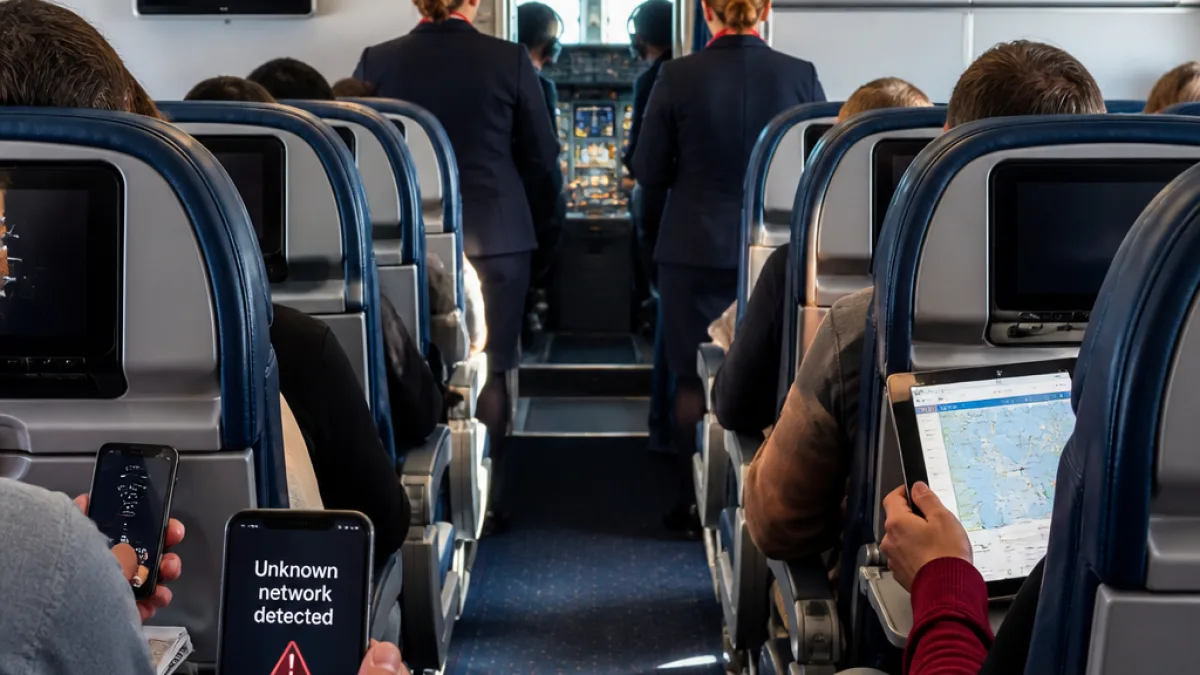
Delta Air Lines deactivated the inflight Wi‑Fi on Flight 591 — a Boeing 757 bound from Las Vegas to Atlanta — after crew members discovered an unauthorised wireless network that appeared to mimic the aircraft’s service. The network was shut down for about 30 minutes while the crew and pilots took steps to secure the cabin systems and notify authorities.
What happened on board
The incident occurred during the flight that carried 199 passengers and six crew members. Cabin staff detected the rogue network and switched off the airplane’s Wi‑Fi. Pilots subsequently informed air traffic control about the situation. There was no declaration of an emergency and no aircraft operating systems were affected.
- Flight: Delta 591, Las Vegas to Atlanta
- Aircraft: Boeing 757
- Passengers: 199
- Crew: 6
- Wi‑Fi deactivated: approximately 30 minutes
“Safety of flight was never in question and no aircraft operating systems were affected. We are fully investigating to gather a complete set of facts, which will take time. We will partner with federal law enforcement and aviation regulators to ensure the incident is thoroughly investigated. We thank our crew for their professionalism and our customers for their understanding.”
The airline’s statement reiterated that flight safety was never compromised and that investigators will work with federal law enforcement and aviation regulators to determine the cause and full facts.
Regulatory response and context
The Federal Aviation Administration said it was aware of the report and has noted that a breach of an onboard Wi‑Fi system would not affect critical flight‑safety systems. Media reports, citing public communications from the cockpit and follow‑up coverage, said pilots told air traffic control a passenger had apparently created a “scam Wi‑Fi” network that impersonated the legitimate onboard service.
Delta also noted the recent presence of a large cybersecurity conference in Las Vegas the preceding weekend — a detail cited in the airline’s public comments. Investigators will consider whether any passengers attending such events could be linked to the episode, though no motive or deliberate criminal intent has been publicly established.
Why this matters to travellers in Delta, B.C.
For travellers based in Delta, B.C., and the lower Mainland who rely on inflight connectivity, the incident underscores two practical points:
- Airlines can and will disable passenger Wi‑Fi as a precaution when network behaviour is suspicious, which may interrupt connectivity for all passengers.
- Authorities treat unauthorised onboard networks seriously but maintain that aircraft control systems remain isolated from passenger Wi‑Fi in modern aircraft designs.
Passengers planning flights should be aware that temporary loss of inflight internet service can occur for operational or security reasons. Crew instructions and announcements remain the primary source of direction during unusual situations on board.
What investigators will look for
Federal law enforcement and aviation regulators will work with the airline to trace the origin of the fake network, review cockpit and cabin communications, and analyse the aircraft’s systems and logs. Airline investigators typically look at device connections, network identifiers, timing and passenger manifests to establish a sequence of events.
While investigators proceed, Delta said it appreciated the professionalism of the crew and the patience of travellers. For now, the airline’s public messaging aims to reassure passengers that routine flight‑safety systems were not affected and that a thorough investigation is under way.
| Item | Detail |
|---|---|
| Flight | Delta 591 (Las Vegas → Atlanta) |
| Aircraft | Boeing 757 |
| Passengers | 199 |
| Crew | 6 |
| Wi‑Fi offline | ~30 minutes |
As the investigation continues, travellers from Delta and other Canadian cities should watch for updates from airlines and federal agencies if they are concerned about inflight connectivity or suspect suspicious activity on flights.