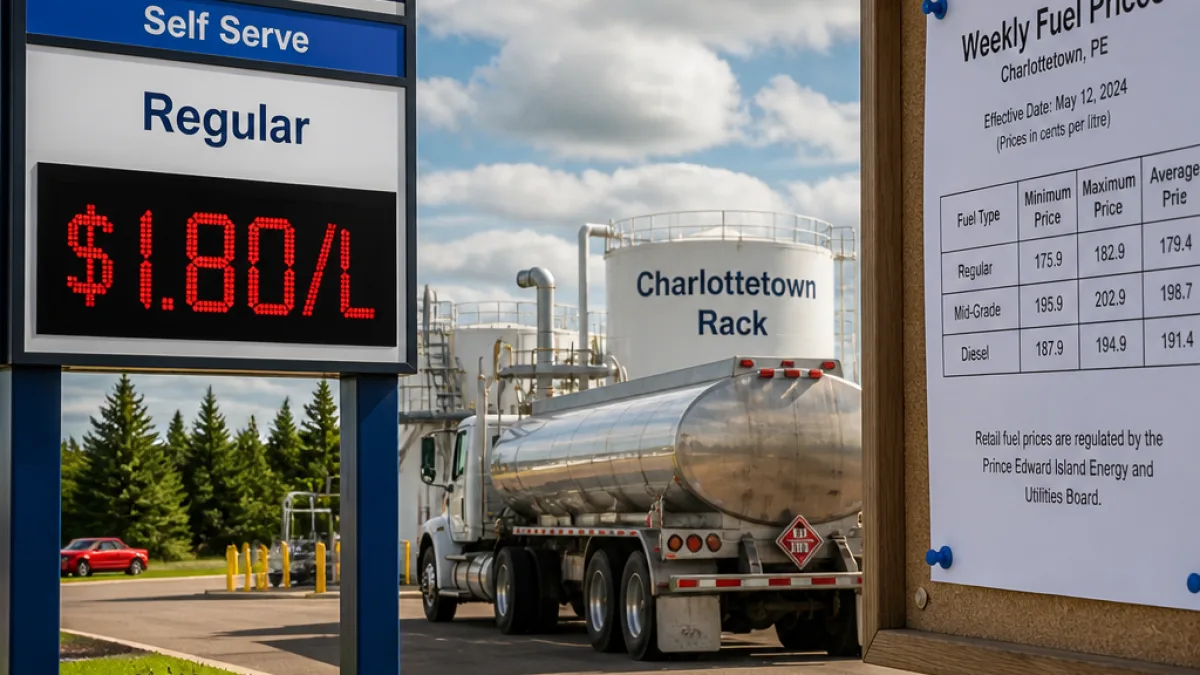
Charlottetown — Even after two recent reductions, gasoline on Prince Edward Island remains costly — about $1.80 a litre for regular as of last Saturday — and many Islanders are asking why pump prices do not always reflect declines in crude oil.
IRAC outlines the main drivers
The Island Regulatory and Appeals Commission (IRAC), which oversees fuel pricing in the province, says raw crude is only one input into the final price motorists pay. The regulator highlighted a number of components that together determine the retail figure, and sought to explain why price changes at the global level do not always translate immediately to outlet pumps.
“Fuel markets change every day, all day. And what we’ve seen over the last few months is a lot of price volatility,” Jaclynne Hamel, IRAC’s policy analyst and communications adviser, told CBC’s Island Morning. She said the commission uses the Charlottetown rack — the price charged to delivery trucks at the terminal on the harbour — as the foundational reference for its formula.
“You’ll see that the crude barrel [price] will have a big drop, and I know that people are expecting that big drop will come at the pumps immediately, but there’s a little bit of a time lag there.”
Hamel stressed that refining, transportation, and logistical expenses are all included in the rack price, meaning those costs are already embedded before retail margins and taxes are applied.
What goes into the price at a glance
IRAC identified several categories that feed the retail sticker price. They can be grouped as follows:
- Rack price: the base cost of fuel at the Charlottetown terminal, which reflects refined product costs and some distribution charges;
- Refining and logistics: costs to turn crude into gasoline and to move product to terminals and retailers;
- Wholesale and retail margins: the amounts wholesalers and stations add to cover operating costs and profit;
- Taxes and environmental levies: federal and provincial taxes applied at the pump.
Below is a simple table summarizing those components and their roles (no numerical breakdown is provided by IRAC):
| Component | Role in final price |
|---|---|
| Charlottetown rack | Base product cost including refining and some logistics |
| Transport & storage | Moving fuel to terminals and stations |
| Wholesale & retail margins | Business operating costs and profit |
| Taxes/levies | Government charges applied at sale |
Why local pumps can lag behind global shifts
IRAC’s explanation helps account for why a steep fall in crude futures does not always produce an immediate and equivalent drop at neighbourhood service stations. Product bought and stored under earlier, higher-priced conditions will still be sold at those embedded costs until terminals turn over inventory.
Logistics also play a role: refining schedules, shipping times and distribution patterns create delays. On a small island such as P.E.I., where fuel moves through a single principal terminal, those timing effects can be more visible to consumers than in larger markets with many competing supply points.
Practical implications for Islanders
For drivers, that means short-term swings in pump prices can appear disconnected from headlines about crude oil. Over time, however, market declines do tend to feed through. IRAC’s public explanation is aimed at reducing confusion and setting expectations about the timing and composition of price changes.
Islanders who want to keep an eye on changes can monitor weekly prices posted by the commission and compare trends on the Charlottetown rack. While IRAC does not set wholesale or retail profit levels independently of market activity, it uses the rack as a common reference point for regulated pricing decisions.
With gasoline at around $1.80 a litre this past weekend despite recent downward moves in crude, the regulator’s message is clear: crude is influential but not sole determinant. Refining, transport, storage, margins and taxes are all part of the arithmetic — and timing differences are normal.
As Islanders budget for travel, commutes and household costs, the transparency offered by IRAC should help consumers understand why pump prices sometimes take a little while to catch up with global market swings.
— Reporting from Charlottetown