A multinational research team that followed a 10-month overwintering mission at Concordia Station in Antarctica reports that constant proximity among crewmembers did not reliably produce better social outcomes and in some cases was associated with higher tension and reduced trust. The findings, led by Jan Schmutz of the University of Zurich and Andrea Cantisani of the University of Bern, carry direct implications for planning long-duration human missions to the Moon and Mars.
Close quarters, unexpected effects
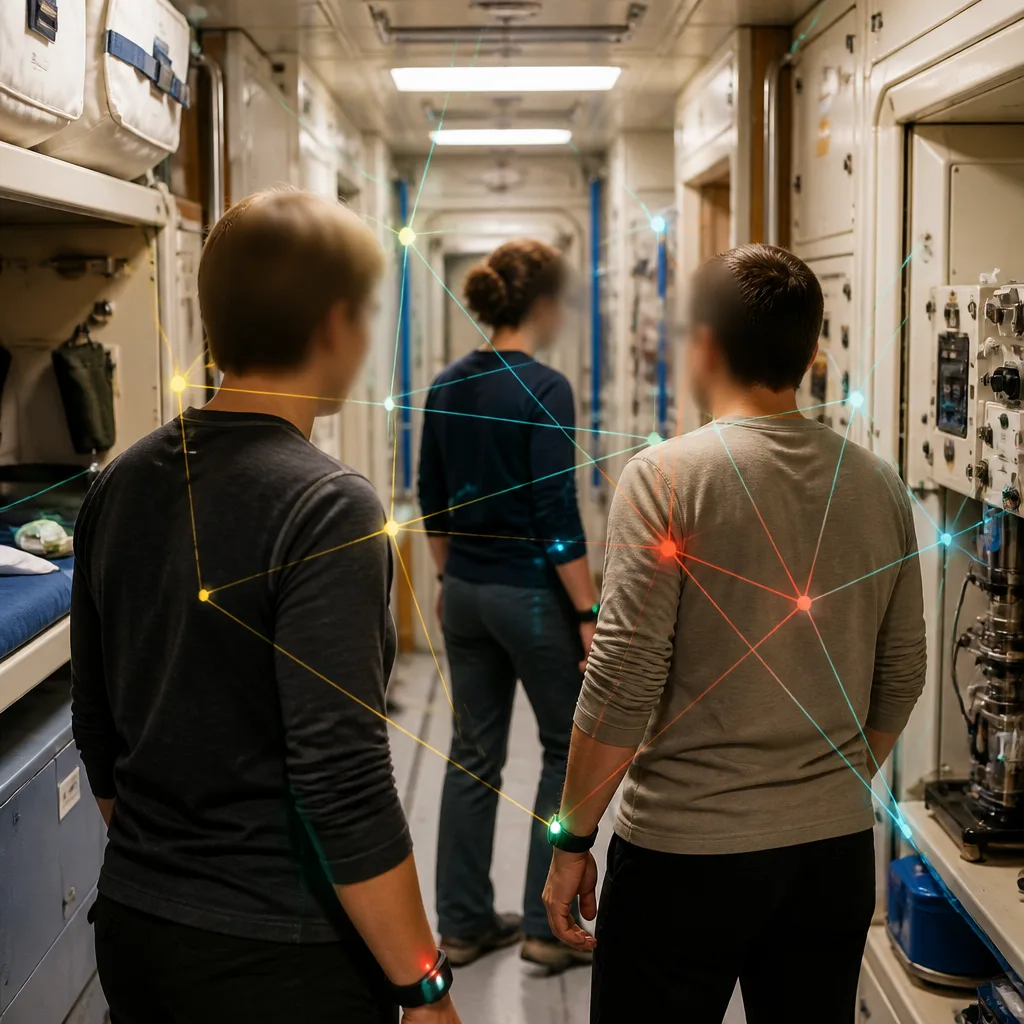
The study combined self-report questionnaires collected at four points during the mission with wearable sensors that logged physical proximity and the duration of interpersonal encounters. The research tracked how loneliness, trust, conflict, social relationships, team cohesion and perceived performance evolved over the course of the winter at one of Earth’s most remote outposts.
Key numerical facts from the field experiment include the following:
| Measure | Value |
|---|---|
| Crew size | 12 |
| Duration | 10 months |
| Questionnaire time points | 4 |
| Recorded winter low | −80 °C |
The combination of dense social contact and extreme environmental stress produced nuanced results. Rather than social contact uniformly buffering the psychological strains of isolation, the investigators found that more frequent proximity sometimes correlated with increased conflict, heightened mistrust and lower ratings of team performance.
"In small teams under extreme conditions, more contact doesn't automatically equate to social support, but can actually increase tensions," said Jan Schmutz.
Why more contact may not help
The authors interpret the pattern as evidence that constant closeness can itself be a stressor when privacy and social variety are scarce. In confined environments, the inability to withdraw from others or to control social exposure can amplify interpersonal friction rather than alleviate it. The study also observed that social bonds increasingly split along cultural and language lines over time.
The researchers emphasise that the results are correlational: they detect associations between proximity and self-reported outcomes but do not establish direct cause-and-effect. For example, people experiencing loneliness might seek out more interaction, and those encounters may not be experienced as supportive.
- Dense, repeated proximity was linked with more reports of conflict and mistrust.
- The crew segregated into groups consistent with language and cultural differences as the mission progressed.
- Privacy—or the lack of it—appears to be a critical factor in wellbeing on long missions.
Implications for Mars and deep-space missions
Concordia Station is frequently used as an analogue for deep-space habitation because of its extreme cold, prolonged darkness and isolation from outside contact. Those conditions mirror many psychosocial challenges expected on missions beyond low Earth orbit, where crews will remain small and opportunities for personal space will be limited for months or years.
Mission planners and space psychologists aiming to preserve team performance on future expeditions may need to rethink assumptions that simply increasing shared time or designing for continuous group interaction will enhance cohesion. Instead, the study suggests that architecture, scheduling and procedures should deliberately create options for solitude, varied social pairings and mechanisms to manage conflict before it compounds.
Design considerations informed by this work could include rotating task assignments to avoid repetitive interpersonal strain, scheduling private time, and creating cross-cultural training and language support that reduce the risk of long-term subgroup formation. The authors’ caution about interpreting correlations underlines the need for further experimental and longitudinal work in diverse analogue settings.
As agencies and private companies prepare for longer missions, the Concordia findings contribute a practical warning: proximity is not a simple proxy for social support. Understanding how people respond to relentless familiarity may be as important as designing life‑support systems when humans travel farther from Earth than ever before.