A promised ban moves to the centre of Quebec politics
Quebec’s new education minister says the province’s minority Parti Québécois government intends to prohibit schoolchildren from wearing religious symbols, setting up an early confrontation over secularism, Charter rights and the government’s priorities for the education system.
Joël Arseneau told journalists Wednesday that banning religious symbols worn by students is non-negotiable. The proposal was included in the Parti Québécois election platform, which described secularism as reflecting a desire among most Quebecers to keep religious practice within the private sphere.
The government has not yet indicated when it will introduce legislation. The available information does not specify the proposed rules, their scope or how they would be enforced. It also does not say whether the measure would apply to every student or to particular religious symbols or school settings.
Muslim organization calls proposal discriminatory
Stephen Brown, president of the National Council of Canadian Muslims, said the initiative would remove rights from children who want to express their faith while attending school. He said the organization had expected the government to consult communities and search for balanced responses to questions involving secularism.
We’re talking about going after the rights of children to have a spirituality and go to school.
Brown said the proposed rules would mainly affect students who wear a kippa, hijab, crucifix or turban. He characterized the plan as discrimination against religious minorities and argued that constitutional protections should not be weakened for electoral or political purposes.
His criticism is directed not only at the substance of the proposed ban, but also at the way it is being advanced. Brown said the government had promised to represent all Quebecers and to engage with communities on difficult policy questions. In his view, the announcement shows the opposite approach.
Québec solidaire says schools have more urgent needs
Québec solidaire’s education and secularism critic, Roxane Milot, said her party will oppose the proposed ban. The party’s response combines an objection based on rights with a broader argument about the pressures facing Quebec’s schools.
Leave the kids alone!
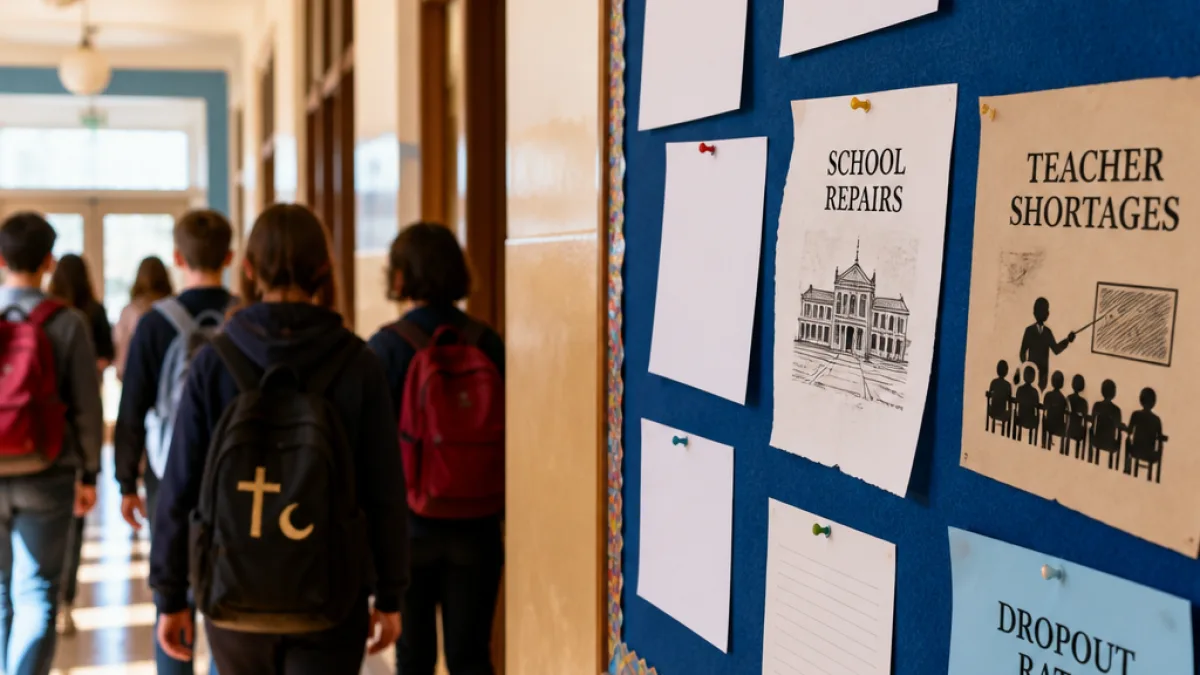
In a news release, Milot pointed to the staff shortage, school repairs, the province’s three-tiered school system and the dropout rate as issues that should receive priority. Québec solidaire also warned against what it called identity-driven political competition, suggesting the new administration risks becoming consumed by symbolic debates instead of concentrating on education services.
The government’s position and the opposition’s response leave the proposed measure at an early stage. A commitment made during the election campaign has now been repeated by the education minister, but no bill has been tabled according to the information available. That means the details needed to assess the policy remain unsettled.
What is known about the proposal
| Issue | Information available |
|---|---|
| Government position | The education minister says the ban is non-negotiable. |
| Political status | The measure was promised by the Parti Québécois and has not yet been presented in a bill. |
| Opposition | Québec solidaire says it will vote against the proposal. |
| Community response | The National Council of Canadian Muslims calls the plan discriminatory and harmful to children’s rights. |
A debate involving children and religious freedom
The central dispute is whether students should be permitted to wear visible religious articles in public schools. Brown’s examples include several forms of religious dress or symbols associated with different faith communities. The government’s stated rationale, as described in its platform, is that religion should be practised in the private sphere.
That position is being challenged as a question of equal treatment. Brown said the people most affected would be members of religious minorities, and argued that children’s rights should not depend on the outcome of an election campaign. The debate therefore reaches beyond school clothing rules and into the relationship between Quebec’s secularism policies and protections for religious expression.
Next step will be a legislative test
The next significant development will be the government’s decision on whether and when to table a bill. Until that happens, the public record does not establish the precise wording of the proposed prohibition, the students who would be covered or how schools would be expected to apply it.
Once legislation is introduced, the debate is likely to move from campaign commitment to detailed scrutiny in the legislature. The government will face questions from opposition parties and community organizations, while education stakeholders will need to consider how any new requirements would operate in schools.
For now, the plan has already become a defining issue for the new education minister. The Parti Québécois says it is advancing a principle it placed before voters. Critics say the proposal targets children from religious minorities and draws attention away from staffing, infrastructure and student success. The eventual bill, if introduced, will determine how those competing claims are translated into policy.