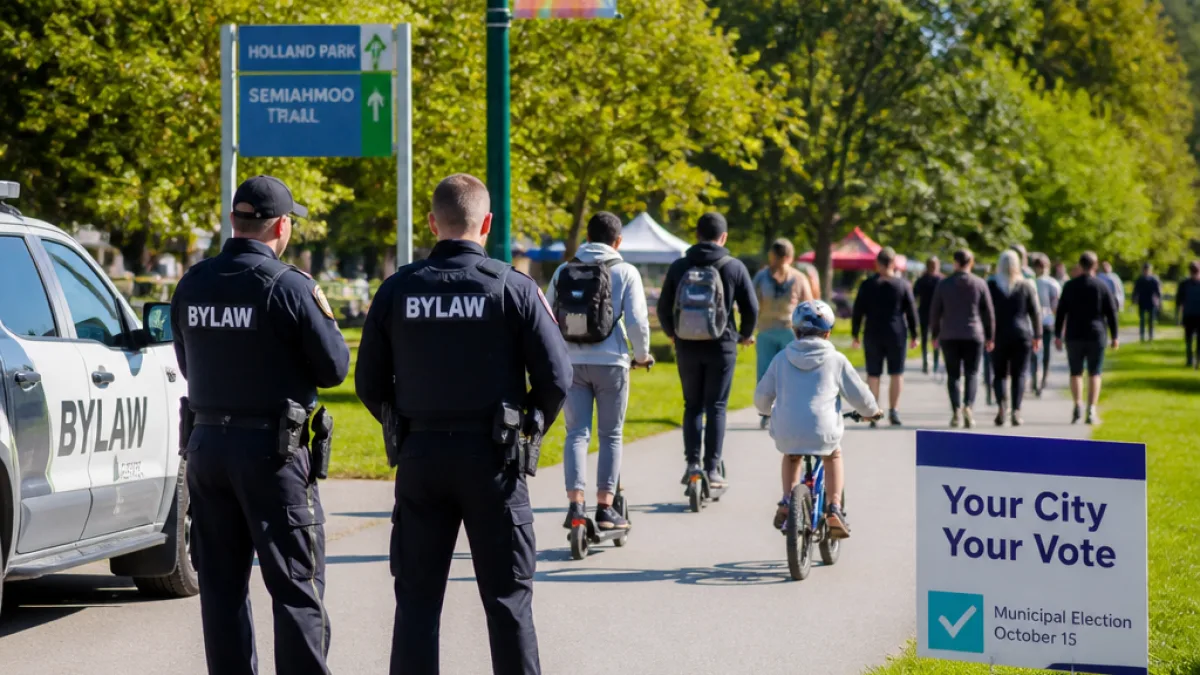
Surrey residents are being urged to take notice after a local letter-writer described what he calls an escalating problem with electric scooters being ridden on public property in contravention of municipal bylaws and provincial law.
Prohibition on public property
In a note published this week, a Surrey resident pointed out that e-scooters are prohibited on all public property in the city, including roadways, sidewalks and parks, and are permitted only on private property. The writer cited the Motor Vehicle Act and Parks Bylaw No. 13480 as the legal basis for that prohibition.
The author described multiple recent observations in which riders used e-scooters on pedestrian routes, including Semiahmoo Trail and Holland Park. In one incident at a Fusion Festival event, a youth was said to be weaving through a crowd in close proximity to two uniformed City of Surrey bylaw officers.
"When I confronted the two officers about their lack of action in the face of the infraction, I was told that they were only present to escort the mayor (who was nowhere in sight). They also told me they could not even talk to a bylaw violator who is a child without the parent present."
Questions about enforcement and public safety
The account lays bare two public concerns. First is safety: the writer describes scooters being operated at speed on mixed-use paths and in parks, creating a hazard for pedestrians. Second is enforcement: the writer alleges bylaw staff were unwilling or unable to intervene.
That combination — more scooters in shared public spaces and perceived reluctance to enforce existing rules — is what spurred the letter-writer to call on voters to consider enforcement when they head to the polls on Oct. 17.
- Where e-scooters are allowed: private property only, per the letter.
- Where e-scooters are prohibited: city roadways, sidewalks, parks and trails, as cited under the Motor Vehicle Act and Parks Bylaw No. 13480.
- Main concern: pedestrian safety and the adequacy of bylaw responses to reported infractions.
Context and consequences for Surrey
Surrey has been growing rapidly and its network of parks, pathways and waterfronts attracts residents and visitors alike. Shared-use spaces such as the Semiahmoo Trail and Holland Park are heavily used in the summer months, increasing the potential for conflicts between pedestrians and micromobility devices.
While some Canadian municipalities have moved to create legal frameworks to regulate e-scooters — including designated lanes, speed limits and rental schemes with geofencing — the letter underscores that in Surrey, according to the writer, operation of privately owned e-scooters on public property remains off-limits under present interpretation.
That leaves residents and visitors to navigate an environment where actual behaviour on paths may diverge from the written rules. The result, the letter suggests, is frustration and concern that city enforcement priorities are not addressing everyday safety risks.
| Issue | Implication for residents |
|---|---|
| Prohibition of e-scooters in public | Riders on sidewalks or trails may be breaking the law and creating hazards. |
| Reported lack of enforcement | Residents may feel unsafe or that bylaws are not applied consistently. |
What residents can do
The letter calls on voters to consider the issue at the municipal ballot box in October. Beyond voting, residents concerned about scooter use and enforcement can:
- Report incidents to Surrey bylaw services or 911 in the event of immediate danger;
- Raise concerns at neighbourhood meetings or through councillor offices to seek clarification on enforcement policy; and
- Engage with community groups focused on active transportation and park safety to press for clearer rules and better signage.
As Surrey continues to plan and invest in public spaces and active-transportation infrastructure, the debate over how to manage emerging modes of mobility is likely to intensify. Residents, officials and enforcement staff will face decisions about whether to continue a prohibitionist approach, to develop a regulated-use model, or to pursue other changes — choices that will affect how people move through the city’s parks and pathways.
This report is based on a letter published in the local press from a Surrey resident describing observed incidents and his interactions with bylaw officers. City officials have not been quoted in the original letter; readers seeking official clarification on enforcement policy should contact Surrey bylaw services or the city’s communications office.