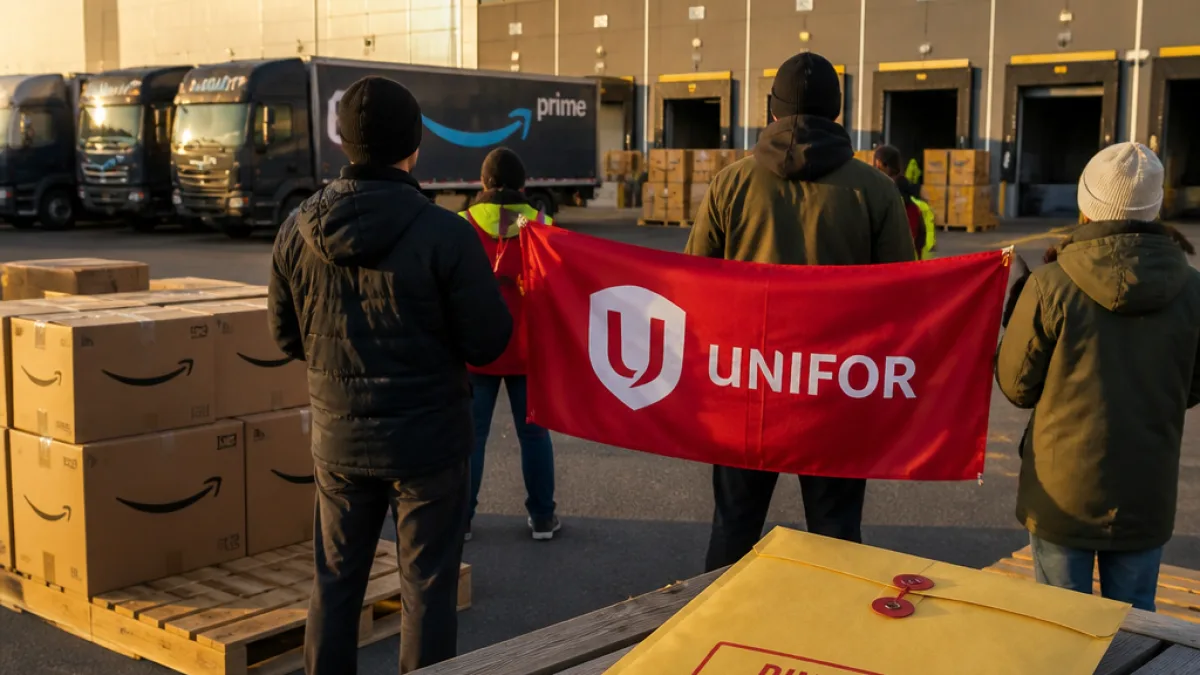
The British Columbia Labour Relations Board has mandated binding arbitration to settle a stalemate between Amazon and unionized workers at the company’s Metro Vancouver distribution centre, the board said in a ruling issued Tuesday.
The decision, handed down by associate chair Andres Barker, requires Amazon and Unifor to "conclude their first collective agreement" through a single arbitrator. If the parties cannot agree on an arbitrator within seven days, the board said it will appoint one.
Why the board intervened
The board’s move follows a prolonged dispute between the e-commerce giant and employees represented by Unifor at the Delta, B.C., site. Amazon had resisted the mediator’s recommendation for arbitration, favouring continued direct negotiations that would preserve both the union’s and the employer’s conventional bargaining options, including the right to strike or lockout.
Earlier this year the panel found Amazon in breach of the provincial labour code for how it treated unionized workers at the Delta facility. That ruling centred on the company’s handling of pay increases that were extended to other employees but not to those at the union-represented site, a finding that fed tensions in bargaining and was cited by the board as part of the context for its decision.
Responses from the parties
Unifor welcomed the board’s direction.
“Amazon’s behaviour has been so bad because it knows what we know: unions build worker power,” Unifor western regional director Gavin McGarrigle said in a statement. “Amazon sees unions as an existential threat to ruthless and unsustainable workplace management.”
Amazon did not immediately provide comment on the board’s latest ruling. In earlier statements, the company described bargaining for an inaugural contract as "complex" but said it had participated in good faith and intended to continue doing so.
What the order means
The board’s directive to use a single arbitrator effectively bypasses further rounds of back-and-forth bargaining and places the outcome in the hands of an impartial adjudicator. Binding arbitration will require both sides to accept the arbitrator’s decision on outstanding terms, which can settle wages, work rules and other key elements of a first collective agreement.
Practically, the ruling accelerates a path to a final settlement while limiting the potential for labour disruption through strikes or lockouts during the arbitration process. If the parties cannot select an arbitrator themselves within a week, the board has signalled it will name one.
Local and broader impact
The case has local significance in Delta, where Amazon’s warehouse employs scores of workers whose first contract will set standards for pay and conditions at the site. It also resonates across B.C. and Canada as governments, unions and employers watch how large, private employers adapt to unionization efforts and provincial labour oversight.
Observers say the ruling may encourage other unions and workers in the logistics and warehousing sector, where union drives have grown in recent years, while signalling to employers the consequences of conduct deemed to contravene the provincial labour code.
Key timeline
| Date | Event |
|---|---|
| Earlier in 2026 | Board ruled Amazon violated provincial labour code regarding pay increases for unionized workers. |
| June 2026 | Amazon rejected mediator’s recommendation for arbitration, preferring direct bargaining. |
| Aug. 4–5, 2026 | Labour Relations Board ordered binding arbitration; arbitrator to be appointed if parties do not agree within seven days. |
What happens next
Under the board’s timetable, the two sides have a narrow window to agree on an arbitrator. If they do, that person will be tasked with hearing outstanding issues and issuing a binding decision. If the board appoints an arbitrator, that process could proceed on the board’s schedule.
- Workers: Await resolution of terms for their first collective agreement.
- Amazon: May have to accept a binding settlement rather than continuing direct bargaining.
- Union: Secures a route to a definitive outcome after alleging bargaining impasses and unfair practices.
The ruling underscores the Labour Relations Board’s willingness to step in when it deems bargaining has broken down in a way tied to statutory violations. For Delta-area workers, it will soon determine the terms that govern their work lives at one of the region’s most high-profile employers.
— Jasmine Leung, NEXO RADAR