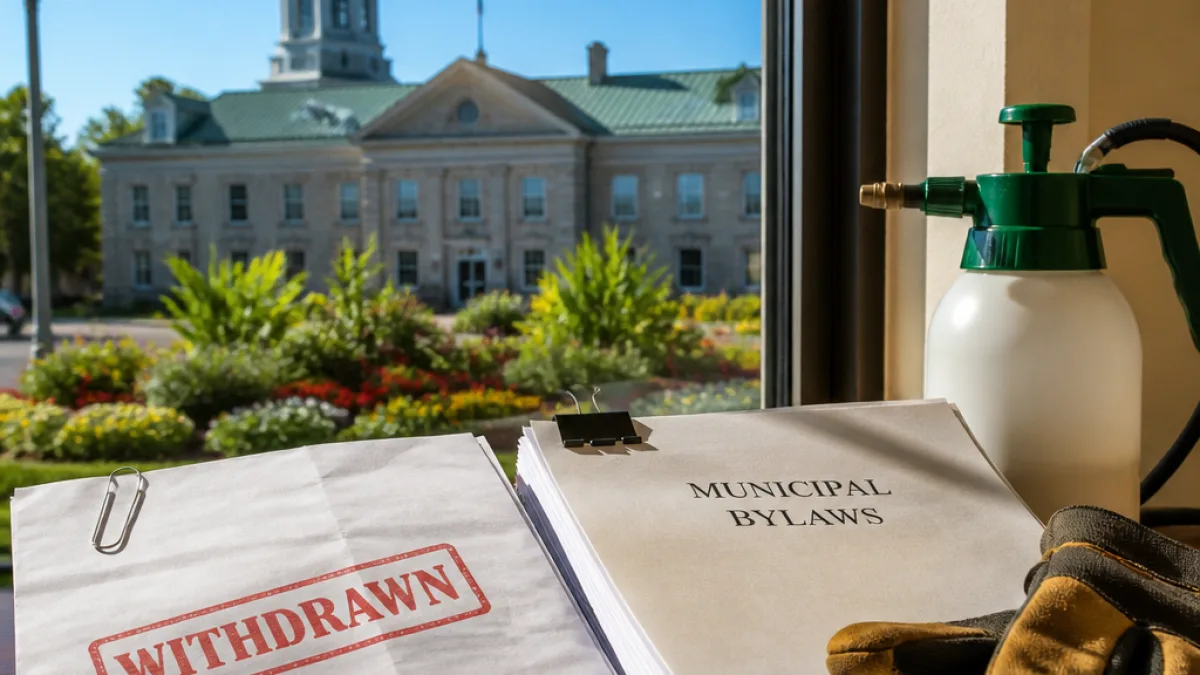
The Association des services en horticulture ornementale du Québec has formally withdrawn a request for judicial review of pesticide restrictions recently adopted by five Quebec municipalities, signalling a shift from confrontation toward cooperation in a dispute that had divided local governments, the horticulture sector and public health advocates.
Association seeks dialogue rather than court fight
In a statement announcing the withdrawal on Wednesday, the industry group represented as many as more than 100 businesses — many of them contractors and service providers for decorative and aesthetic lawn care and greenspaces — and said it wanted to work with municipalities rather than pursue litigation. The association had contested local bylaws passed this spring in Saint‑Hyacinthe, Granby, Beauharnois, Bromont and Plessisville that largely ban pesticides, while allowing a category of products it described as “low‑impact.”
“We simply want to bring the dialogue back,” said Jean‑Luc Poirier, administrative coordinator of the association.
The legal action had been filed at the Quebec Superior Court. According to the association’s original filing in Saint‑Hyacinthe, the municipalities made what the industry called an “unreasonable” distinction between biopesticides — substances derived from natural sources — and chemical pesticides. That argument is no longer being pursued in court.
What the municipal rules allow
The five towns’ bylaws include exceptions and clarifications that influenced the debate. Among the permitted uses are certain biopesticides and a short list of substances that provincial guidelines allow on the grounds of childcare centres and schools. Additional exceptions apply in cases such as responses to infestations.
| Municipality | Action taken this spring |
|---|---|
| Saint‑Hyacinthe | Banned most pesticides, allowed "low‑impact" category |
| Granby | Banned most pesticides, allowed "low‑impact" category |
| Beauharnois | Banned most pesticides, allowed "low‑impact" category |
| Bromont | Banned most pesticides, allowed "low‑impact" category |
| Plessisville | Banned most pesticides, allowed "low‑impact" category |
Federal authorities including Agriculture and Agri‑Food Canada note that many biopesticides are derived from natural sources and are treated differently from synthetic chemical pesticides in regulatory or advisory contexts. The municipalities’ approach would therefore permit a range of products classified as biopesticides while limiting the use of other substances.
Critics accused industry of intimidation
The withdrawal ends, for now, a legal confrontation that some public‑interest voices had characterised as an effort to intimidate small towns. Pascal Priori, identified as a public health advocate, said the legal challenges had the effect of pressuring municipalities that lack extensive legal resources.
“They’re using these legal challenges, in our opinion, as the equivalent of an intimidation lawsuit, to bully these small towns that have few legal resources to allocate to the case,” said Pascal Priori.
With the court file closed by the association’s withdrawal, the next phase of the dispute is likely to unfold in municipal councils, consultation tables and possible negotiations over the scope of permitted products and exceptions.
What this means for local businesses and municipalities
For ornamental horticulture businesses operating in the affected towns, the decision removes the immediate uncertainty and cost of a court battle. But it also leaves intact the municipal bans as passed this spring. Businesses that rely on pesticides for certain services will need to work with local officials to clarify whether their products fall within permitted categories, and to find alternatives where they do not.
- Association represents more than 100 ornamental horticulture businesses.
- Bylaws passed this spring in five municipalities largely ban pesticides, with exceptions for a "low‑impact" category and emergency infestations.
- Legal challenge was withdrawn; the association prefers dialogue with municipalities.
The withdrawal does not resolve the broader policy questions about pesticide use, environmental protection and municipal authority in Quebec. It does, however, move the conversation away from courtroom confrontation and back into public fora where municipalities and industry may negotiate how the rules are implemented and enforced.
As the towns continue to implement their bylaws, municipal officials, industry representatives and public‑health advocates will likely return to debates over definitions, acceptable products and the mechanisms for exemptions — discussions with direct consequences for local green‑space management and public expectations about environmental protection.