
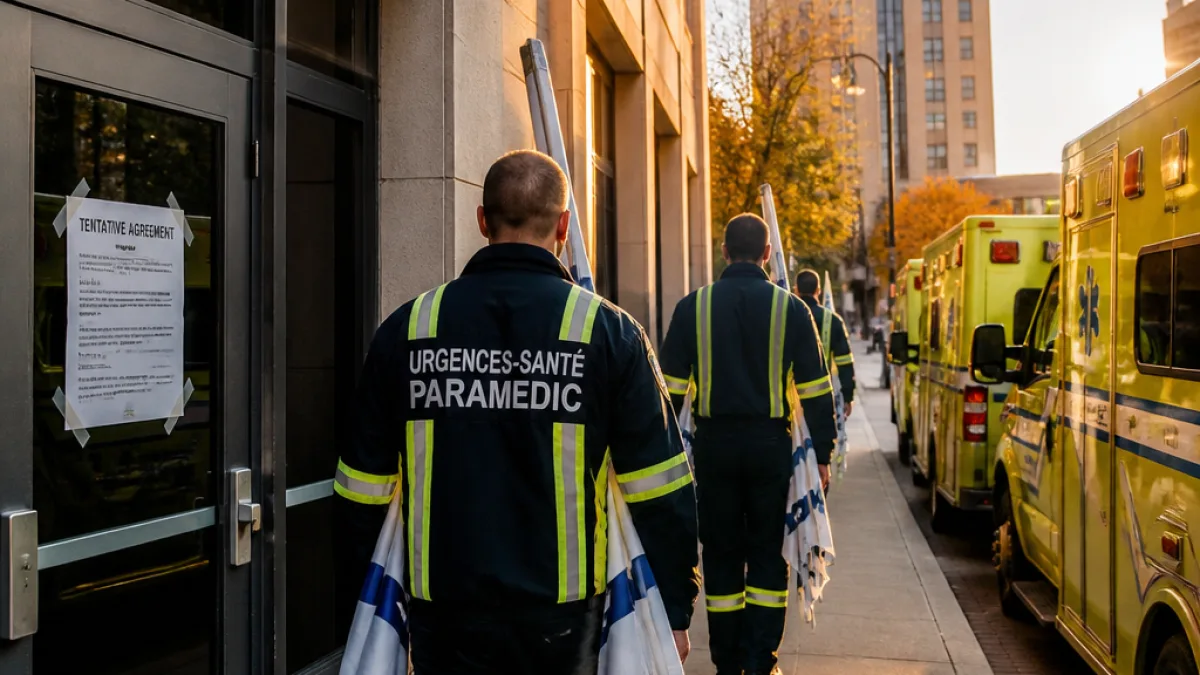
Quebec and a union representing roughly 3,500 paramedics have reached a tentative labour agreement, officials announced late Sunday, ending a prolonged period without a collective contract that has included strike action and service tensions across the province.
What the deal means for services
The proposed agreement was negotiated over six days and will now be presented to union members for ratification. The workforce covered by the deal includes more than 1,000 paramedics employed by Urgences-santé, the public ambulance service that serves Montreal and Laval.
The office of the Quebec Treasury Board president, France-Élaine Duranceau, said the agreement is intended to "improve paramedics' working conditions while helping ensure efficient and continuous ambulance services for the public," according to a government statement released with The Canadian Press report. The government and union have not yet released the detailed terms of the proposed contract.
Background: a long-running dispute
Paramedics in Quebec had been operating without a collective agreement for more than three years. The labour dispute intensified last year when strike action began in July 2025, with pay and working conditions at the centre of the conflict. The tentative deal marks a potential end to more than a year of job action that affected ambulance availability in some areas at various times.
Both the union and the provincial government have so far kept the specifics of the proposed settlement under wraps pending ratification. Union leaders said the agreement was reached after a final round of intensive bargaining and that it will be submitted to members "as soon as possible."
Local impact and practical considerations
If ratified, the new contract could stabilise frontline emergency services and ease staffing pressures that have been felt by hospitals and dispatch centres. Paramedics have warned in the past that stretched shifts, staffing shortages and compensation below market rates were hampering recruitment and retention.
For patients and residents, the most immediate practical effects would likely be improved continuity of ambulance coverage and clearer scheduling for crews. Hospital emergency departments that have coped with intermittent ambulance slowdowns may also see steadier patient flow if recruitment and retention improve under the terms of the agreement.
- Who is covered: about 3,500 paramedics across Quebec
- Key employer: Urgences-santé (Montreal and Laval) — more than 1,000 paramedics
- Negotiations: final push lasted six days
- Recent labour activity: strike action beginning July 2025
Timeline and figures
| Item | Detail |
|---|---|
| Paramedics represented | ~3,500 |
| Paramedics at Urgences-santé | >1,000 |
| Negotiation period (final round) | 6 days |
| Time without collective agreement | More than 3 years |
| Strike action began | July 2025 |
Next steps
Union members will vote on the tentative contract after details are made available. Should the membership ratify the proposal, the agreement will replace the status quo that has persisted for several years and potentially bring an end to intermittent labour actions.
If the deal is rejected, negotiations would likely resume, and labour disruptions could continue to affect emergency medical services. Both the government and union have stressed the importance of a stable system to protect public safety.
For now, the tentative agreement is a significant development for frontline health workers and for citizens who rely on timely ambulance response. The province and union have signalled a willingness to move forward; the next decisive moment will be the ratification vote by paramedics themselves.
Reporting for NEXO RADAR.