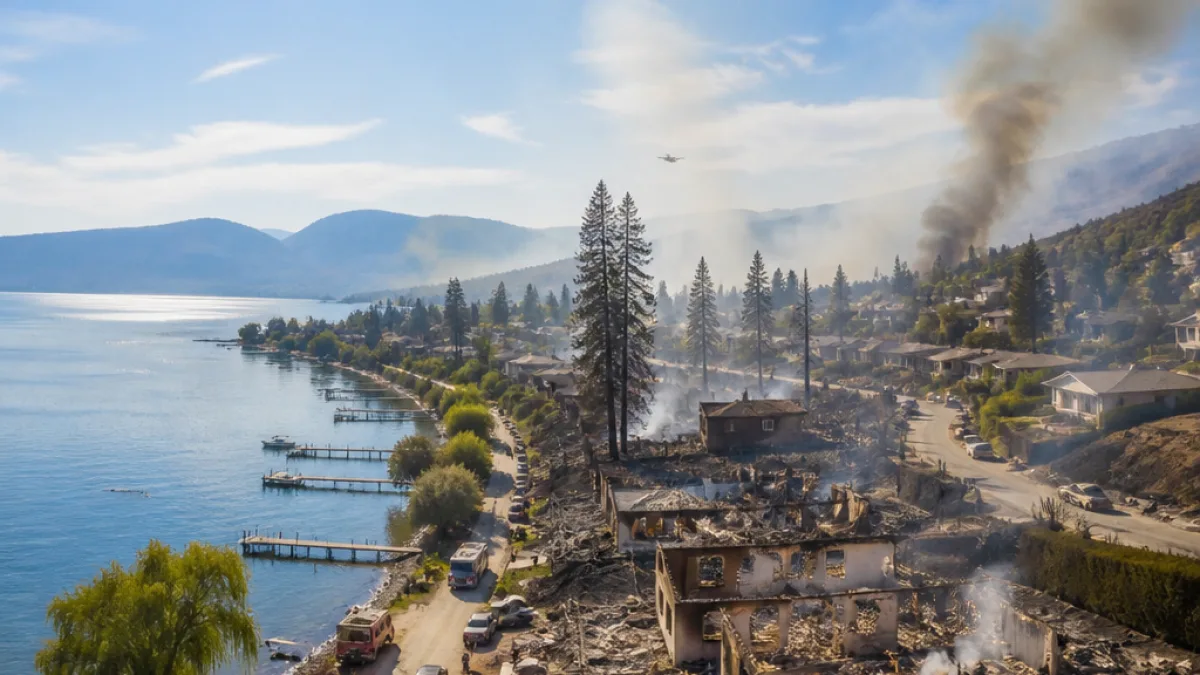
As crews continue to assess damage from a fast‑moving wildfire along Okanagan Lake, emergency officials say a combination of dry lightning and rising temperatures will increase the risk of new outbreaks across British Columbia’s southern Interior this week.
Fire conditions expected to worsen
Cliff Chapman of the BC Wildfire Service said forecasts call for daytime highs in the mid‑30s Celsius and a dry‑lightning event on Thursday, a forecast that would create favourable conditions for new fire starts. The service is prepared to surge aircraft and crews to respond to new ignitions.
"If it materializes as expected, we’ll see more fire starts across the southern Interior," Chapman said.
At present, the province is dealing with an estimated 115 wildfires, with six described as fires of note burning near communities in the southern Interior. Firefighters are shifting resources between active incidents as conditions evolve.
Homes destroyed and local impacts
Damage assessments are under way after a wildfire swept through an Okanagan Indian Band reserve on Saturday. Band leadership reported at least 230 homes destroyed during the blaze, a figure that underscores the human toll as residents face displacement and property loss.
Emergency responders and community leaders are focused on immediate needs — search and rescue, reunification, temporary shelter and the logistics of damage documentation for insurance and recovery funding.
Preparedness and response
BC Wildfire Service officials say they have helicopters and fixed‑wing aircraft ready to mobilize and are coordinating with local fire departments, Indigenous governments and provincial emergency management bodies. With dry lightning capable of producing multiple, simultaneous ignitions, rapid detection and response will be critical to contain new incidents before they spread toward communities.
- What officials are monitoring: lightning forecasts, daily temperature highs, humidity and fuel dryness.
- Resources on standby: helicopters, fixed‑wing air tankers and ground crews.
- Local impacts to expect: evacuation alerts or orders, road closures and smoke impacts to air quality.
Where fires are burning
Most of the province’s active fires are concentrated in the southern Interior, where terrain, warm temperatures and available fuels can accelerate fire behaviour. Officials have described six incidents as of concern because of their proximity to communities.
| Metric | Value |
|---|---|
| Estimated active wildfires in B.C. | 115 |
| Wildfires of note | 6 |
| Homes reported destroyed (Okanagan Indian Band) | 230 |
| Temperature forecast | Mid‑30s °C |
Advice for residents
Residents in the southern Interior should stay alert for public safety notifications from local authorities and the province. Those in or near evacuation zones should be ready to leave with essential items and documentation. Homeowners are urged to check insurance coverage and photograph damage when it is safe to return, and community members should follow air‑quality advisories to reduce smoke exposure.
Local relief organisations and band governments are mobilizing to support displaced residents. In past wildfire emergencies, efforts have included sheltering, food services and assistance with recovery planning; officials say similar supports will be organised as needs are confirmed.
Outlook
With a dry‑lightning threat and heat expected to persist, the coming days are likely to be challenging for firefighters and communities across B.C.’s southern Interior. Authorities emphasise the importance of early detection and a coordinated response to limit the number of large, destructive fires.
Those seeking the latest provincial updates are advised to consult the BC Wildfire Service and local emergency management websites for real‑time information on fire activity, evacuation orders and air‑quality notices.
— Reporting from the Okanagan region.