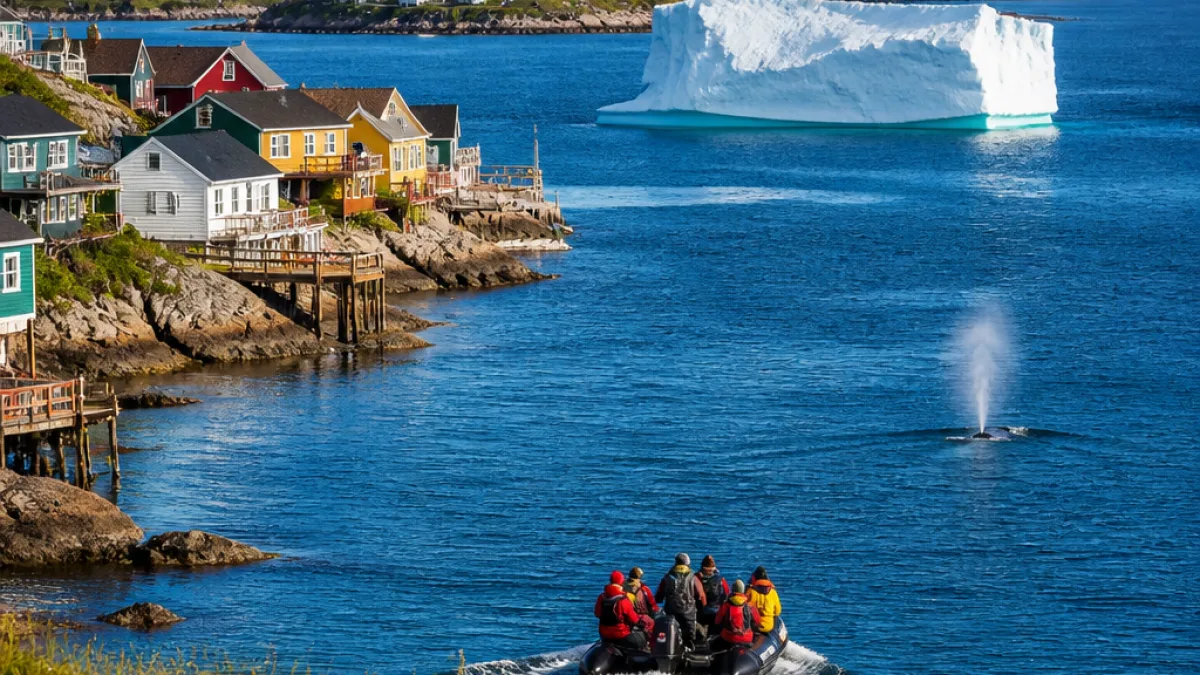
The narrow streets and colourful clapboard houses of Trinity, population 76, have long been a postcard for Newfoundland and Labrador. In recent years the village on the Bonavista Peninsula has also become a front-row seat for a very different kind of spectacle: icebergs and whales moving along the corridor known locally as Iceberg Alley.
Where ancient ice meets a living coast
Iceberg Alley stretches from Labrador’s coast to the southeast shores of the island of Newfoundland. In Trinity, small operators run marine safaris in nimble Zodiacs that put passengers within thrilling proximity of tabular bergs and the whales that frequent the same waters.
The bergs themselves can be astonishing in age. Some of these frozen giants are estimated to be between 12,000 and 15,000 years old, calved from the ice sheets of western Greenland and carried south over years by ocean currents before being swept into the Labrador Current and along Newfoundland’s coast.
When to go and what to expect
Timing matters. According to the provincial tourism office, May and June tend to produce the highest number of visible icebergs. Sightings, however, are not guaranteed and depend on a range of natural forces — wind, ocean currents, temperature and the presence of sea ice, which can shelter bergs from waves and extend their lifespan.
“May and June tend to be the best months for viewing (as they’re most plentiful during this time), but it’s not uncommon to see icebergs into July, especially the further north you go,” said Candice Walsh with the Newfoundland and Labrador Department of Tourism, Culture, Arts and Recreation.
Captain Barry Rogers of Iceberg Quest, a local operator, refers to the larger formations affectionately as “the ancient ones.” Their slow southward drift means that conditions can vary dramatically over a short distance — one cove might be empty while a headland 100 kilometres away is crowded with ice.
Practical advice for visitors
For those planning the trip, operators and tourism officials stress flexibility and preparedness. Common-sense measures will make the experience safer and more enjoyable:
- Dress in layers and bring a waterproof outer layer — weather on the water changes quickly.
- Book marine safaris in advance during peak season, especially in May and June.
- Be prepared to travel — iceberg concentrations can shift along the coast.
- Follow the guidance of tour operators regarding safe distances and behaviour near wildlife and ice.
| Month | Typical iceberg activity |
|---|---|
| May | Peak sightings common |
| June | High likelihood of sightings |
| July | Possible sightings, more likely further north |
Some coastal areas of southern Labrador are accessible year-round by car ferry from Newfoundland, allowing travellers to chase the bergs further north if conditions warrant. The province’s shorelines offer many accessible vantage points by road for those who prefer to remain on land.
Local benefit and conservation considerations
The seasonal arrival of icebergs is an economic boon for small communities such as Trinity. Local tour operators, lodging and restaurants see increased demand in iceberg season. Operators emphasise conservation-minded practices to protect marine mammals and the coastal environment while giving visitors meaningful encounters with the natural world.
Guides on Zodiac tours typically combine iceberg viewing with whale spotting and natural-history commentary, turning a short harbour outing into an immersive lesson in oceanography, climate and local maritime culture.
A moving spectacle with variable fortunes
Seeing an iceberg up close is an unpredictable but unforgettable experience. The icebergs themselves are reminders of distant glaciers and millennia of climatic history, while the presence of whales and seabirds underscores the productivity of Newfoundland and Labrador’s cold waters.
For travellers and locals alike, Trinity and the broader Iceberg Alley remain among the province’s most vivid natural attractions — best visited with patience, warm clothing and a readiness to follow the bergs wherever the Labrador Current carries them.