St. John’s University announced in July that it has eliminated 55 staff and administrative positions as part of an organisational reshuffle tied to its three-year strategic plan, The Torch reported.
Plan aims to refocus resources amid demographic pressures
The jobs cuts are connected to the university’s “Moving Forward Together” strategic plan — a framework the institution says is designed to sharpen academic focus and bolster student supports while improving financial health and operational efficiency and innovation.
University officials framed the changes as a response to long-term shifts across the higher-education landscape. In a statement supplied to The Torch, the university noted that demographic changes in the college-age population have created challenges for institutions nationwide and that regular reassessment of operations is necessary to sustain leadership in the sector.
“For more than 156 years, St. John’s University has been a national leader in higher education. However, to maintain our leadership position, we know we must regularly examine our operations and make appropriate adjustments to further strengthen it in the future,”
The university said the decisions followed a comprehensive review process with input from across the campus community and were guided by institutional values, fairness and respect.
Scope and immediate impact
According to the statement, the affected positions represent roughly 2 per cent of the university’s total workforce. University spokesperson Brian Browne confirmed that no faculty positions were impacted by the reorganisation. Browne characterised the moves as difficult but necessary steps to redirect resources to areas that will “position our students for success.”
- Positions eliminated: 55 staff and administrative roles
- Faculty affected: 0 positions
- Workforce share: Approximately 2 per cent
| Item | Figure |
|---|---|
| Staff/administrative positions cut | 55 |
| Faculty positions affected | 0 |
| Institutional history | 156 years |
| Share of workforce | ~2% |
Offices reshaped to align with priorities
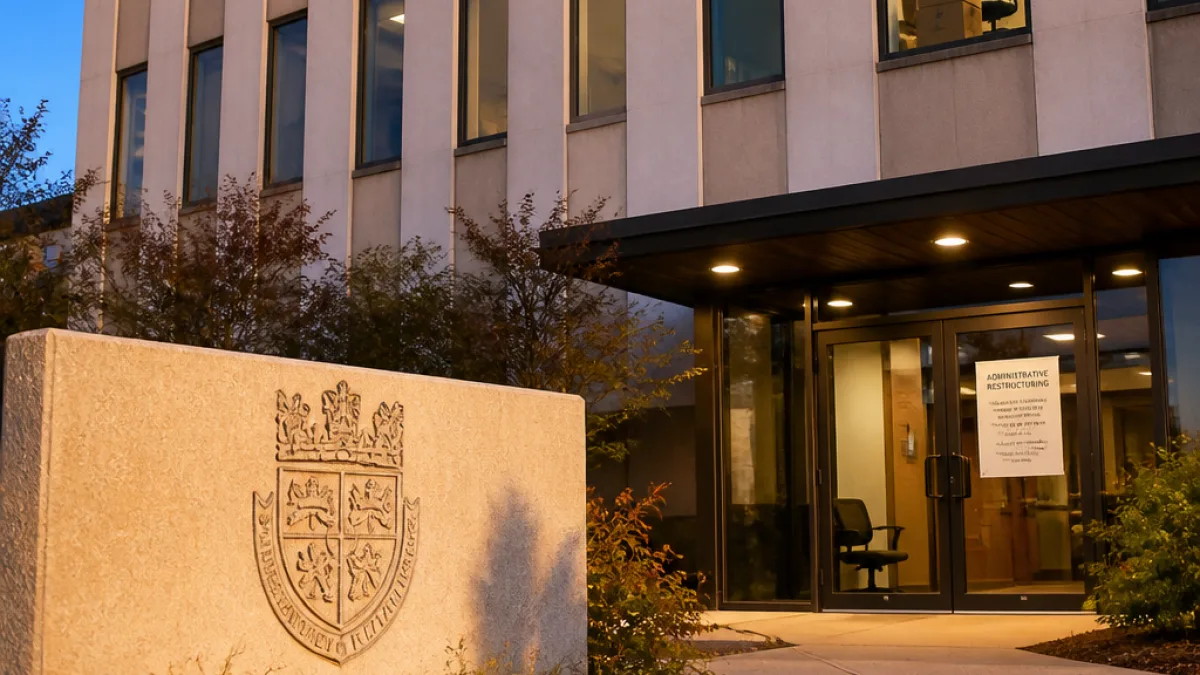
The restructuring includes changes to administrative units, and the university indicated some offices would be reorganised to better reflect the strategic priorities of academic excellence, inclusive student success and service.
One example highlighted in reporting was that the Office of Equity and Inclusion will be affected by the reorganisation. The university’s external communications emphasised that the goal is to redirect resources toward initiatives expected to have the greatest impact on student outcomes.
University leadership stressed that the reviews and subsequent actions were intended to strengthen the institution’s long-term prospects rather than as short-term cost-cutting alone.
What this means for post-secondary sector watchers
While the announced cuts are modest in proportion to the overall workforce, they reflect a pattern now familiar across North American higher education: institutions reassessing structures and staffing in response to changing demographics and fiscal pressures.
For students, staff and alumni, the moves will be watched closely as indicators of how the university plans to balance mission and finances in the coming years. For staff whose roles were eliminated, the university said the decisions were made following a comprehensive review and with regard for fairness and respect, though details on severance, supports or redeployment were not outlined in the material released to The Torch.
As the university implements the strategic plan, stakeholders inside and outside the institution will likely seek updates on how redirected resources translate into measurable improvements in student support, academic programs and institutional sustainability.
This development in New York is another reminder to Atlantic Canada’s post-secondary observers that the pressure to adapt is widespread, and local institutions may face similar strategic decisions as enrolment patterns evolve.