The provincial government is asking Newfoundland and Labrador residents to contribute directly to a new 10-year Poverty Reduction and Prevention Strategy by taking part in local consultations, completing a brief online survey or sending written submissions. The effort is a key commitment from Budget 2026 and aims to build a long-term framework for reducing poverty and improving outcomes across the province.
Who is being asked to take part
Officials say input is being gathered from a wide range of voices, including community organisations, service providers, Indigenous governments and organisations, and people with lived and living experience of poverty. The government also invited other partners and stakeholders to add their perspectives as the strategy is developed.
Provincial sessions have already taken place in several communities, with more scheduled through August and into the fall. The locations already visited include Corner Brook, Stephenville, Rocky Harbour, Carbonear, Grand Falls-Windsor, Gander, Bonavista, Clarenville and Marystown. The government said additional sessions will be announced as they are arranged.
How to participate and the timeline
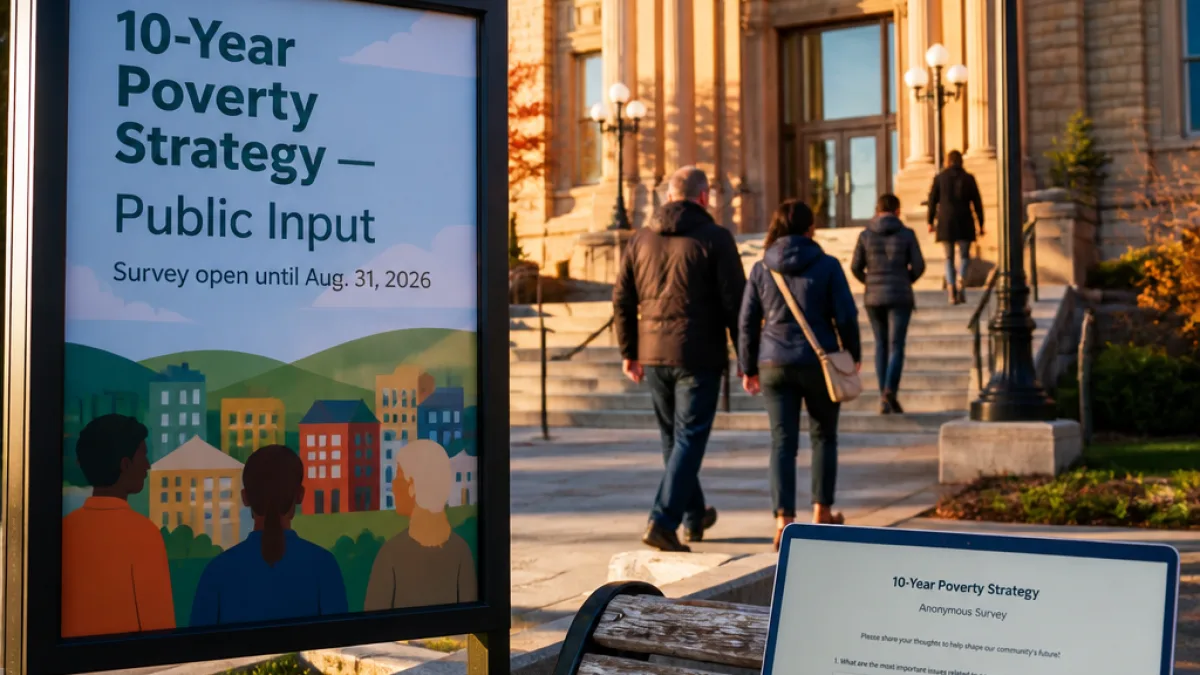
Residents can take part anonymously through an online survey on the EngageNL platform. The government says the survey takes roughly five minutes to complete. Written submissions are also accepted by email or by mail. The deadline for online and written submissions is Aug. 31, 2026.
- Online survey: EngageNL (anonymous, ~5 minutes)
- Email submissions: [email protected]
- Mail: Poverty Reduction and Prevention Strategy, Department of Social Supports and Well-Being, Confederation Building, P.O. Box 8700, St. John's, NL A1B 4J6
The government stated feedback from face-to-face sessions, online responses and written submissions will be used together to ensure the strategy reflects regional differences and the lived realities of people across the province.
"Reducing and preventing poverty begins with listening. Every voice, every experience and every perspective shared through these consultations will help shape a practical, inclusive strategy that reflects the needs of people and communities throughout Newfoundland and Labrador. I encourage everyone to take a few minutes to participate and help us build lasting solutions that create brighter futures for all of us."
The quote is attributed to the Honourable Joedy Wall, Minister of Social Supports and Well-Being and Minister of Poverty Reduction.
What the plan is meant to achieve
Budget 2026 names the 10-year strategy as a central plank of the province's approach to social supports. The stated goals are to reduce poverty, prevent people from falling into poverty and improve long-term outcomes for individuals, families and communities. Officials say a multi-year plan should allow more consistent programming and measurement than short-term initiatives.
Exact policy measures have not been released. The government is framing this phase as information-gathering: compiling lived experience, regional perspectives and service-provider input to inform concrete actions later in the process.
Where this matters locally
Poverty in Newfoundland and Labrador has regional contours: rural and remote areas, in particular, face challenges linked to distance from services, transportation costs, and labour market limitations. Urban centres have their own pressures, including housing affordability and service demand. The government’s consultations across the province aim to capture those variations.
| What was done | Where | Next steps |
|---|---|---|
| Public engagement sessions | Corner Brook; Stephenville; Rocky Harbour; Carbonear; Grand Falls-Windsor; Gander; Bonavista; Clarenville; Marystown | Additional sessions through August and into fall to be announced |
| Online survey and submissions | Province-wide | Submissions accepted until Aug. 31, 2026 |
For many community groups and front-line service providers, the promise of a longer-term approach is welcome but raises questions about measurable targets, funding levels and how progress will be reported. Those specifics will depend in part on the feedback gathered in this consultation phase.
Anyone interested in contributing is encouraged to use the online survey or contact the department directly. With the deadline approaching, officials say now is the time for residents to make their voices heard.