Alberta’s roadside attractions are not just kitsch for the camera — several of them hold world records and represent local history, culture and geology. Scattered across the province are a massive glacial boulder, an imposing Indigenous monument and a monument to Ukrainian cuisine, each with a story that explains how it came to stand out.
Big Rock: a glacial traveller
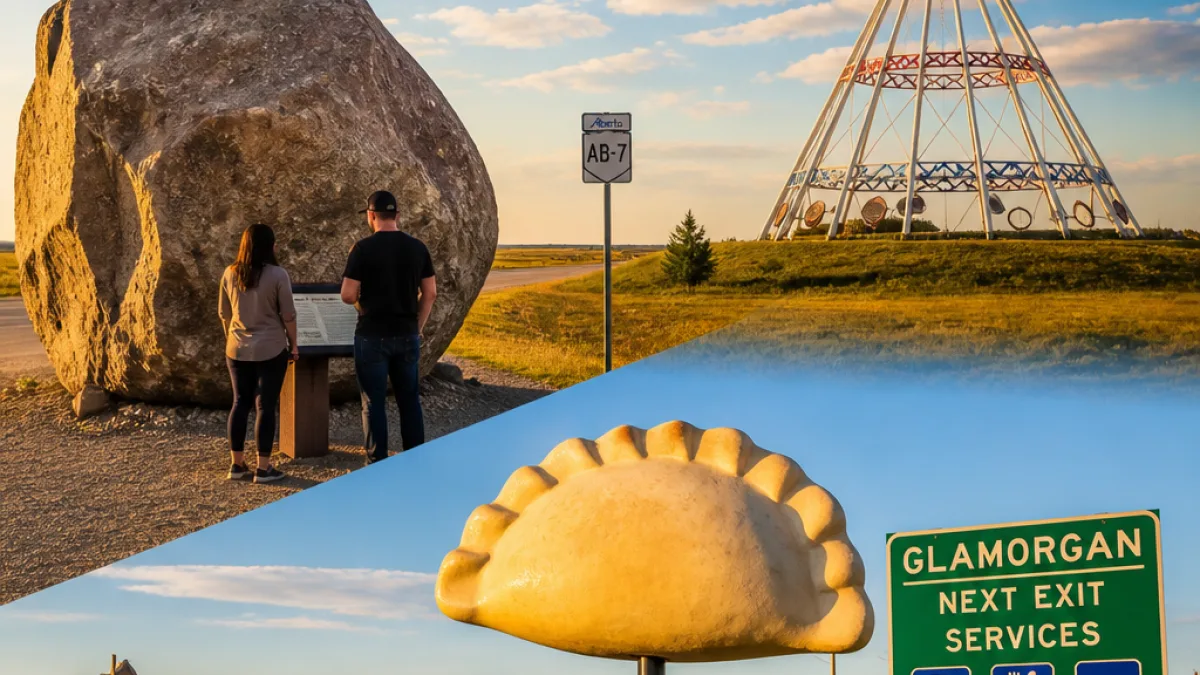
The Okotoks Erratic, commonly called Big Rock, is a quartzite boulder estimated to weigh about 16,500 tonnes. Scientists say the rock was transported by ice during the last Ice Age and dropped hundreds of kilometres from its source as glaciers retreated. The erratic is recognised as the largest known glacial erratic in the world, and visitors can stand beside it to appreciate its scale and the geological forces that moved it.
Its location along AB‑7 in Foothills County makes Big Rock accessible to travellers between Calgary and Okotoks. The site is a quiet place for short visits where people often pause to take photographs and to reflect on Alberta’s deep natural history.
Saamis Tepee: a towering cultural symbol
In Medicine Hat, the Saamis Tepee rises to about 215 feet, giving it the title of the world’s largest teepee. The structure was originally created for the 1988 Winter Olympics in Calgary as a tribute to Indigenous histories and art, and it was moved to Medicine Hat in 1991. The exterior is composed of multiple large panels of artwork, each representing stories and traditions connected to the local Indigenous communities.
The teepee is visible to drivers approaching the city from the main highway. Visitors can walk around the base to view the artwork and to consider its role as a public monument acknowledging Indigenous presence in the region.
Glendon Perogy: a towering taste of Ukrainian heritage
In northeastern Alberta, the town of Glendon commemorates its cultural roots with a 25-foot tall perogy. Built in 1991, this oversized dumpling acknowledges the significance of Ukrainian heritage in the region. The community organises an annual Perogy Festival that celebrates music and traditional food, drawing residents and visitors together for local cuisine and entertainment.
What to know before you go
- These landmarks vary from geological formations to cultural monuments; wear appropriate footwear for short walks and outdoor conditions.
- Respect signage and any protective barriers, especially at natural sites such as Big Rock, to preserve both the landmark and visitor safety.
- When visiting cultural sites such as the Saamis Tepee, observe and respect any interpretive information and consider local context and protocols.
- Check local municipal or tourism websites for seasonal access and any event schedules, such as Glendon’s Perogy Festival.
At-a-glance comparison
| Landmark | Record | Notable figure | Location |
|---|---|---|---|
| Okotoks Erratic (Big Rock) | Largest glacial erratic | ~16,500 tonnes | AB‑7, Foothills County |
| Saamis Tepee | World’s largest teepee | 215 feet | Medicine Hat (32 Eagle Birth Rd. SW) |
| Glendon Perogy | Large novelty perogy | 25 feet | Perogy Park – Hwy‑882, Glendon |
These three attractions illustrate how Alberta’s identity is shaped by its land and the communities that live on it. Big Rock speaks to the province’s prehistoric past and the dramatic shifts wrought by ice; the Saamis Tepee recognises Indigenous presence and artistic expression; the Glendon Perogy reflects the cultural pride of immigrant communities and the way food can anchor local celebration.
Visiting these sites offers more than a photo opportunity. They are entry points into conversations about geology, heritage and community memory. For travellers mapping a drive across Alberta, these stops provide varied perspectives on what the province values and chooses to commemorate in public spaces.
Whether you are tracing the path of ancient glaciers, exploring Indigenous art installations, or sampling local festivals that honour immigrant traditions, Alberta’s record-holding landmarks make for memorable, educational and distinctly Albertan stops on any road trip.