
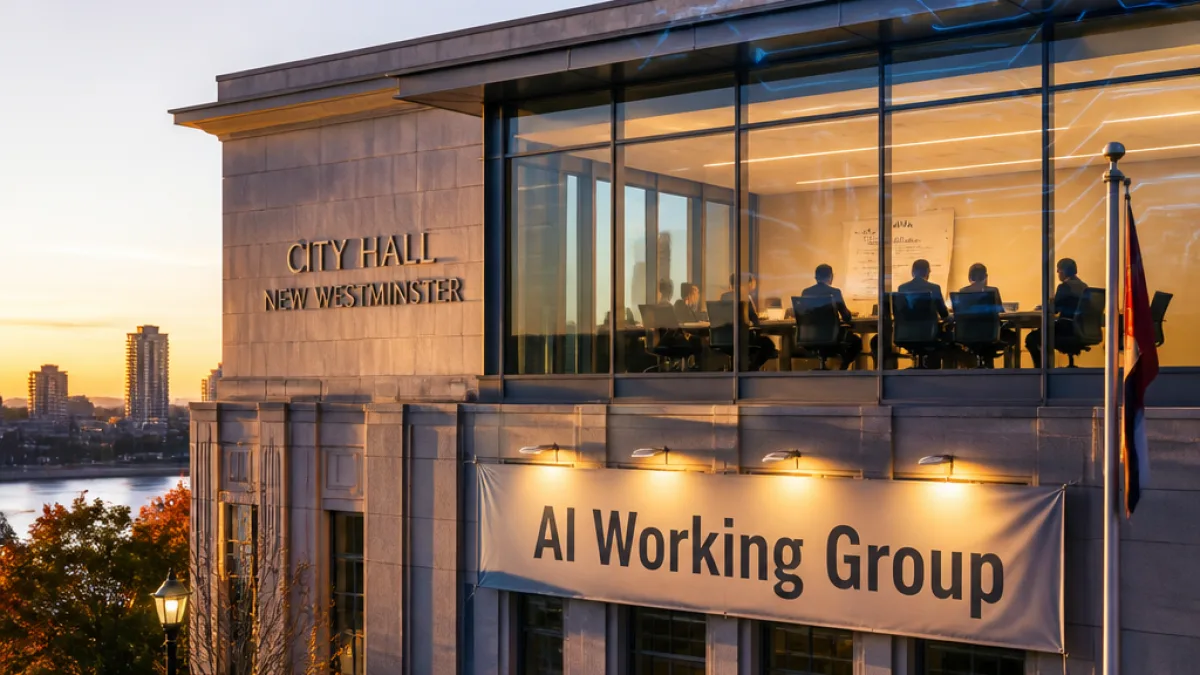
The City of New Westminster has established an AI working group and published early guidance for staff, contractors, volunteers and elected officials as municipal leaders confront the rapid spread of generative artificial intelligence platforms.
City report flags rapid growth, limited monitoring tools
A report received by council on July 13 said publicly available generative AI (GenAI) platforms have “surged” since their emergence in late 2022 and 2023 and that there are now more than 15,000 GenAI platforms and tools online, with new tools launching daily. City staff told councillors the municipality currently lacks the specific tools to produce detailed reports on city devices’ interactions with GenAI services.
“At this time, the city does not possess the specific tools that would allow for meaningful, detailed reporting on the use of GenAI platforms by city staff, contractors, volunteers and students,” the report states. IT staff said they can gather only high-level insights indicating some staff are using GenAI tools on corporate devices.
Why the city is acting now
Staff argued that avoiding interaction with AI prompts is increasingly difficult because major internet search platforms and software vendors are embedding large language models and conversational AI into standard services and applications. The report notes that this trend will intensify as companies such as Google further integrate advanced AI models into traditional web searches and as desktop applications like the Adobe suite add AI features.
The report also lists a series of risks associated with GenAI use, including:
- Data privacy concerns
- Compliance and regulatory violations
- Misinformation and disinformation
- Cybersecurity impacts
- AI bias and discrimination arising from the data on which models are trained
“This will increasingly be the case as Google and other organizations further integrate advanced AI models into traditional web searches,” the report said.
Guidelines and next steps
In response, city staff have developed and published an initial set of guidelines aimed at those working on behalf of the municipality, including the mayor and council. The stated goals of the guidelines are to enhance productivity while enabling safe use of GenAI and to mitigate the risks identified in the report.
The working group will continue to review and refine policies, and staff outlined planned next steps in the report. Those include further assessment of monitoring and reporting capabilities and continued evaluation of vendor-supplied AI features embedded in local applications.
| Issue | Municipal concern |
|---|---|
| Rapid tool proliferation | More than 15,000 GenAI platforms online; new tools daily |
| Monitoring limitations | No specific tools yet for detailed reporting on GenAI use by city accounts |
| Embedded AI features | Search engines and desktop software increasingly integrate AI |
For New Westminster, the new working group and published guidelines mark a transition from awareness to governance. City staff must now balance enabling efficiencies that AI can offer municipal work with protecting residents’ personal information, meeting regulatory obligations and guarding against cybersecurity threats. The approach also acknowledges that blanket bans are increasingly impractical given how pervasive AI features are becoming in widely used services.
Council will receive updates as staff refine their capacity to monitor AI use and as the working group develops further policy recommendations. For residents, the developments mean city services and communications may increasingly be informed by AI-driven tools — but under a framework intended to reduce harms and ensure accountability.