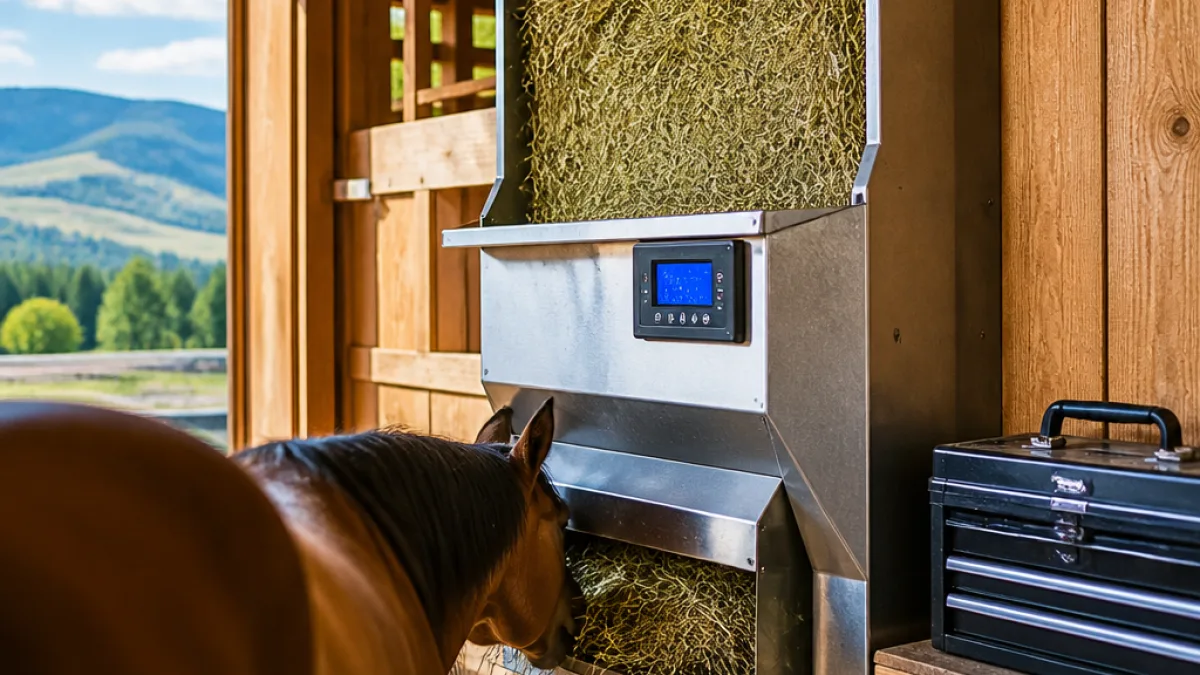
Kelowna entrepreneurs have built a mechanical response to a centuries‑old routine at the barn. Nordic AutoFeed, designed and manufactured in Kelowna, delivers small, scheduled portions of hay to horses up to 12 times per day, aiming to match animals’ natural grazing and to cut manual labour for owners and stable staff.
What the feeder does
The system lets users program a first and last feeding time, total weight of hay to be dispensed and the desired number of daily portions. From those inputs the unit calculates feeding intervals automatically. At each scheduled dispensing a door opens to allow access to hay and a built‑in scale measures consumption, closing the door once the allocated amount has been eaten. A time‑based mode is also available for owners who prefer to control access by minutes rather than weight.
"Horses naturally graze in small amounts throughout the day, but domestic feeding schedules often concentrate their food into two or three meals."
The product was developed as part of a diversification programme led by company founders Kirsten Wiklund and Ashton Shura. The idea evolved from years of horse care and a desire to provide a feeding approach that reduces long intervals without forage while lowering routine labour.
Local production and practical details
From its Kelowna manufacturing facility, Nordic AutoFeed has begun distributing units to customers in British Columbia and Alberta. Each feeder can hold a standard bale of hay — roughly 50 to 70 pounds — and is typically refilled every two to three days, depending on herd size and the programmed rationing.
- Maximum feedings: 12 per day
- Bale capacity: ~50–70 lb
- Refill interval: usually every 2–3 days
- Modes: weight‑based (scale) and time‑based
| Feature | Detail |
|---|---|
| Daily feeds | Up to 12 |
| Bale capacity | ~50–70 lb |
| Refill frequency | ≈2–3 days |
The company pitches the AutoFeed as a tool for owners who want to manage intake more precisely, reduce the peaks and troughs of two‑ or three‑meal schedules, and simplify the physical work of feeding. By automating both portion control and timing, the feeder is presented as supporting better digestive health for horses through more naturalised grazing rhythms.
Scope and ambitions
Nordic AutoFeed has already placed units with customers in B.C. and Alberta. With production rooted in Kelowna, the company is now exploring opportunities to bring its made‑in‑the‑Okanagan approach to international markets, signalling ambitions to scale manufacturing and sales beyond regional distribution.
For Kelowna residents the development underscores a local technology niche that crosses agriculture, animal welfare and manufacturing — an intersection where small‑scale innovation can influence both rural barn routines and regional economic activity.