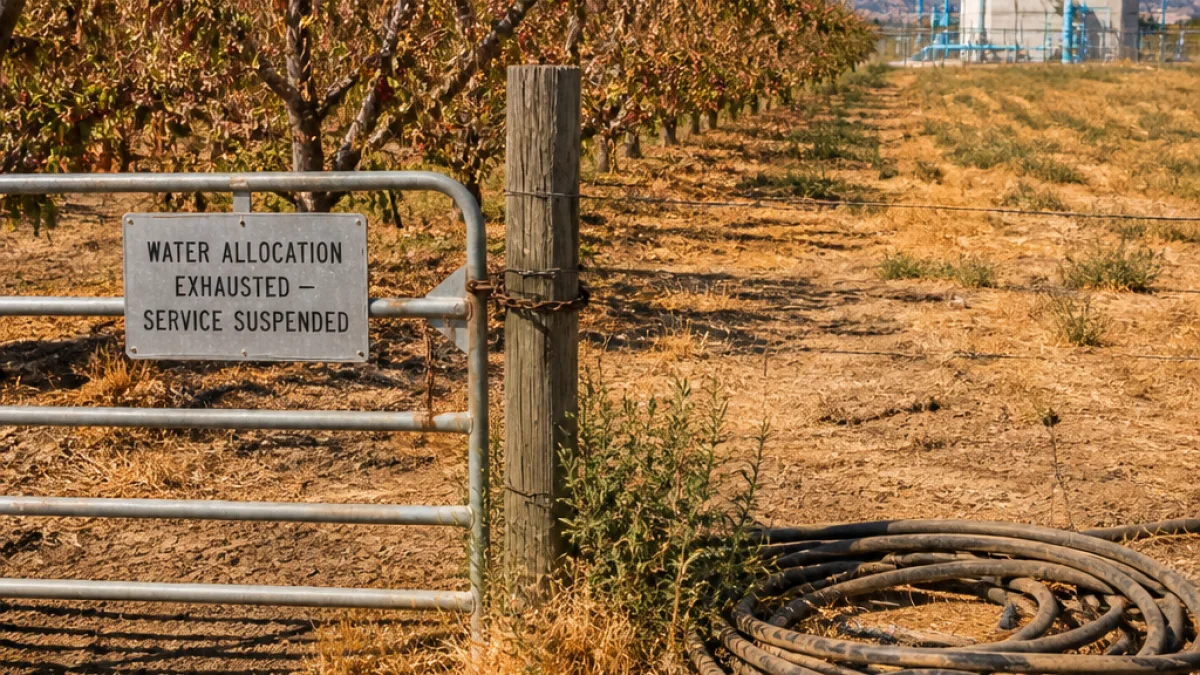
Vernon-area orchardists are urging immediate action after Greater Vernon Water began cutting off agricultural service to properties that have exhausted their reduced seasonal allocations amid a worsening drought.
Growers demand coordinated plan
The BC Fruit Growers’ Association (BCFGA) says the regional approach — reducing agricultural allocations by 70 per cent and terminating service once that allocation is used — was imposed without a coordinated survival plan for affected farms. Many growers received notices by July 13 that their allocations had been reached and water service would be shut off during some of the hottest weeks of the year.
BCFGA president Deep Brar told NEXO RADAR that growers are not disputing the severity of the drought, but are alarmed at the lack of planning for long-term crops such as apples and cherries. The association says the shut-offs affect more than 2,100 acres of orchard land in the Greater Vernon area.
“No one is disputing that the drought is serious, and growers are not asking anyone to deliver water that does not exist. What we are saying is that you cannot simply shut off the water to hundreds of farms and treat it as a routine restriction.”—Deep Brar, president, BC Fruit Growers’ Association
Economic stakes and local impacts
The BCFGA warns of steep economic consequences if mature orchards die. The group estimates more than $250 million in direct losses to orchards, and upwards of $300 million when lost production, packing, trucking, labour and supplier impacts are included. Unlike annual crops, mature orchards represent long-term agricultural infrastructure; mortality would translate into years of lost production and recovery time.
In its public call, the BCFGA urged Greater Vernon Water and the Regional District of North Okanagan to halt the current shut-off policy and immediately establish a coordinated management plan developed with growers and senior provincial government. The association says provincial authorities have tools and resources that a regional district does not, and those should be part of any survival strategy for orchards.
Practical measures stalled, association says
The BCFGA also suggested that practical local measures could mitigate damage but have not advanced quickly enough. The association highlighted Vernon’s own reclaimed water source as a potentially reliable supply that could alleviate pressure on agricultural users if access and infrastructure were prioritised and coordinated.
- Allocation cut: 70 per cent reduction for agricultural water.
- Acreage affected: more than 2,100 acres of apple and cherry orchards.
- Estimated losses: $250 million direct; over $300 million including secondary effects.
| Item | Figure |
|---|---|
| Agricultural allocation reduction | 70% |
| Affected orchard area | More than 2,100 acres |
| Estimated direct economic loss | $250 million |
| Estimated total economic loss (including related sectors) | Over $300 million |
For Vernon residents, the dispute has immediate local consequences. The closure of orchards would not only affect farm owners and seasonal workers but could ripple through packing operations, transport contractors and retail suppliers based in the North Okanagan. The BCFGA emphasised that the loss of established trees is measured in years, not a single season, and warned that the economic shock would radiate through the community.
Greater Vernon Water and the Regional District of North Okanagan have been named in the association’s call for renewed coordination. The BCFGA is asking both bodies to pause enforcement of shut-offs while a collaborative plan with growers and the province is developed to prioritise limited supplies and deploy available alternatives, including reclaimed water.
The association’s appeal arrives as many growers face decisions about irrigation timing, crop protection and long-term orchard survival. With the summer heat intensifying and water availability uncertain, the coming weeks will be critical for owners of Vernon-area orchards and the broader local economy that depends on them.
NEXO RADAR has reached out to Greater Vernon Water and the Regional District of North Okanagan for comment.