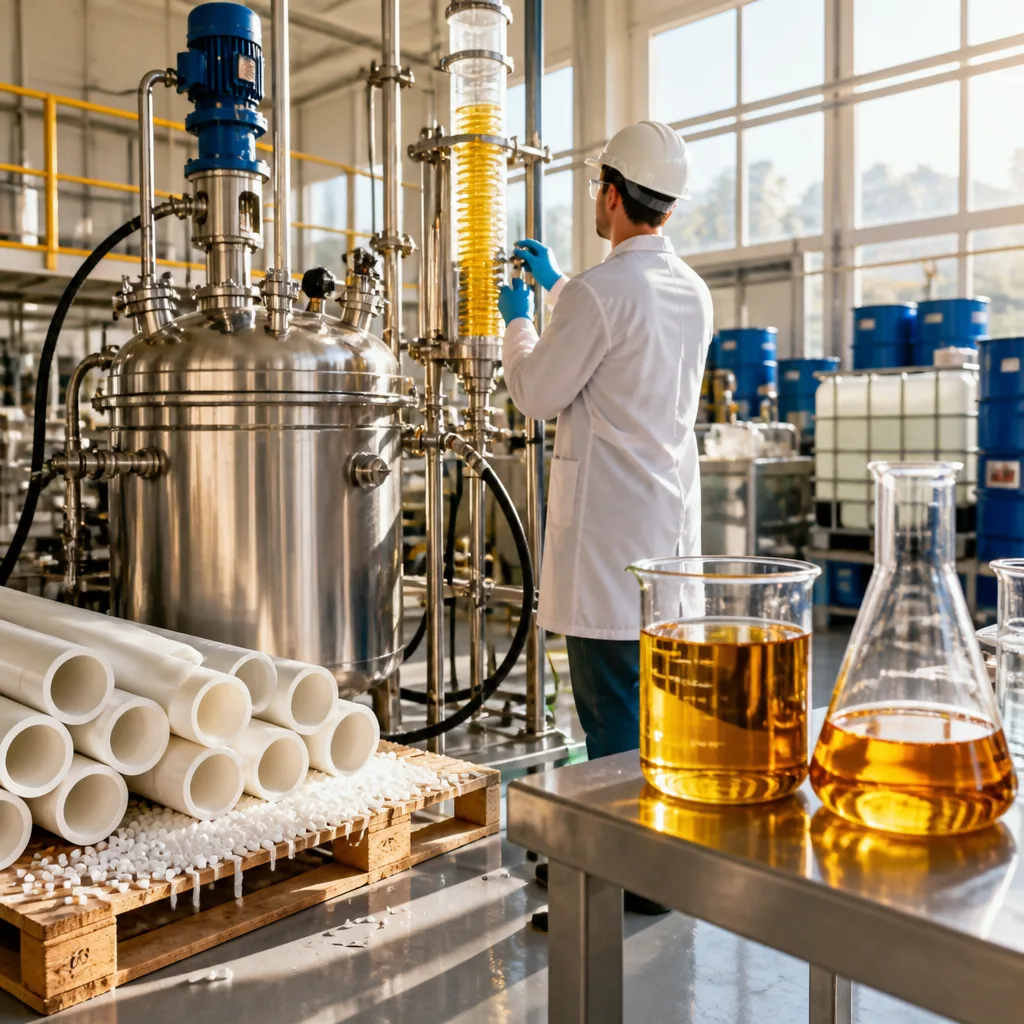
Virginia Tech chemists report a process that turns discarded polyvinyl chloride (PVC) — one of the planet's most difficult-to-recycle plastics — into polyalphaolefin (PAO), a primary building block for synthetic lubricants including engine oil. The results, published Aug. 5 in Nature, propose a new route for turning chlorine-bearing plastic waste into a commercially important industrial material.
From chlorine-laden waste to lubricant feedstock
PVC has long posed a recycling challenge because of its chlorine content and the many additives manufacturers incorporate into products. Those features make PVC incompatible with many conventional recycling streams and have left large volumes destined for landfill. The Virginia Tech team, led by chemists and chemical engineers in the Liu lab, developed a method to remove chlorine atoms from PVC — effectively dechlorinating the polymer — and then convert the dechlorinated carbon backbone into PAO.
The work links two pressing issues: the environmental burden of non‑recyclable plastics and the demand for synthetic lubricant ingredients, which are resource intensive to produce. PAO is widely used in engine oils and other lubrication fluids for vehicles, industrial equipment and aerospace applications, so creating it from waste could reduce pressure on conventional feedstocks.
Technical and environmental context
The Liu lab demonstrated conversion of household‑type PVC items into material that integrates into lubricant formulations. Photographs accompanying the study show lab samples and demonstrations in which PVC objects were transformed into fluids suitable for lubricant testing. The researchers describe the route in the peer‑reviewed paper; the process addresses the key chemical barrier — the polymer’s chlorine content — that has long complicated PVC recycling.
- Challenge: PVC contains chlorine and diverse additives, making standard recycling difficult.
- Innovation: Chemical dechlorination followed by conversion of the carbon chain into PAO.
- Implication: Potential to divert PVC from landfills and create a valuable industrial product.
The researchers emphasise that lubricants are integral to many sectors — from small engines to aerospace — and that stable access to high‑quality lubricant components is important across industries. Converting discarded PVC into a lubricant feedstock could therefore have broad practical value if the approach can be scaled and integrated into existing waste and chemical processing systems.
Limitations and next steps
The publication represents an important proof of concept but does not, by itself, establish an immediate, large‑scale replacement for current recycling or lubricant production practices. Industry adoption would require scale‑up studies, lifecycle assessments and economic analysis to determine whether the process is energy efficient and cost‑competitive once real‑world feedstocks and contaminants are considered.
| Item | Role in the study |
|---|---|
| PVC | Feedstock with high chlorine content; traditionally hard to recycle |
| Polyalphaolefin (PAO) | Target product; key synthetic lubricant component |
If the chemistry proves robust at industrial scale, it could reduce the fraction of PVC entering landfills and provide a higher‑value destiny for that material than current disposal routes. The work also underscores the wider trend in materials science of seeking circular or upcycled endpoints for problematic wastes rather than relying solely on mechanical recycling or incineration.
The study was accompanied by laboratory images showing converted samples and by discussion of potential applications; the authors note that further development is needed before commercial rollout. For now, the paper adds a compelling example of how targeted chemical transformations may help revalorize stubborn plastic waste streams into products with established markets.