
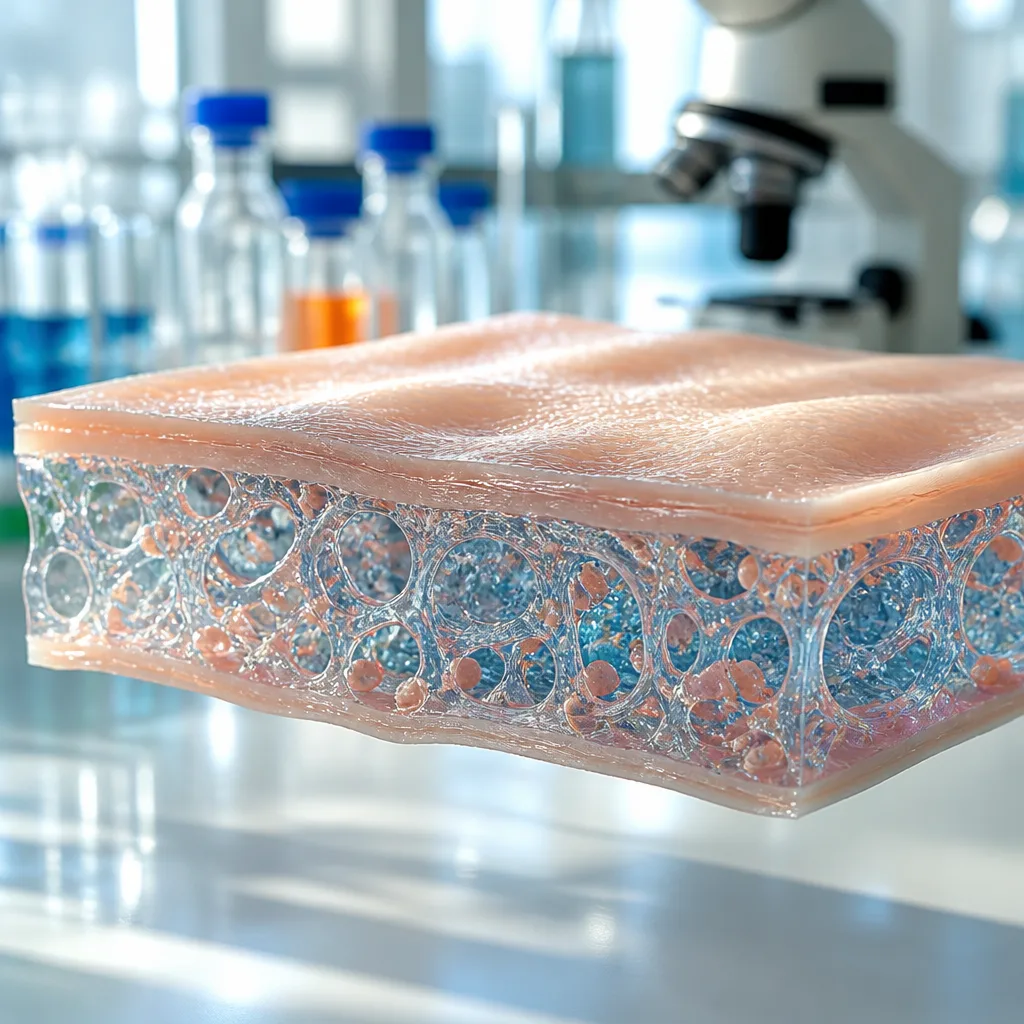
Researchers at the Massachusetts Institute of Technology report a new hydrogel architecture that combines high water content with an interconnected network of air pathways, producing a material that is substantially more permeable to oxygen and water vapour than conventional skin patches.
What the material does
The hydrogel contains a stable, three‑dimensional network of microscopic, air‑filled channels created by dispersing silica aerogel particles into a water‑rich matrix. The particles act as tiny, water‑repellent scaffolds that trap air and help keep the channels open. Despite a retained water content of about 70 per cent, the experimental material achieved an oxygen permeability of up to 185 barrer in laboratory tests — roughly 10 times the permeability of a conventional hydrogel.
In addition to oxygen transport, the hydrogel transmitted water vapour at rates between 10 and 100 times higher than typical silicone and polyurethane patches, enabling better moisture escape from skin during prolonged contact. The researchers also report the material is soft and durable, retaining about 95 per cent of its air permeabilit[y] after handling and testing.
Why it matters
Wearable health sensors, medical patches and wound dressings often rely on hydrogels because they are comfortable and conform to skin. But conventional hydrogels can trap heat and sweat, creating skin irritation, interfering with sensor readings and limiting continuous monitoring. By increasing gas and vapour transport while keeping a high water fraction, the new approach aims to reduce those problems and extend the functional time of devices that need to remain in contact with skin for hours or days.
The new work builds on prior advances in breathable hydrogel sensors. A 2024 study achieved eight days of continuous skin monitoring with a gas‑permeable hydrogel sensor about 10 micrometres thick, reinforced with a polyurethane nanomesh. The MIT team takes a different path — creating an internal, macroscale network of air channels inside a bulk hydrogel rather than relying on ultrathin layers and reinforcing meshes.
Key technical points
- Structure: silica aerogel particles form interconnected air channels within a hydrogel matrix.
- Water content: approximately 70 per cent retained in the hydrogel.
- Oxygen permeability: up to 185 barrer — about 10× higher than conventional hydrogels.
- Water‑vapour transmission: 10–100× higher than silicone and polyurethane patches.
| Property | Reported value |
|---|---|
| Water content | ~70% |
| Oxygen permeability | Up to 185 barrer |
| Water‑vapour transmission | 10–100× vs silicone/polyurethane patches |
Potential applications and limits
The combination of softness, durability and enhanced gas transport could benefit several device categories: continuous wearable sensors that measure biophysical signals, medical adhesives and wound dressings that need to manage moisture, and any skin‑mounted electronics whose performance degrades with trapped heat and sweat.
However, the report describes laboratory characterizations rather than clinical trials or long‑duration wearable deployments. The 2024 study cited in the research showed eight days of continuous monitoring using a different type of gas‑permeable hydrogel. The MIT approach may offer a route to similar or better monitoring times in bulk materials, but further work will be necessary to confirm biocompatibility, long‑term stability on skin and manufacturing scalability.
For Canadian researchers and companies in medical devices and health technologies, the design strategy — using inert, air‑trapping particles to stabilise channel networks inside hydrogels — could be of immediate interest. If the material translates from lab benches to practical products, it would address a persistent trade‑off between hydration and breathability that limits many current wearable systems.
The study, led by an MIT team, was published in Nature in 2026 and details the lung‑inspired air‑carrying architecture that yields the reported permeability gains.