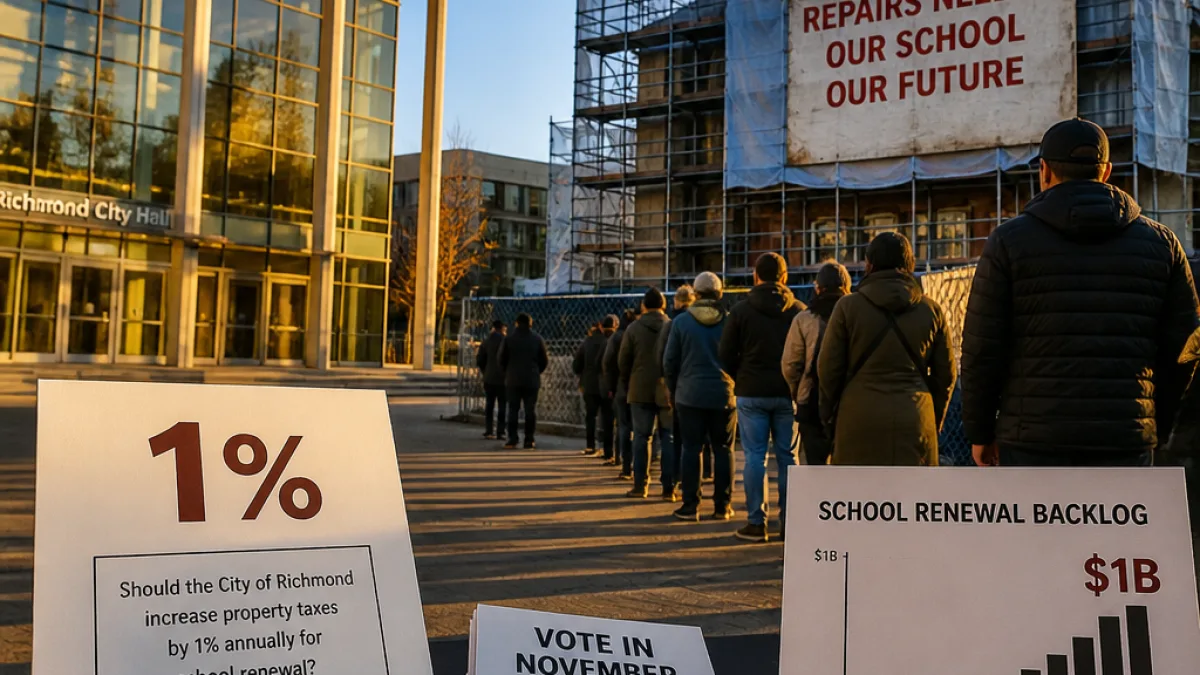
Richmond leaders announced Thursday they will ask voters in November to approve a 1 per cent sales tax dedicated exclusively to school construction and repairs, a bid to confront what school officials describe as a roughly $1 billion backlog of work across the district.
What officials are proposing
The proposal, revealed at a joint news conference with Mayor Danny Avula, Richmond Public Schools superintendent Jason Kamras and members of city council and the school board, would direct revenues from the new sales tax solely to capital projects in school buildings. City officials say the tax would not apply to groceries and medicine, in line with recent state-level changes that permit localities to adopt the levy only by voter approval and only for school construction or repairs.
City estimates presented at the announcement show the tax would raise an estimated $47.5 million in its first year and increase the city's borrowing capacity so more projects can be undertaken sooner. Mayor Avula told reporters that the additional revenue would enable the city to make approximately $850 million in school capital investments between 2028 and 2034, roughly doubling what current plans would deliver in the near term.
Needs on school campuses
Superintendent Kamras outlined the scale and nature of the problems the funds are meant to address: leaking roofs, heating, ventilation and air conditioning systems that underperform in extreme weather, crumbling facades and the presence of asbestos in some buildings. He said the new funding stream would allow repairs that will reach students who are currently enrolled.
"At minimum, it's a billion-dollar challenge that we face," Kamras said. "Roofs that leak, HVAC systems that don't provide as much cooling as we'd like when it's warm and as much warming as we like when it's cold. We have asbestos in some buildings. We have facades that are crumbling."
Budget context and offsets
Leaders also announced a move intended to partially address an existing operating shortfall in the school division, citing an $8.9 million gap. City officials said they plan to pair the new sales tax with offsetting reductions in other local levies — specifically cuts to the meals tax and property taxes — if voters approve the measure. Details of those cuts have not been finalised pending the referendum result.
- Proposed levy: 1 per cent local sales tax for school capital
- First-year revenue estimate: $47.5 million
- Estimated capital capacity 2028–2034: $850 million
- Documented shortfall: $8.9 million in the school operating budget
City Council president Cynthia Newbille framed the choice as one for residents to consider: the state budget change that took effect July 1 created the option for localities to levy such a tax, but only if voters approve it in a referendum. Newbille said the measure gives Richmonders a chance to decide on a different path to address persistent capital needs.
Implications for students and taxpayers
Officials stressed the priority is to accelerate repairs so students currently in district schools will see improvements within their years in the system. They say that by increasing borrowing capacity, more projects can be scheduled and completed sooner than under the existing capital plan.
At the same time, the proposal asks residents to weigh a new consumption levy against promised reductions in other local taxes. The city has not finalised the precise structure or timing of any offsetting cuts; those would be developed if and when the sales tax referendum is approved by voters.
| Item | Amount |
|---|---|
| First-year revenue estimate | $47.5 million |
| Estimated capital available (2028–2034) | $850 million |
| Documented operating shortfall | $8.9 million |
With the referendum set for the November ballot, officials will now move into public engagement and the technical steps required to place the question before voters. If approved, the measure would create a new, dedicated revenue stream for school capital projects while prompting subsequent decisions about adjustments to the city's other tax rates.
The decision puts an onus on Richmond voters to balance near-term tax choices with longer-term investments in school infrastructure, a debate that will unfold over the coming months as more details and project priorities are developed.