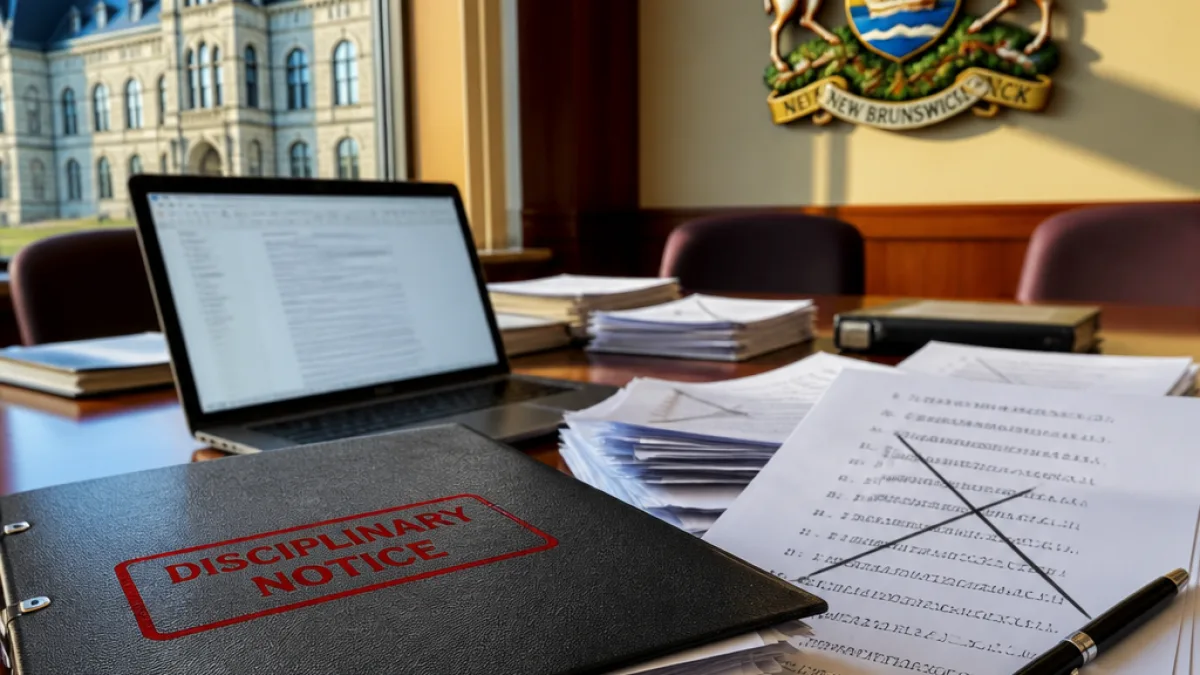
The Law Society of New Brunswick has launched disciplinary proceedings after alleging a lawyer submitted a legal brief containing largely fabricated case citations — a development that has provoked wider debate about the use of generative artificial intelligence in the legal profession.
Allegations and response
According to a public notice from the regulator, in April a lawyer identified as Denis Sawyer filed a brief in which 10 of 12 citations were fictitious. The notice says Mr. Sawyer later filed a corrected brief removing almost all of the false citations except two. In a response filed in July, the lawyer reportedly admitted the facts set out in the notice and accepted "full responsibility for my oversight." The matter is scheduled for a hearing next month.
Experts say the problem is not AI itself but how it is used
Legal scholars and practitioners in Canada have been watching such incidents closely. While many see potential benefits in applying AI to legal work — from faster document review to improved access to research — experts caution that the technology can introduce serious errors when used improperly.
"Using AI is not unethical in itself. What is unethical is using AI incompetently,"
said Norman Siebrasse, a professor at the University of New Brunswick's faculty of law. His observation reflects a growing consensus in legal circles that due diligence and verification must remain the responsibility of the lawyer, regardless of whether an assistant was human or algorithmic.
"When a lawyer is submitting material to court, the buck stops with that lawyer, whether or not they receive help from a human or a technology tool,"
added Amy Salyzyn, a law professor at the University of Ottawa.
Rising number of cases involving AI-fabricated materials
Data compiled by a justice watchdog, Courtyready, shows a marked increase in judicial decisions addressing AI-fabricated legal materials. The contrast over recent years is stark and suggests the problem has escalated rapidly.
| Year | Recorded decisions involving AI-fabricated materials |
|---|---|
| 2024 | 7 |
| 2025 | 87 |
| First half of 2026 | 74 |
Practical implications for lawyers and courts
The Sawyer case in New Brunswick is illustrative of several practical challenges. First, courts rely on accurate citations to situate arguments within precedent; fabricated or erroneous citations can waste judicial time, mislead decision-makers and undermine confidence in filings. Second, regulators must now consider how existing professional conduct rules apply when technology is used to prepare materials.
Professors and practising lawyers say the solution is not banning AI tools but ensuring robust human oversight. That includes:
- Verifying every authority and citation generated or suggested by AI;
- Maintaining clear records of how AI tools were used in preparing submissions;
- Adopting office protocols and training to prevent over-reliance on unverified outputs.
Ethics and education
Academics note that legal education and continuing professional development must adapt. As one law professor observed, AI can increase access to legal research and streamline routine tasks, but only if lawyers retain the competence to spot errors and to validate sources. The risk is not only incorrect citations; researchers also warn about hallucinated factual assertions, mistaken summaries of law and the potential for biased or incomplete results.
Regulatory and systemic questions
The disciplinary hearing next month will examine whether the conduct alleged in the public notice breaches professional standards. Beyond the individual case, regulators across Canada are grappling with how to update guidance and enforcement to reflect the growing use of generative AI. Some jurisdictions are considering specific rules on disclosure of AI use in court filings and on recordkeeping when technology assists legal work.
For litigants and the public, this episode underscores that technological tools are only as reliable as the professionals who use them. As courts encounter more AI-related errors, the legal community faces pressure to build safeguards that preserve accuracy, protect client interests and maintain public confidence in the justice system.
The Sawyer matter will be watched closely by lawyers across the province and beyond as a test case in how the profession adapts to new tools while upholding long-standing duties of competence and candour to the court.