FREDERICTON — New Brunswick law enforcement agencies report they intercepted more than 4.3 million contraband cigarettes during three separate investigations over a four-week period in May and June, part of an intensified provincial campaign against illicit tobacco and cannabis sales.
Scope of the seizures and arrests
Officials with the province's Justice and Public Safety Department said the recent operations were carried out by the department's Inspection and Enforcement Branch together with multiple policing partners. The investigations led to the seizure of cigarettes, vehicles and weapons, along with the arrest of four people.
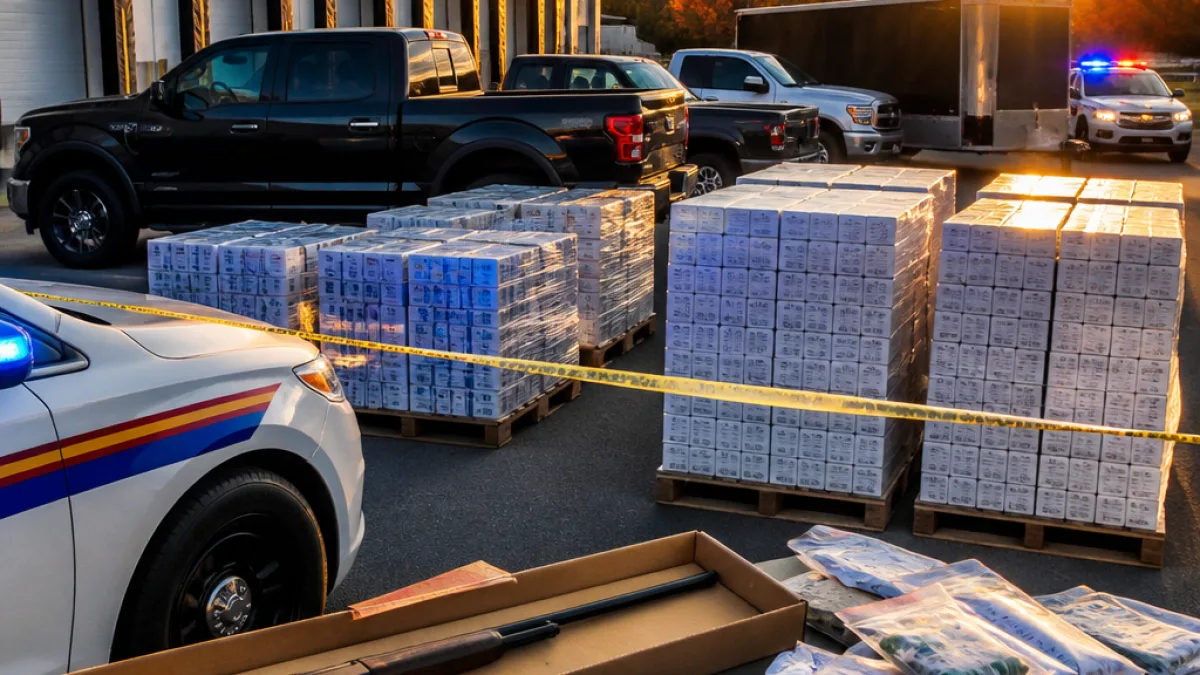
Authorities say the items seized in the cases include three pickup trucks, an enclosed cargo trailer, cannabis products and a Remington 12-gauge shotgun, in addition to the contraband tobacco. Three of those arrested are residents of New Brunswick; one is a 32-year-old from Ontario. They face charges under the Criminal Code as well as federal excise and tobacco tax laws.
"The illegal tobacco trade is often connected to organized crime and other criminal activity that can threaten the safety and well-being of our communities," Public Safety Minister Robert Gauvin said at a Fredericton news conference. "When law enforcement disrupts these operations, they are not only taking illegal products off the streets — they are helping to address broader criminal networks and protect New Brunswickers."
Tax revenue and provincial context
Authorities estimate the contraband cigarettes seized during the May–June operations represent approximately $1.1 million in lost tax revenue. For the calendar year to date, the branch says it has confiscated more than 8 million illegal cigarettes, with missed tax revenues totalling about $3.72 million for federal and provincial coffers.
Those figures mark a substantial increase from the previous year's enforcement totals. In 2025, the branch reported seizing 2,270,675 illicit cigarettes.
| Period | Contraband cigarettes seized | Estimated missed tax revenue |
|---|---|---|
| May–June 2026 (three investigations) | 4.3 million | $1.1 million |
| 2026 year to date | 8 million+ | $3.72 million |
| 2025 (full year) | 2,270,675 | — |
Why enforcement has increased
The heightened activity follows a provincial Liberal government decision to increase funding for efforts targeting illegal tobacco and cannabis distribution. Officials say the aim is twofold: to remove untaxed, illicit products from circulation and to disrupt the criminal networks that profit from those markets.
Enforcement actions of this kind typically involve co-ordination across municipal, provincial and federal agencies. The department's statement notes cooperation with other jurisdictions, though it did not specify which police forces participated in the recent operations.
Community impact and public safety concerns
Officials stress that contraband tobacco is not merely a fiscal issue. The sale and distribution of illegal tobacco have been linked to broader criminal activity, and removal of those products is presented as a public-safety measure as much as a revenue-protection effort.
For consumers and small businesses, the immediate effects include disruption of illicit supply chains and the potential for prosecutions that could result in fines or other penalties. For law-abiding retailers who collect and remit tobacco taxes, authorities say enforcement helps level the playing field.
- More than 4.3 million contraband cigarettes seized in three investigations during May–June.
- Over 8 million illegal cigarettes seized in New Brunswick so far in 2026.
- Four arrests; seizures included vehicles, a trailer, cannabis products and a shotgun.
What happens next
The people arrested face charges under the federal Criminal Code, the Excise Act and the Tobacco Tax Act. Court dates and further details about the charges were not provided in the department's release.
Investigators say enforcement will continue, bolstered by the additional provincial funding announced earlier this year. Officials also urged members of the public to report suspected illegal tobacco or cannabis activity to local police or the province's enforcement branch.
As the investigations proceed, the seizures underline both the scale of illicit tobacco entering the province and the government's renewed focus on disrupting those operations.