Quebecers seeking non‑urgent medical advice by phone are facing far longer waits to reach a nurse on the Info‑Santé 811 line, according to recent performance figures from Santé‑Québec.
Rising waits, acute summer peaks
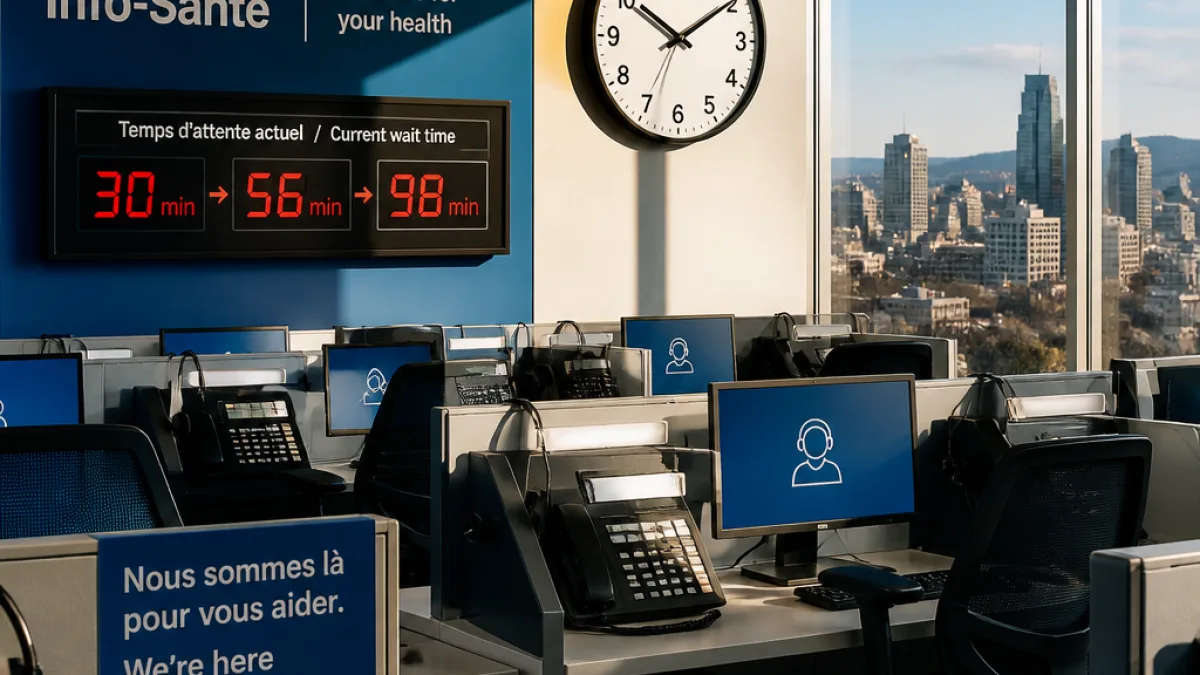
Average wait times have been increasing steadily: callers waited an average of 30 minutes in 2022, and that figure had risen to roughly 56 minutes in 2025, Santé‑Québec data show. This summer the situation worsened, with the average time to speak to a nurse reaching a peak of 98 minutes on July 14, and remaining elevated at 87 minutes on July 25.
Santé‑Québec has acknowledged the pressure, attributing the deterioration to staff shortages and a higher volume of incoming calls.
Personal experiences underline the strain
For some people the delays are more than an inconvenience. Camille Racine, a 72‑year‑old resident of Lac‑aux‑Sables in the Mauricie region who does not have a family doctor, described a recent call in which he waited about 15 minutes before someone answered and was then put back on hold.
"It's awful because you wait about 15 minutes before someone answers," Racine said. "But then you're put on hold."
He later spent nearly two hours speaking with three different people to try to obtain an appointment, only to be told they could not help because it was late in the day and no appointments were available.
Language disparity and service barriers
Performance indicators also show a disparity for English‑language callers: on average, callers who request service in English wait about 10 minutes longer than those calling in French. That gap further complicates access for anglophone users in the province.
What the numbers look like
| Year / Date | Average wait time |
|---|---|
| 2022 (annual average) | 30 minutes |
| 2025 (annual average) | 56 minutes |
| July 14 (peak) | 98 minutes |
| July 25 | 87 minutes |
Practical implications for callers
Info‑Santé 811 is intended for non‑urgent health advice. The current wait times mean callers without a family physician or with time‑sensitive but non‑emergent concerns may experience significant delays in getting guidance. In some cases, callers are transferred between multiple staff members without a resolution, increasing frustration and uncertainty.
- Expect longer waits than in previous years; peak days can approach or exceed 90 minutes.
- English‑language callers typically face additional delay — roughly an extra 10 minutes on average.
- Those with urgent or life‑threatening symptoms should seek immediate emergency care rather than relying on a telephone advice line.
Systemic pressures and context
Health authorities across the province have been grappling with workforce shortages in multiple areas, a reality Santé‑Québec points to as a key factor behind the performance decline on the 811 line. Higher demand for telephonic services since the pandemic has also placed extra strain on staffing and scheduling.
The combination of staff shortages and rising call volumes has practical consequences beyond wait times: callers may face longer total call durations, multiple handoffs between staff, and difficulty arranging same‑day appointments when needed.
What to watch next
Improving access to primary care and stabilizing health‑system staffing are longer‑term solutions that provincial authorities and health‑system managers will need to address. In the short term, performance indicators published by Santé‑Québec will be a key metric to monitor whether the 811 line’s wait times return to more acceptable levels and whether measures to shore up staffing and call handling are effective.
For now, callers to Info‑Santé 811 should be prepared for a wait and consider alternate options if they need immediate, in‑person assessment.