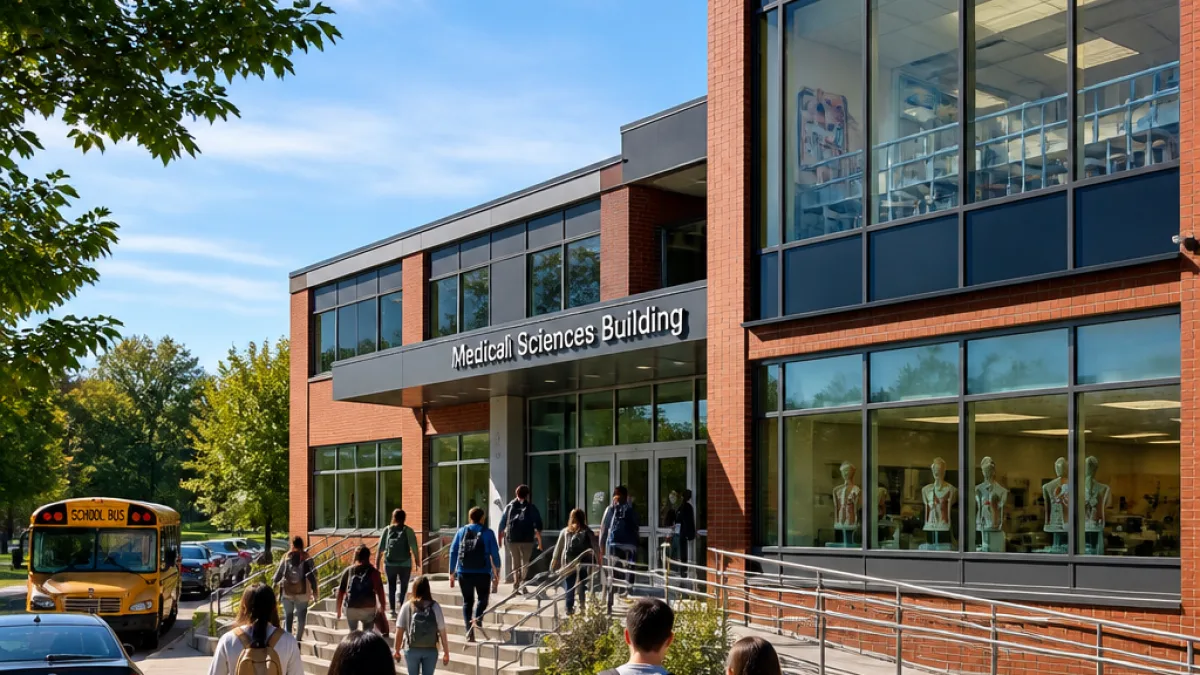
SYDNEY, N.S. — Students at the Cape Breton Medical Campus (CBMC) moved into a new medical sciences building on Aug. 24 as the program expands its intake, a provincial investment aimed at producing more family physicians for rural communities across Nova Scotia.
Facility and enrolment milestone
The new building is the cornerstone of the partnership between Dalhousie University’s Faculty of Medicine and Cape Breton University. It provides modern learning space, including a full anatomy laboratory, a clinical simulation centre and connected classrooms equipped with advanced technology.
Thirty students began classes in the new facility this week, joining the inaugural cohort to bring the campus’s total first- and second-year enrolment to 60. The first cohort started last August in a temporary location at the former Nova Scotia Community College campus while construction was completed.
Provincial goals and rural focus
The provincial government has framed the expansion as part of a strategy to improve access to healthcare in rural areas. Admissions at the CBMC prioritise qualified Nova Scotia applicants with lived experience in rural communities. Students admitted to the program sign return-of-service agreements, committing to practise family medicine in rural parts of the province after graduation.
“Our government is making sure Nova Scotians in rural communities have reliable access to the healthcare they need, close to home,” Premier Tim Houston said. “By training more doctors in Cape Breton and prioritizing students with rural experience, we are helping build a stronger pipeline of physicians who understand these communities and are committed to serving them. This new medical sciences building is a critical step toward better care for families across Nova Scotia.”
Training amenities and hands-on learning
Officials highlighted the building’s features as central to the campus’s educational mission: high-tech classrooms to enable remote and collaborative learning across sites, a dedicated anatomy lab for dissection and study, and a clinical simulation centre that allows students to practice clinical skills in realistic scenarios before encountering patients.
Brian Wong, Nova Scotia’s Minister of Advanced Education, said the facility gives future doctors the space and technology needed for hands-on training and supports the province’s investment in homegrown medical talent.
What this means locally
For Cape Breton and other rural communities, the immediate effects are twofold: more medical students training in the region and a formal emphasis on recruiting students with rural backgrounds who are more likely to return to those communities to practise. The return-of-service model aims to convert training capacity into staffing capacity for family medicine in underserved areas.
- New building: full anatomy lab, clinical simulation centre, connected classrooms
- Enrolment: inaugural cohort + new first-year students = 60 learners
- Admissions priority: Nova Scotia applicants with rural experience
- Return-of-service: graduates commit to practising family medicine in rural Nova Scotia
Numbers at a glance
| Item | Figure |
|---|---|
| First-year students (2026 intake) | 30 |
| Total students at CBMC (first + second year) | 60 |
Context and next steps
The CBMC is part of a broader effort to expand medical training capacity in Nova Scotia. Placing students in rural settings and encouraging recruitment from rural areas are approaches provincial officials say will help relieve long-standing shortages of primary-care physicians outside urban centres.
Operational details such as the timing of future intake increases, clinical placement partnerships with local health providers, and how provincial workforce planning will track where graduates ultimately practise were not detailed in the release announcing the building opening. For communities in Cape Breton and across rural Nova Scotia, the key measure will be whether these investments translate into more family doctors working close to home.
The new facility offers a visible and immediate enhancement to local medical education. For the students beginning their studies this week, it also represents the start of a training pathway explicitly tied to serving rural Nova Scotian families—an ambition the province says is critical to building a more resilient health-care system.
Reporting from Sydney.