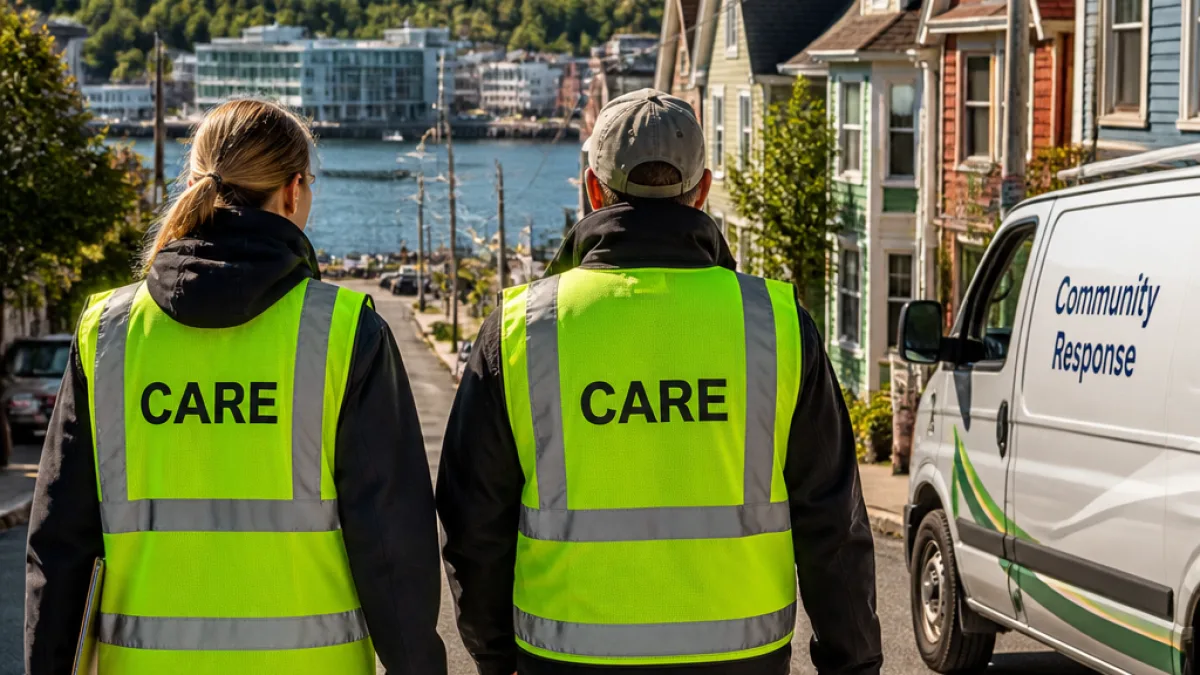
The Halifax Regional Municipality has expanded the community-led Crisis Assistance and Response service — known as CARE — to cover the entire Halifax peninsula, officials announced this week. The move is the program’s third expansion in less than a year and broadens an alternative to police responses for non-urgent calls related to mental health, substance use and basic needs such as food and housing.
From pilot to peninsula
CARE began as a pilot in October 2025 in Dartmouth. It moved to a 24-hour operation in January and saw further growth in March when it began handling calls in Halifax’s north end and waterfront areas. The latest change brings the service to the whole peninsula, meaning residents across central Halifax will be able to access the alternative response team for qualifying concerns.
The program is run under the municipality’s community safety team as part of its broader public-safety strategy. Calls are routed through 211 Nova Scotia, where the appropriate type of support is determined before CARE is dispatched.
“We have calls that we can’t respond to because they are outside the service area,” said Bamidele Bello, alternative response manager for Halifax’s community safety team. “So having reviewed team capacity and the need for the service, we think we can accommodate this expansion.”
What CARE offers and what it changes
CARE responds to non-emergency situations where people are experiencing mental-health challenges, struggling with substance use, or facing food and housing insecurity. The model provides a community-based alternative to police attendance for such incidents, emphasising care, de-escalation and connection to supports rather than criminal enforcement.
- Scope: Non-urgent calls related to mental health, substance use, food and housing needs.
- Access: Calls assessed through 211 Nova Scotia determine if CARE is appropriate.
- Oversight: Operated by Halifax’s community safety team, as part of municipal public safety planning.
Timeline of the program
| Month | Development |
|---|---|
| October 2025 | CARE launched as a pilot in Dartmouth |
| January 2026 | Expanded to 24-hour service |
| March 2026 | Coverage extended to Halifax north end and waterfront |
| August 2026 | Expansion to the whole Halifax peninsula announced |
For residents, the extension could mean fewer instances of police attendance at non-violent mental-health or social-crisis calls, and faster connections to community resources. For the municipal team, it represents a scaling of capacity and coverage that had been constrained by geographical limits earlier in the pilot.
Community-based crisis response models like CARE are intended to provide specialised, non-police support and to reduce the burden on emergency services. The program’s oversight within the municipality signals a deliberate local approach to public safety, integrating social supports and crisis intervention into the broader response system.
Officials said the decision to expand followed a review of team capacity and evident community need. As CARE’s footprint grows, municipal leaders and the community safety team will be watched closely to see how the service performs across a denser urban area and whether it reduces escalations, provides timely supports and integrates smoothly with 211 and other local services.
Residents seeking assistance for non-emergency mental-health concerns, substance use issues, or urgent needs for food or housing should continue to use 211 Nova Scotia, where staff assess and direct calls to the appropriate response — which now may include CARE on the Halifax peninsula.
This expansion marks a significant step in Halifax’s experiment with alternative crisis responses, one that will shape how the city balances public safety, health and social support systems in the months ahead.