
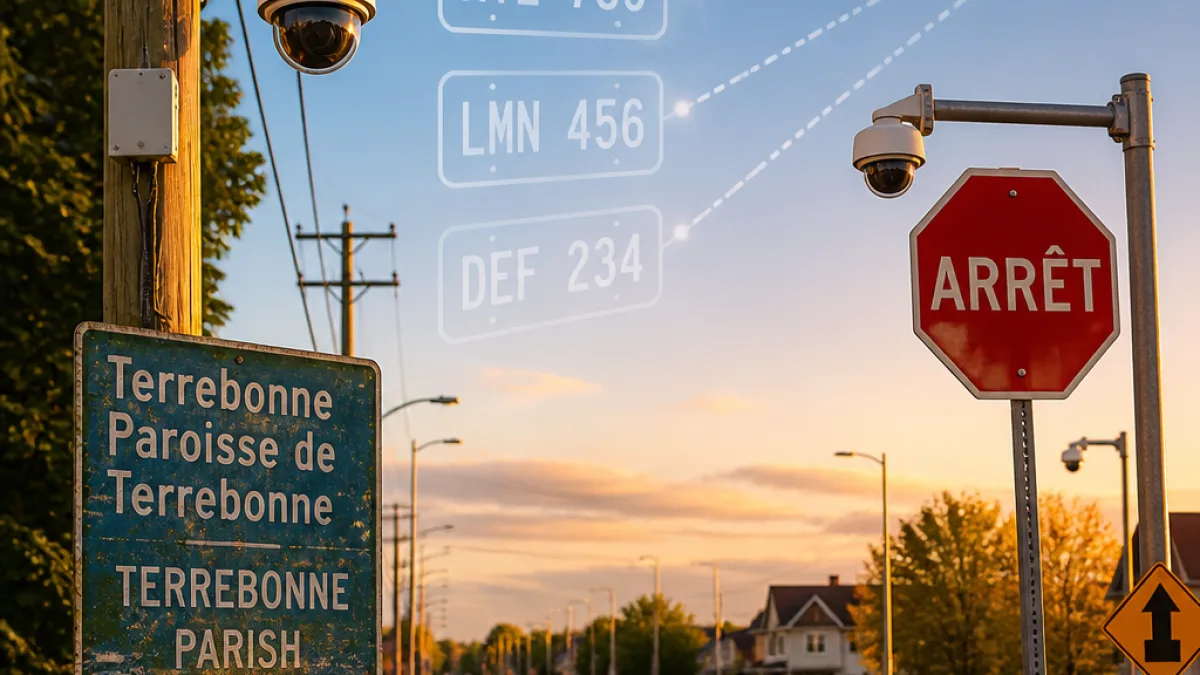
TERREBONNE — Close to one hundred automated licence‑plate reader (ALPR) cameras now scan vehicles across Terrebonne and neighbouring Lafourche parishes, prompting a debate that pits law‑enforcement officials’ claims about faster investigations against civil‑liberties concerns about mass surveillance and potential misuse of stored vehicle data.
How many cameras and how the system works
According to parish law‑enforcement information, the Terrebonne Parish Sheriff’s Office has installed 39 Flock Safety ALPR cameras within its boundaries. The Lafourche Parish Sheriff’s Office operates 54, while Port Fourchon accounts for an additional 6, bringing the combined total for the two parishes to nearly 100 cameras.
| Location | Number of cameras |
|---|---|
| Terrebonne Parish | 39 |
| Lafourche Parish | 54 |
| Port Fourchon | 6 |
The cameras photograph passing vehicles and read licence plates, uploading that information to an internet cloud database. The stored records are kept for up to 30 days, and law‑enforcement agencies may query them to identify where and when specific vehicles appeared in the region.
Arguments for and against the technology
Supporters within law enforcement say ALPR systems provide a significant investigative advantage. In an email, the Lafourche Parish Sheriff’s Office public information officer described the value succinctly.
“Having the ability to go back to the time around an incident and see what vehicles were in the area provides an incredible advantage in helping solve crimes and solve them faster,” Brenan Matherne wrote. “The reasoning behind all of this is that most crimes have one common denominator: the use of a vehicle.”
By contrast, privacy advocates and some legislators have expressed alarm. Critics argue the continuous capture and storage of vehicle movements amounts to "unconstitutional mass surveillance," raising questions about who can access the data, for what purposes, and how long records should remain searchable. The story notes recent instances in other states where law‑enforcement personnel misused similar databases, leading to arrests and job losses, although local officials have not cited specific incidents within the parishes.
- Proponents: faster case resolution, ability to trace vehicles arriving at or leaving crime scenes.
- Critics: potential for invasion of privacy, risk of misuse by officials, need for stronger rules and oversight.
- Legislative action: a state representative is preparing a bill that would ban the cameras, citing constitutional privacy concerns.
Oversight, transparency and local impact
Questions remain about the oversight mechanisms that govern access to the cloud database and the safeguards in place to prevent inappropriate use of the information. The presence of an online GPS map identifying ALPR camera locations nationwide has made the network more visible to residents and privacy advocates.
For Terrebonne residents, the debate centres on balancing neighbourhood safety with civil‑liberties protections. Proponents emphasise the investigative utility of knowing which cars were near a scene at a given time. Opponents point to the breadth of data collected on everyday travel patterns and the potential for retention and query of those records without adequate legal constraints.
Municipal officials, community groups and citizens concerned about privacy have options to explore: request briefings from the sheriff’s office about access policies, ask for independent audits, seek municipal resolutions endorsing limits, or press provincial and federal representatives for clearer statutory safeguards. At the state level in Louisiana, at least one legislator has begun drafting a ban, suggesting lawmakers are watching the technology’s expansion.
As the discussion continues, the competing priorities of public‑safety effectiveness and protection of personal movement data will shape how—or whether—controls are tightened on ALPR networks in Terrebonne and neighbouring parishes.
— Reporting for NEXO RADAR from Terrebonne