A multinational research team led by Professor Jung Kyu Kim has reported a catalyst that directly converts carbon dioxide into 2‑propanol at room temperature and pressure, a result the authors describe as a world‑record efficiency for ambient CO2 electroreduction. The work, published online in Applied Catalysis B: Environment and Energy, points toward a route for turning a major greenhouse gas into a high‑value industrial chemical used in semiconductor cleaning and disinfection.
What the team achieved
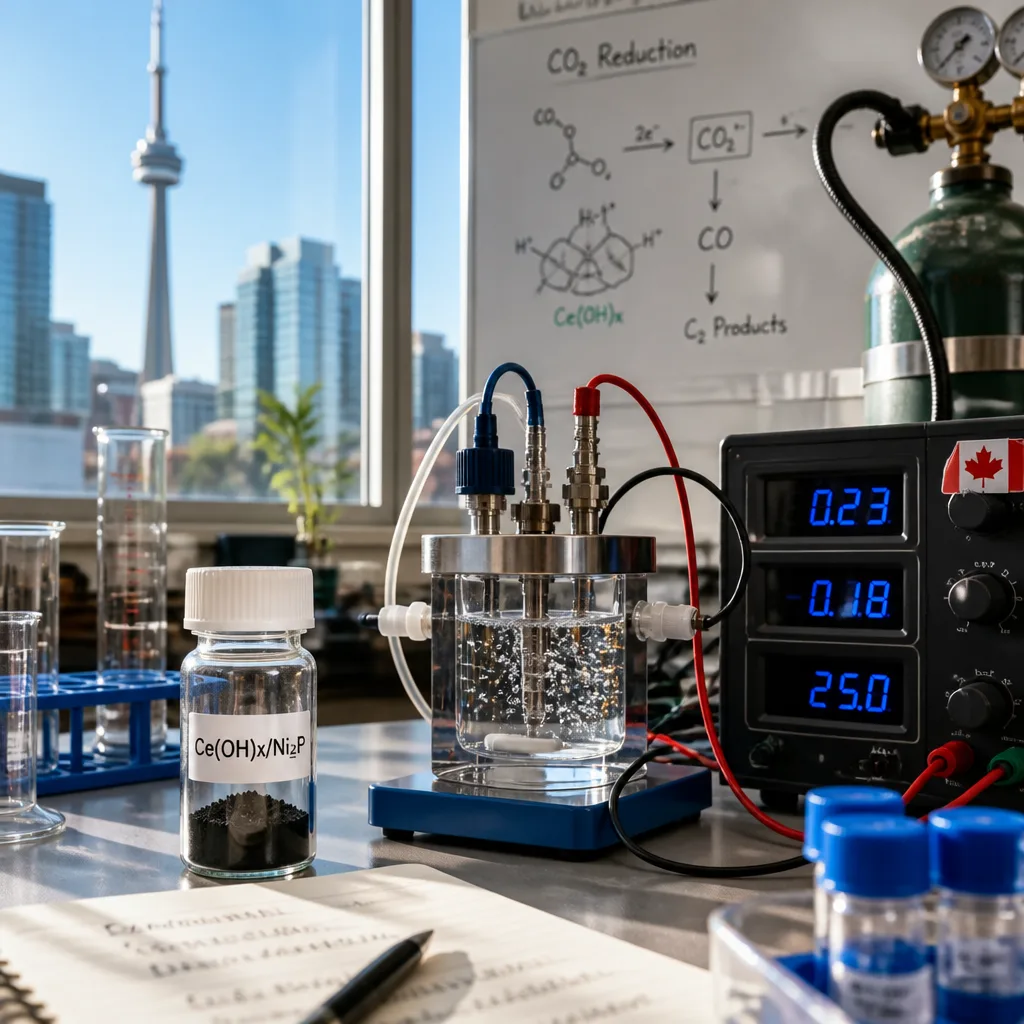
The researchers developed a composite catalyst identified as Ce(OH)x/Ni2P. According to the paper, the material enables bifurcated electrochemical reaction pathways on its surface, steering carbon dioxide through reaction routes that produce 2‑propanol rather than simpler products such as carbon monoxide or methane—compounds that have dominated previous CO2 electroreduction efforts.
The study is the product of collaboration among several Korean institutions: Professor Jung Kyu Kim’s group in the School of Chemical Engineering (with first author Ph.D. candidate Won Tae Hong), Professor Sang Uck Lee’s team in the Department of Chemical Engineering (co‑first author postdoctoral researcher Seong Chan Cho), and Dr. Jai Hyun Koh’s group at the Korea Institute of Science and Technology (KIST).
Why it matters
- Higher‑value product: 2‑propanol (isopropyl alcohol) is more valuable than simple reduction products and has established industrial demand.
- Ambient conditions: The reported reactions occur at room temperature and pressure, lowering energy and engineering barriers that have hindered previous approaches.
- Potential for upcycling: Demonstrates a pathway for converting CO2 emissions into feedstocks, which could complement capture and storage strategies.
In plain terms, producing a multi‑carbon alcohol like 2‑propanol from CO2 is chemically demanding because it requires multiple proton‑electron transfers and carbon‑carbon coupling steps. The authors argue that the engineered interfacial electronic properties of the catalyst favor those pathways.
Claims and caveats
The team reports world‑record efficiency under ambient laboratory conditions and includes assessments of performance, stability and economic implications for the catalyst. The paper, however, should be read in context: lab success does not automatically translate into industrial viability. The study appears to address key technical hurdles, but it does not remove the need to scale up, integrate with CO2 capture systems, or demonstrate long‑term durability under commercial operating cycles.
Important questions remain open for industry and policymakers considering adoption:
- How will the catalyst perform under continuous, large‑scale operation where impurities, fluctuating input streams and engineering limitations matter?
- What are the total energy inputs and lifecycle emissions when the process is assessed from CO2 capture through product separation?
- What are the downstream processing and market pathways for sustainably integrating such electroreduction products into existing supply chains?
Details worth noting
The paper is published in a leading field journal, which signals peer scrutiny. The research teams combine academic and national‑lab expertise, a typical arrangement for early‑stage chemical‑conversion breakthroughs. The authors are careful to frame the work as a material and mechanistic advance; they present catalytic behaviour, stability tests and an economic evaluation within the scope of the study.
| Attribute | Reported detail |
|---|---|
| Catalyst | Ce(OH)x/Ni2P composite |
| Product | 2‑propanol (isopropyl alcohol) |
| Publication | Applied Catalysis B: Environment and Energy |
For Canada’s tech and clean‑energy sectors, the result is notable. If the approach can be scaled economically and paired with low‑carbon electricity, it could provide a domestic route to manufacture solvent and disinfectant feedstocks without fossil‑carbon inputs. That prospect would intersect with federal and provincial clean‑industrial initiatives, but the pathway from lab bench to plant remains long and uncertain.
The paper advances the science of CO2 electroreduction and adds momentum to efforts aiming to treat greenhouse gases as raw materials. Yet sober assessment is required: scaling, integration and a full accounting of energy and emissions will determine whether the reported efficiency translates into meaningful climate or industrial benefits.