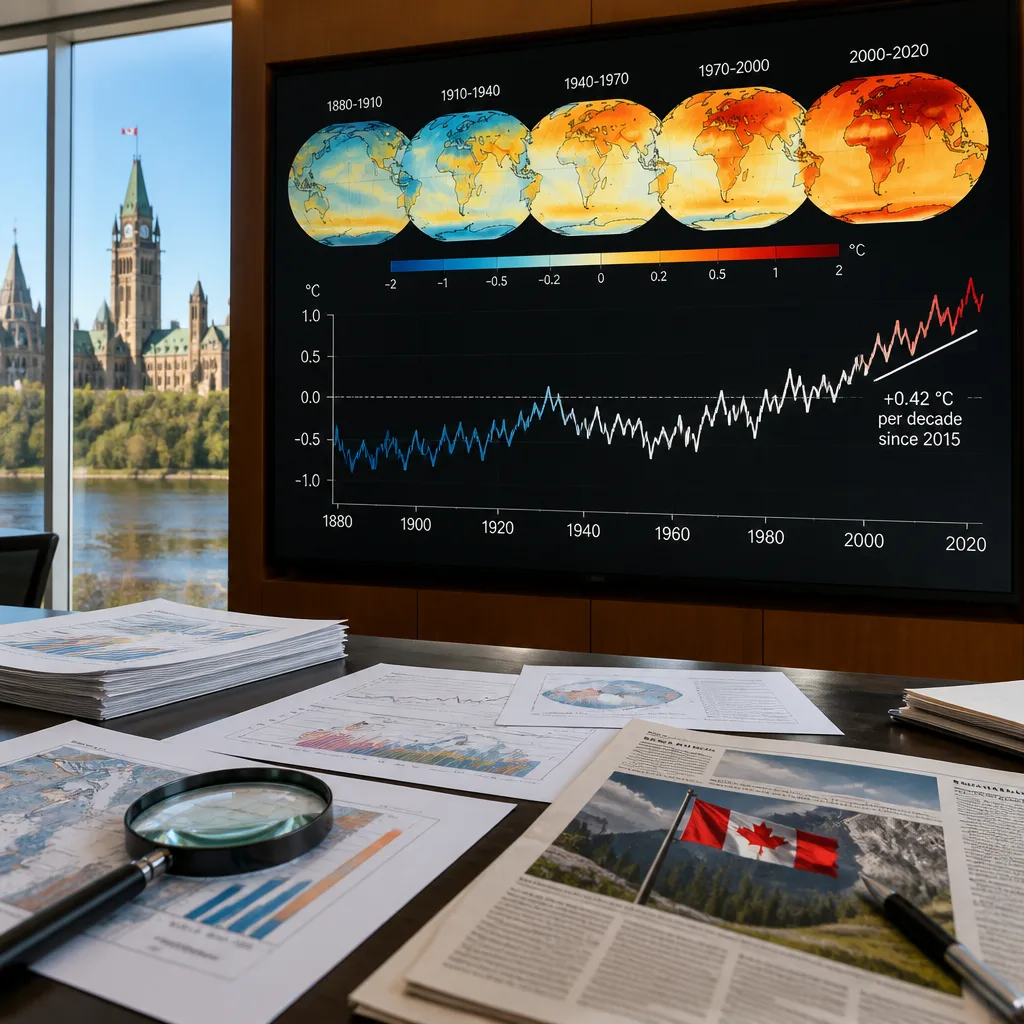
Global temperatures have entered a faster phase of warming, according to a new analysis from the Potsdam Institute for Climate Impact Research (PIK) that isolates long‑term trends from short‑term natural variability. The study, published in Geophysical Research Letters, concludes that the warming rate since about 2015 is roughly 0.35°C per decade, considerably higher than the average of just under 0.2°C per decade observed from 1970 to 2015.
Filtering out the short‑term noise
The researchers removed effects from well‑known natural drivers — such as El Niño, volcanic eruptions and fluctuations in solar activity — to make the underlying warming trend clearer. By analysing five widely used global temperature records (NASA, NOAA, HadCRUT, Berkeley Earth and ERA5), the team reports a consistent acceleration across datasets and methods, with a stated confidence level exceeding 98 per cent.
"We can now demonstrate a strong and statistically significant acceleration of global warming since around 2015," said Grant Foster, a statistics expert and co‑author of the study.
PIK lead author Stefan Rahmstorf described the approach as one that reduces short‑term "noise" in the observational data, allowing the longer‑term warming signal to be seen more clearly. The adjusted series, the authors say, show an acceleration that is greater than any decade since instrumental records began in the late 19th century.
How the numbers compare
The study contrasts two multi‑decadal rates of change:
- Recent decade (≈2015 to present): about 0.35°C per decade.
- Historic period (1970–2015): just under 0.2°C per decade.
A small table summarises the reported rates across the two periods.
| Period | Approximate warming rate (°C per decade) |
|---|---|
| ~2015 to present | 0.35 |
| 1970–2015 | ~0.2 |
Implications and context
The finding that the long‑term warming rate has accelerated carries practical and policy consequences. An increase in the underlying pace of warming means that temperature thresholds linked to climate impacts — such as extreme heat, sea‑level rise and shifts in precipitation patterns — could be reached sooner than projected using earlier, slower rates.
By examining multiple independent datasets, the authors sought to ensure the result is robust to measurement choice and method. The datasets examined include those maintained by major international and national research bodies, giving the conclusion broad observational support.
Scientists routinely account for short‑term variability such as El Niño and volcanic aerosols when interpreting temperature records, because these processes can temporarily amplify or dampen global mean temperatures. The Potsdam team removed those influences to focus on the trajectory driven by longer‑lasting forces.
What the study does and does not say
The paper presents a statistical detection of an acceleration in the planet's warming rate; it does not alter the physical understanding that emissions of greenhouse gases are the primary driver of long‑term temperature rise. Rather, the result refines how quickly that long‑term trend appears to be changing in the observational record once short‑term fluctuations are accounted for.
For Canada, a nation already experiencing rapid regional warming in many areas, a faster global rate underscores the urgency of adaptation planning and emissions reduction. The report adds observational weight to the case that near‑term climate risks could intensify if warming continues at the newly quantified pace.
The authors emphasise that their conclusions are consistent across all five datasets and independent of the analysis method chosen. That cross‑validation strengthens confidence in the central result: the long‑term warming trend has increased since around 2015.
Further reading: the study is published in Geophysical Research Letters and presents the adjusted instrumental series, the methodological approach to removing natural variability, and an assessment of statistical confidence across datasets.