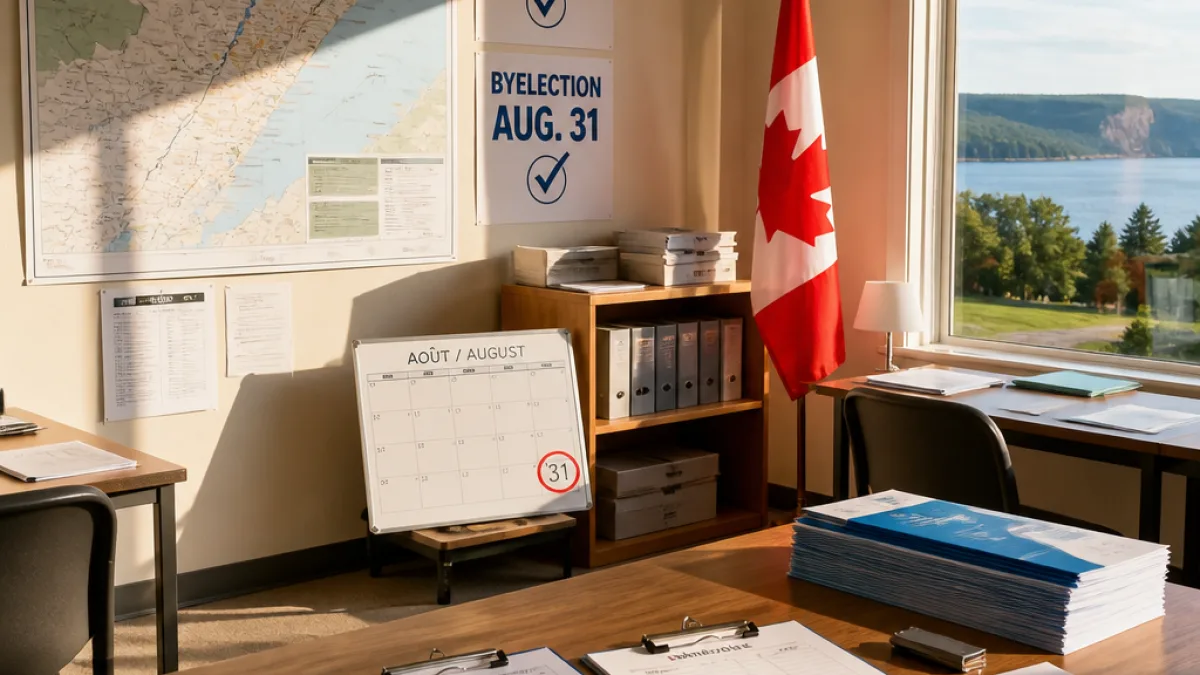
Prime Minister Mark Carney has formally called three federal byelections to be held on Aug. 31, 2026, including one in Quebec’s Chicoutimi—Le Fjord, the prime minister’s office announced Sunday.
Seats up for grabs and why
The three ridings scheduled for contests are in British Columbia, Ontario and Quebec. They are being vacated following a series of recent moves among MPs and political appointments that have altered the composition of the House of Commons.
| Riding | Province | Reason for vacancy |
|---|---|---|
| North Vancouver–Capilano | British Columbia | Vacated seat (byelection called) |
| Beaches–East York | Ontario | Vacated seat (byelection called) |
| Chicoutimi—Le Fjord | Quebec | Seat vacated after MP appointment to another role |
The three contests will replace former MPs who left their seats for a variety of reasons, including appointments and resignations. Among those mentioned in the prime minister’s release are former Liberal MP Jonathan Wilkinson (now Canada’s ambassador to the European Union) and former Liberal MP Nathaniel Erskine-Smith. The seat in Quebec will also fill the vacancy left by former Conservative MP Richard Martel, who has been appointed to the Senate.
Why this matters in Ottawa and in Quebec
The outcome of the Aug. 31 byelections carries weight for the governing Liberals. As of the announcement, the Liberals held 171 seats in the House of Commons (not counting the Speaker). Party standings are expected to shift slightly over the summer: a planned resignation by Liberal cabinet minister Steven Guilbeault on Aug. 28 will reduce the Liberal total by one before Parliament resumes, and other opposition vacancies will also be in play.
If the Liberals can pick up at least one of the three seats, they will maintain a working total of 171 seats, preserving a small but meaningful margin over the combined opposition numbers. Without that pickup, their arithmetic in the House will be tighter.
- Byelection date: Aug. 31, 2026
- Seats being contested: 3 (B.C., Ontario, Quebec)
- Key change before Parliament returns: Guilbeault stepping down on Aug. 28
Local implications for Chicoutimi—Le Fjord
For voters in Chicoutimi—Le Fjord, the byelection launches the formal process of candidate nominations and local campaigns. Parties will name their contenders in the coming weeks. The riding — centred on the Saguenay region — will be watched provincially and nationally because each seat can sway delicate arithmetic in a minority Parliament.
Beyond the parliamentary math, byelections give local issues a platform. In Quebec ridings such as Chicoutimi—Le Fjord, candidates typically address matters ranging from regional infrastructure and resource-sector concerns to health care access and francophone cultural priorities. Voters will expect to hear where contenders stand on these topics as campaigns unfold.
Timing and next steps
With the vote set for Aug. 31, political parties have a narrow window to select candidates, organise local campaign teams and begin outreach. The outcome will be known before MPs return to Ottawa after the summer break in late September, meaning any shifts in seat totals will feed directly into parliamentary strategy.
Observers note that byelection results sometimes diverge from federal general election patterns, reflecting local dynamics or protest votes. Still, when a minority government holds a slim margin, outcomes in even a single riding can alter the balance of power and bargaining dynamics in the House.
For residents of Chicoutimi—Le Fjord and the other two federal ridings, election administrators will publish voting locations and advance-voting schedules in the weeks ahead. Parties and candidates will announce platforms and campaign events as they mount their bids for the seat.
As the campaign period progresses, NEXO RADAR will follow candidate nominations and campaign developments in Quebec and report on how local issues are shaping the contests.