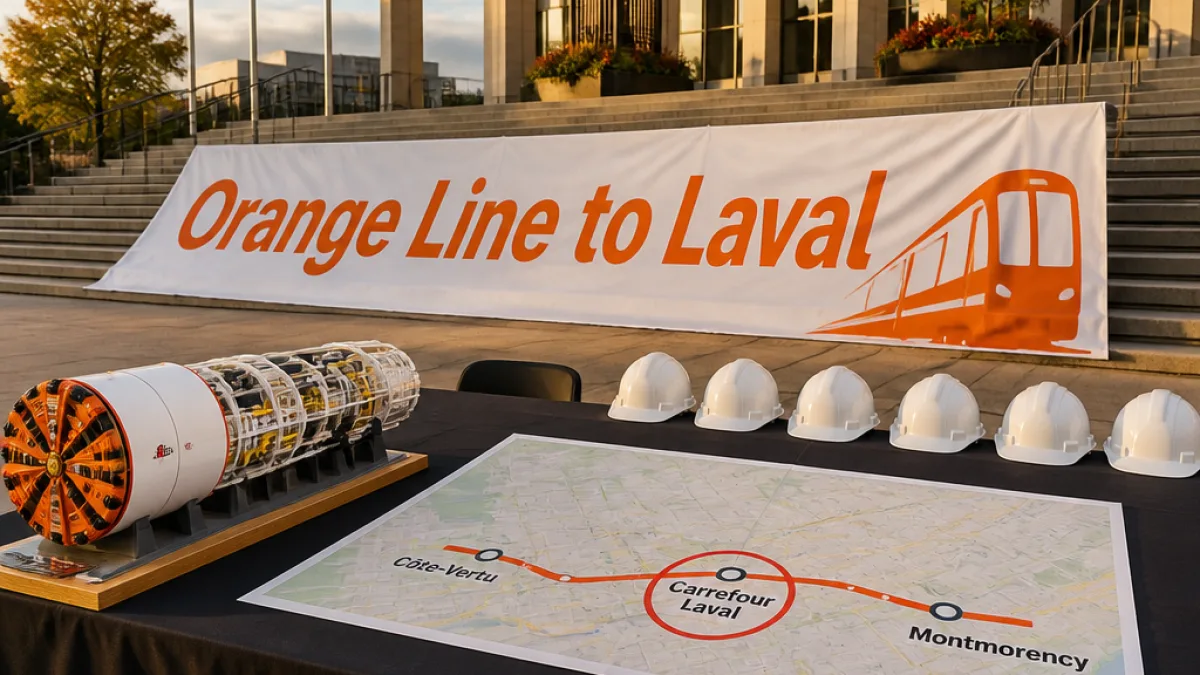
The mayor of Laval has taken a high-profile lead in shaping the next phase of Greater Montreal’s transit planning by campaigning for an extension of the Orange Line of the métro from Côte-Vertu into Laval. His proposal, advanced ahead of formal regional studies, calls for six to eight new stations, including a station at Carrefour Laval, and closing the loop with the Montmorency terminus.
Local push ahead of regional plan
The Autorité régionale de transport métropolitain (ARTM) has identified eight corridors for detailed study through 2029, with the St-Laurent—Chomedey corridor — the area that connects directly with parts of Laval — listed as the first to be examined. Rather than wait for the ARTM's process to run its course, Laval's mayor has publicly embraced the St-Laurent—Chomedey review and supplied planning figures to make the case for a métro extension.
The region’s broader transit planning has a recent history of shifting ideas and price tags. A previous long-range plan presented to Quebec drew criticism as an unaffordable “wish list” and was rejected. A separate east-end project that began as an elevated light-rail proposal drew scrutiny after the Caisse de dépôt et placement du Québec stepped away; the ARTM later proposed an underground option that former premier François Legault described as so costly it "almost made him choke on his coffee." That underground plan carried a roughly $36-billion estimate, and the ARTM then revised the concept to a surface line priced near $18 billion.
What Laval is proposing
Details released by the mayor indicate an ambition to repurpose existing resources and speed implementation. Among the practical elements mentioned is the idea of using Lisette, the giant tunnel-boring machine currently employed on the Blue Line extension, to cut new tunnels for an Orange Line leg. The mayor’s figures — released before the ARTM completes its study — are meant to give weight to a concrete plan rather than a general corridor vision.
- Stations proposed: 6–8 new stops, including Carrefour Laval
- Linkage: New leg would connect Côte-Vertu and Montmorency
- Equipment: Potential repurposing of the Lisette tunnel-boring machine
Where this fits in regional priorities
The ARTM’s eight-corridor programme is broad and presently conceptual: the corridors are named by region rather than by specific projects, and the agency will study them in sequence through 2029. The announced order begins with St-Laurent—Chomedey, followed by a west-central Montreal sector, then the Laurentians, Les Moulins, eastern Montérégie, St-Laurent—Ahuntsic—Montreal North, Marguerite-d’Youville and Roussillon.
| Corridor | Notes |
|---|---|
| St-Laurent—Chomedey | First in line; covers corridor linking Montreal and Laval |
| West-central Montreal | To be studied later in 2026 |
| Laurentians | Included among the eight through-2029 studies |
| Les Moulins | Regional corridor review |
| Eastern Montérégie | Part of long-range planning |
| St-Laurent—Ahuntsic—Montreal North | Urban corridor review |
| Marguerite-d’Youville | Included in the sequence |
| Roussillon | Included in the sequence |
For Laval residents, the proposal represents a possible shift from bus-based regional links to a direct métro connection that would change commute patterns and transit capacity. The mayor’s public figures are intended to influence both public opinion and the ARTM’s more technical studies, which will assess feasibility, costs and timelines.
Political and practical considerations
Any major métro extension will face the familiar hurdles of intergovernmental coordination and budgeting. The Montreal region’s planning history shows how proposals can evolve dramatically: initial visions can draw very large price tags and be scaled down or re-envisioned. That evolution underlines why the ARTM’s systematic review of corridors matters — it aims to move from high-level ideas to projects that are viable and fundable.
"It almost made him choke on his coffee,"
The comment above reflects the reaction of a former Quebec premier to one of the region's cost estimates and underlines persistent public sensitivity to price. For Laval, pressing now for a métro extension is a way to stake a claim in the region's priorities as the ARTM refines its work.
Residents can expect more details as the ARTM proceeds with the St-Laurent—Chomedey study later this year, and as municipal and provincial leaders respond to proposals that shift the conversation from corridor names to specific, fundable projects. For commuters in Laval, the debate will centre on whether a métro leg to Carrefour Laval and connections to Montmorency can deliver faster, more reliable regional service than current options.