Judge says evidence points to mid‑level retail dealing; defence highlights long history of addiction and injuries
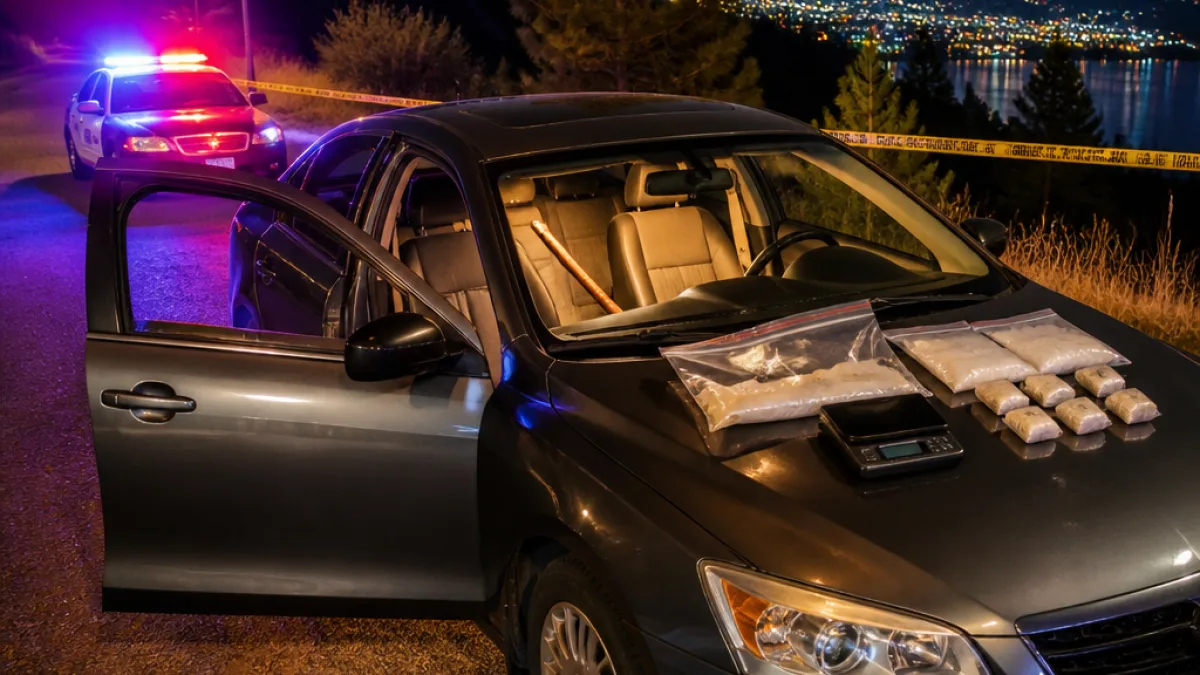
A 56-year-old Kelowna man who was discovered asleep in his vehicle with almost $49,000 worth of illicit drugs and drug‑paraphernalia has been sentenced to three years in prison after a B.C. Supreme Court decision released July 17.Police located the man, identified in court documents as Nick Dubois, in his car in Lake Country shortly after midnight, responding to a call from a concerned member of the public. Officers found Dubois with a cellphone in his hand and a bat by his feet; a subsequent search of the vehicle turned up a quantity of drugs, utensils commonly associated with distribution, and cash.
The Crown described the quantities and purity of the substances as indicative of trafficking beyond simple personal use. Justice Judith Hoffman, in sentencing, concluded Dubois was engaged in some form of mid‑level retail dealing, but situated him at the lower end of that spectrum.
- Fentanyl: 169 grams (approx. 70% purity)
- Methamphetamine: 48 grams
- Cocaine: 108 grams
- Also seized: digital scale, unused baggies, two cell phones, a large folding knife, a tactical knife, and over $700 in cash
“I would place Mr. Dubois within the lower end of the retail dealer spectrum,”The court documents note that the seized fentanyl’s estimated purity — roughly 70 per cent — suggested it had been produced in a laboratory rather than street‑level cutting, a factor Crown counsel used to argue for a more significant sentence. Crown prosecutors sought a four‑year term, pointing to Dubois’s previous drug convictions and a criminal record stretching back to his twenties. Defence counsel painted a different picture: that the accused was a long‑time substance user who trafficked to feed his addiction, rather than running a sophisticated commercial operation. The decision records that Dubois has struggled with substance use intermittently for some 25 years and that his dependency followed a series of serious injuries.
“His injuries were treated with opiate medication, and he developed a dependence,”Court filings list a snowmobile accident in 2000, a motor vehicle collision in 2010, and a serious assault in 2018 among incidents that left him with lasting health problems. The defence told the court that, in the four years since the offence, Dubois had largely remained off substances and participated in opioid replacement therapy beginning in 2023. He also volunteered to help others dealing with addiction as part of his rehabilitation. A small table summarises the items seized at the scene:
| Item | Quantity |
|---|---|
| Fentanyl | 169 g (approx. 70% purity) |
| Methamphetamine | 48 g |
| Cocaine | 108 g |
| Cash | Over $700 |