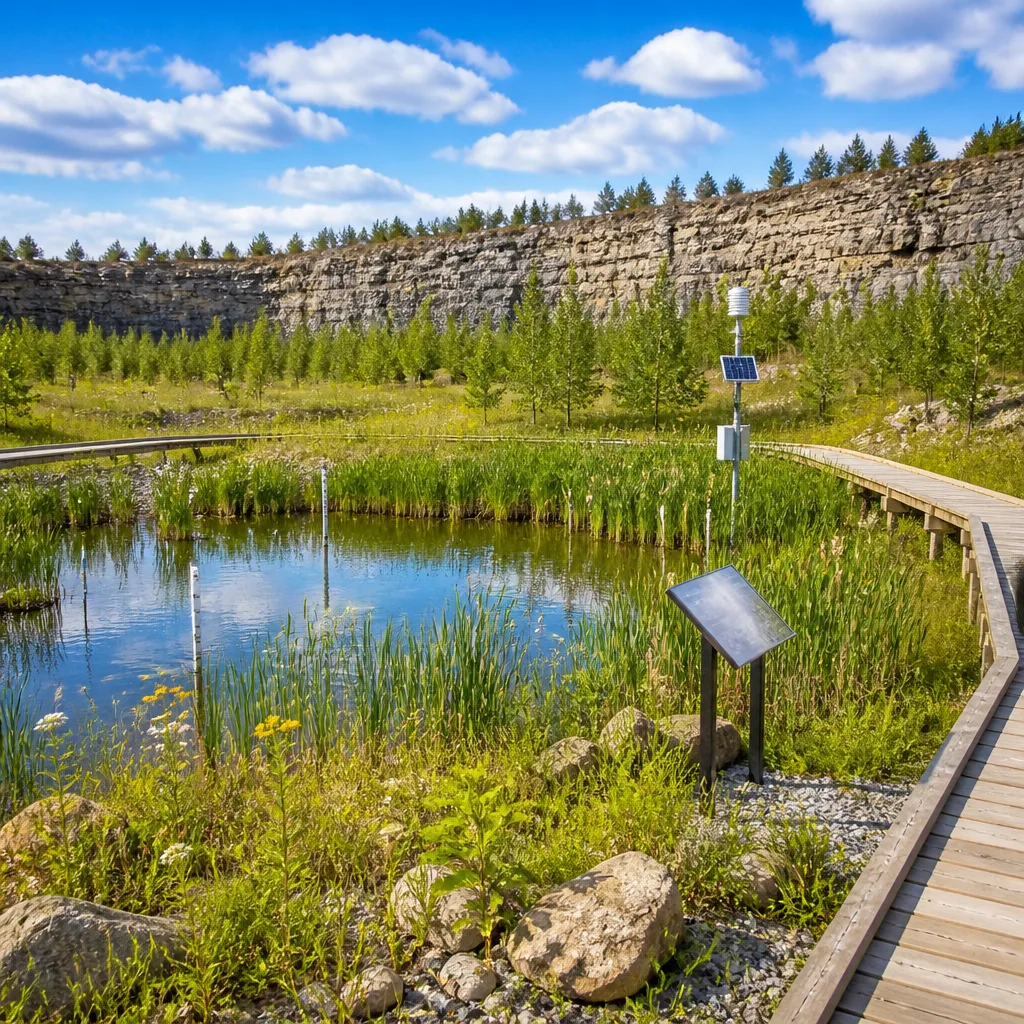
Newbold Quarry, once a source of construction aggregate, has been repurposed through a science-led rehabilitation effort that created new wetland and woodland habitat on the former extraction site, the company says. The project forms a component of Holcim UK’s Nature Strategy and its NextGen Growth 2030 roadmap.
Science-led restoration with community value
Holcim UK describes the work at Newbold — near Burton upon Trent in England — as a progressive approach: rather than simply returning land to its previous state, the company says it has intentionally developed entirely new habitat types on post-extraction ground. The effort includes what the company identifies as 11 hectares of wetland and woodland designed to support local biodiversity and ecosystem functions.
The project was planned to align with local expectations and to provide public benefit, Holcim says. It also aims to contribute to broader landscape-scale recovery by integrating with the Trent Valley Living Landscape, a regional initiative for nature restoration.
“The past and present of Newbold Quarry near the English town of Burton upon Trent is a lighthouse example of transformative rehabilitation and how we can leave nature in a better state than when we found it,” says Tom Redfern, Holcim UK’s Head of Sustainability.
Targets, modelling and ecosystem services
Holcim points to a science-based methodology underpinning the site's rehabilitation. That includes landscape modelling intended to ensure long-term resilience of the habitats established after extraction ceased. The restored landscape is described as delivering multiple ecosystem services, beyond providing habitat for wildlife — specifically, roles in carbon sequestration and natural water storage, which the company frames as contributions to urban resilience.
The Holcim account also refers to results across the company’s portfolio: it states that approximately 44 former aggregate extraction locations have been restored and now support thriving natural habitat, including rare or protected species. The Newbold work is presented as a case study within that wider effort.
- Site: Newbold Quarry, near Burton upon Trent
- Restored habitat: 11 hectares of wetland and woodland (company figure)
- Corporate framework: Nature Strategy; NextGen Growth 2030
| Metric | Company-stated figure |
|---|---|
| Restored habitat area | 11 hectares |
| Former extraction sites restored (approx.) | 44 locations |
Context and consequences
Industry-led rehabilitation of extraction sites is increasingly positioned as an opportunity to reverse habitat loss and to deliver measurable ecosystem benefits. Holcim frames Newbold as an example of doing more than traditional reinstatement — deliberately creating habitat types that were not previously present on site. If the reported outcomes hold up to independent evaluation, the practice could be a model for how post-extraction landscapes contribute to regional restoration targets.
There are broader implications where restored sites deliver carbon storage and improved water retention. Municipal planners and provincial authorities in regions with legacy extractive landscapes may see such projects as tools for climate adaptation and nature-based flood mitigation, although Holcim’s release does not include independent assessments of those services.
Holcim’s account emphasises a collaborative, patient approach combining ecological expertise and community input. The company says its approach seeks long-term resilience, but independent scientific appraisal and monitoring data will be needed to confirm species outcomes and the longevity of the newly established ecosystems.
The Newbold initiative adds to a growing industry narrative that post-extraction land can be repurposed to provide public and environmental goods — from biodiversity to water and carbon management — when rehabilitation is guided by ecological science and community priorities.
This article is based on material provided by Holcim UK describing its Newbold Quarry rehabilitation project and related corporate initiatives.