
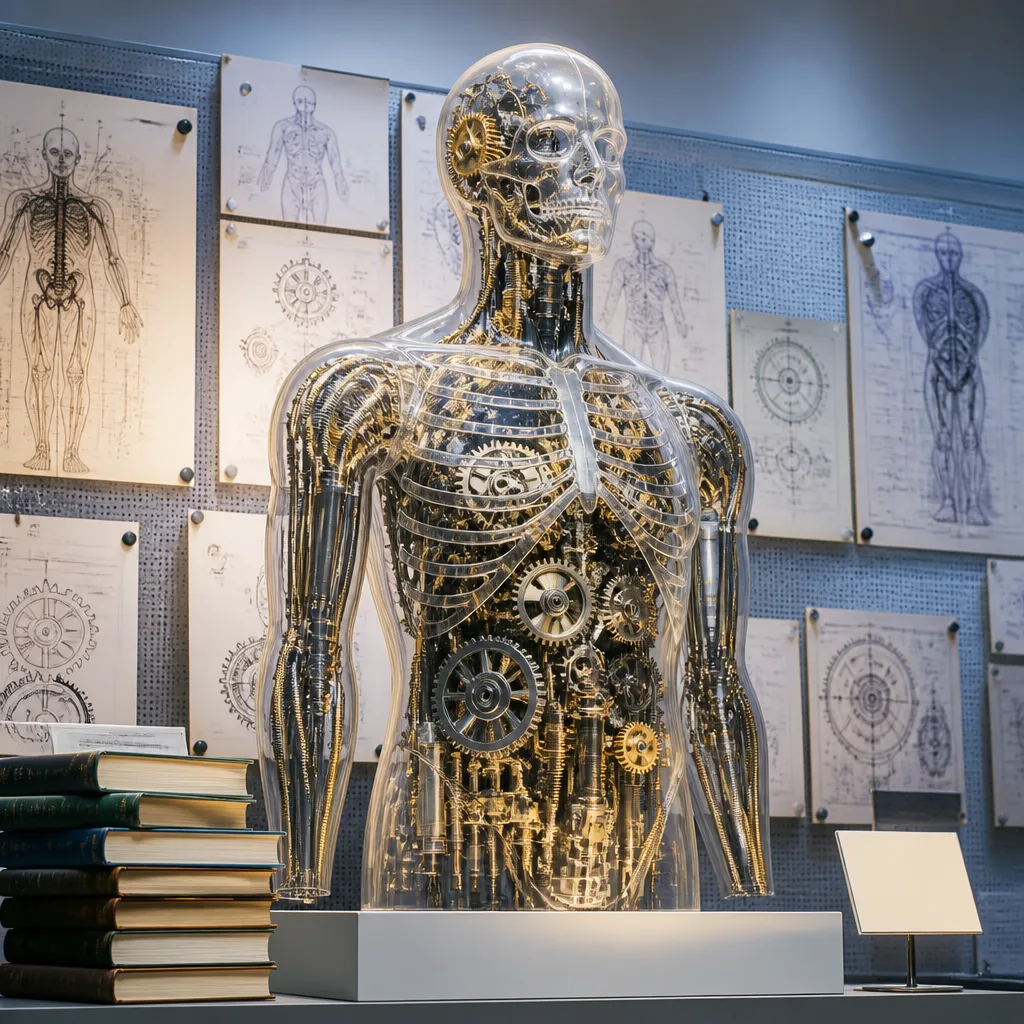
Dr. Stuart Burgess, a mechanical engineer with a record of academic posts and applied-design work, contends that many features of the human body represent "ultimate engineering," a claim that revives debate over intelligent design and biological function.
Claims, career and context
Burgess is described as having held full-professor academic appointments at Bristol University and Cambridge University in the United Kingdom and at Liberty University in the United States. His applied work includes serving as the lead transmission designer for three British Olympic gold-medal-winning track cycling teams and contributing gearbox designs used on the European Space Agency’s four largest earth-observation satellites. He has also been recognised with industry awards, including being named the UK’s top mechanical engineer in 2019.
In published and public materials, Burgess presents a technical and philosophical challenge to the common scientific characterisation of biological form as frequently suboptimal or compromised. His 2026 book, Ultimate Engineering: An Engineer Investigates the Biomechanics of the Human Body, examines the mechanical properties and organisation of anatomical structures — the eye, fingers, wrist, spine, knee, foot and ankle — and systems such as blood circulation, digestion and the nervous system. He argues these demonstrate design that approaches the bounds of what is mechanically possible.
Public engagement and controversy
Burgess spoke on his thesis at the Discovery Institute’s 2026 Dallas Conference on Science and Faith. The book and related talks explicitly position him against what he characterised as a “kneejerk” assessment by proponents of Darwinian evolution. The source material names several well-known scientific critics — Nathan Lents, Richard Dawkins and Jerry Coyne — as representatives of that opposing perspective.
"The human body isn’t a masterpiece of design — it’s a patchwork of evolutionary compromise."
The material provided is the opening of a longer question-and-answer exchange in which Burgess responds to an academic colleague who advanced that view. The published exchange is presented as Part One of a series in which Burgess addresses the claim and lays out his engineering-based interpretation of anatomy and physiology.
What Burgess bases his argument on
His case is built on a mix of professional design experience and scholarly output: Burgess is the author of seven books and more than 200 research papers on design in engineering and biology, and has been an invited speaker in over 30 countries. He draws on comparative analysis of mechanical function within biological tissues and organs to argue that many biological solutions are optimised in ways a practising engineer would recognise.
- Academic posts at major universities in the UK and US.
- Applied engineering work for elite sports and space systems.
- Substantial publication record and public speaking history.
Those credentials are central to how he frames his critique of evolutionary explanations that emphasise constraints, trade-offs and historical contingency rather than optimal outcomes.
| Area | Noted detail |
|---|---|
| Academic roles | Professor-level posts at Bristol, Cambridge and Liberty |
| Applied design | Transmission design for Olympic teams; gearboxes for ESA satellites |
| Publications | Seven books; >200 research papers |
Implications for science communication
The exchange illustrates enduring fault lines in public and academic conversations about biology: whether structures should be read primarily through the lens of evolutionary history — with its emphasis on contingency and compromise — or through functional appraisal that highlights apparent optimisation. The source material does not report peer-reviewed rebuttals to Burgess’s specific technical claims in the new book; it presents his argument and credentials and notes the prominent scientists he positions as opponents.
How the argument is received in mainstream biology will depend on detailed scrutiny of the empirical claims and on whether Burgess’s engineering analyses are integrated with or challenged by evolutionary biology’s explanatory frameworks. The ongoing series of exchanges suggests Burgess intends a sustained public engagement with critics and colleagues on these issues.
As the discussion continues, readers should note the distinction between an engineer's assessment of mechanical efficiency and the broader explanatory aims of evolutionary biology, which also addresses historical, genetic and developmental processes. The coming parts of the series will, according to the source, further lay out Burgess’s responses to claims that the human body is a product of evolutionary compromise rather than of optimised design.