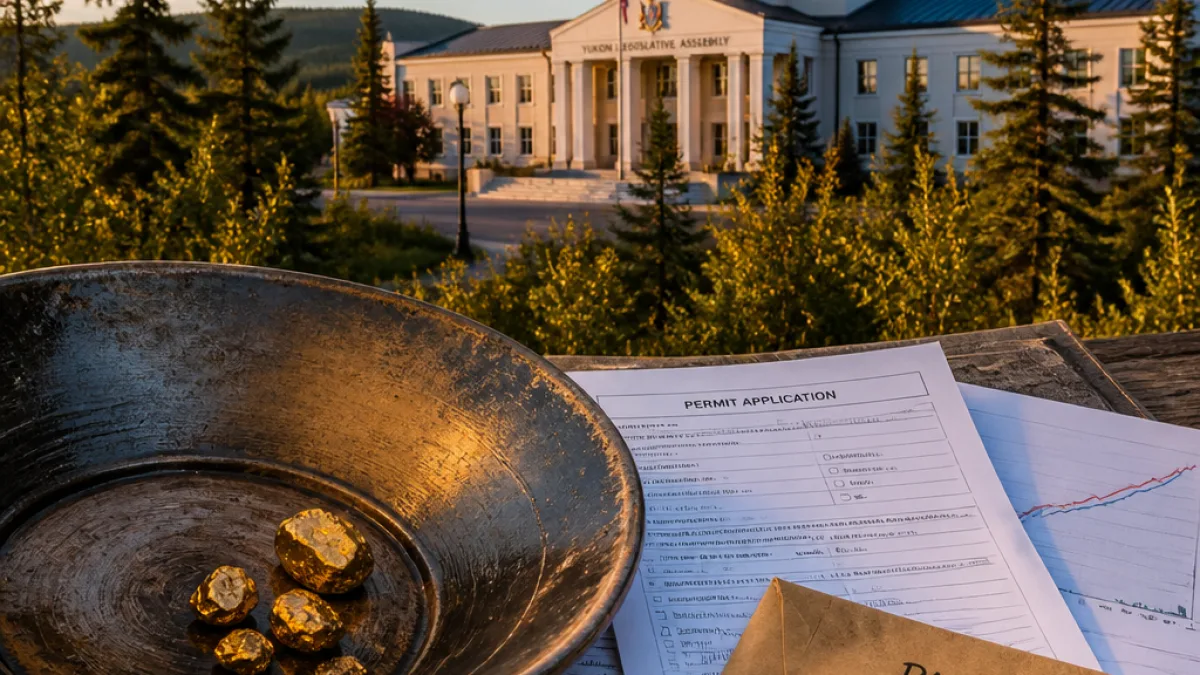
The Yukon government’s bid for greater fiscal flexibility has revived debate over how the territory raises revenue from its natural resources and transient workforce.
Debt cap talks prompt focus on revenue, not just spending cuts
Federal officials have signalled a willingness to consider raising Yukon’s debt cap, but they want assurances the territory can demonstrate disciplined fiscal management and concrete plans to control spending. Some local commentators and policy observers say that discussion is heavily tilted toward cost cutting and has not given enough attention to boosting revenues.
One area under renewed scrutiny is the royalty regime on gold produced in Yukon. Under legislation set generations ago, the effective rate for gold that leaves the territory is currently a small flat amount — described as 37.5 cents per ounce — a relic of an older price base that critics say fails to reflect today's market values.
Proposals to raise returns from resource activity
Civic voices have made several proposals to increase territorial receipts from resource activity and industrial users. Suggested measures include:
- Higher royalty on gold — shifting from the century-old formula to a percentage-based charge on gold produced within Yukon.
- Increased application and licence fees — raising the price of permits and water licences so they better cover administrative costs.
- A payroll tax for non-resident workers — mirroring approaches in other jurisdictions to capture income tax from workers who earn in the territory but live elsewhere.
Proponents argue these measures would allow Yukon to remain competitive for investment while delivering a fairer share of public returns from publicly owned resources.
Gold royalty: from flat fee to percentage
The current fee for exported gold originates from historic legislation calculated at a fraction of a bygone American gold price. One suggested alternative is a modest royalty based on production — for example, a rate in the vicinity of 1% of the value produced — applied to gold actually mined in the territory rather than to export shipments. Advocates say this type of change would modernize tax policy and increase revenues without deterring investment.
| Current measure | Described amount |
|---|---|
| Gold export levy | 37.5¢ per ounce (historical formula) |
| Proposed alternative | ~1% of gold produced (production-based royalty) |
Water licences and industrial charges
Another revenue target is the cost recovery of environmental and resource-management permits. For instance, routine charges such as the application fee for a Type A water licence and the annual water-use licence fee have been criticised as too low to cover processing and oversight costs.
Some suggest introducing an industrial user tax calculated on the volume and quality of water withdrawn, a model that would align fees with actual use and environmental impact rather than a flat nominal charge.
Capturing income from non-resident workers
Yukon’s transient workforce is also in the spotlight. One proposal is to enact a payroll or withholding mechanism that would require non-resident workers to remit their income tax to the jurisdiction where they earn wages. Advocates point to similar arrangements in other northern jurisdictions as templates for ensuring a portion of income earned in Yukon remains with the territory.
Balancing competitiveness and fiscal fairness
Supporters of reform frame these changes as a way to balance two goals: keeping Yukon attractive for exploration and development while ensuring the public receives a meaningful return from resources that lie within its borders. Opponents or cautious observers are likely to raise concerns about potential impacts on investment decisions and project economics.
Any substantive alteration to royalties, licensing fees or payroll taxation would require legislative action and consultation with stakeholders, including Indigenous governments, industry and local communities. The territorial government must weigh those consultations alongside the federal government’s expectations for fiscal prudence if it hopes to secure more latitude on borrowing.
As Yukon navigates talks over its debt ceiling and long-term budgeting, the discussion over how to modernize resource-related revenues is set to be central to the territory’s fiscal policy debates this fall.