Brazilian federal authorities have established a dedicated forensic laboratory in the capital to identify the geographic origin of seized gold, a move aimed at disrupting illegal mining that is accelerating deforestation, contaminating waterways with mercury and threatening Indigenous and local communities in the Amazon.
Science meets enforcement
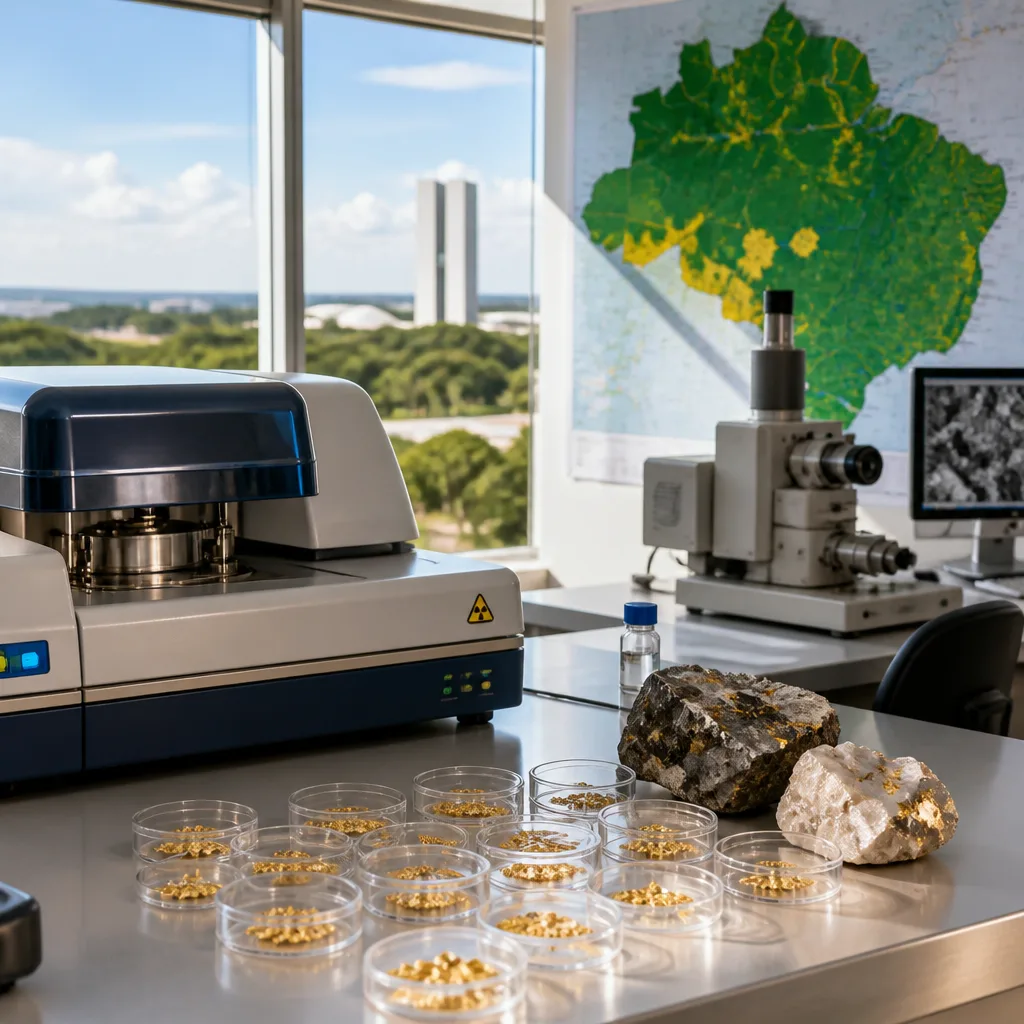
At the National Institute of Criminalistics in Brasilia, investigators keep tiny samples of gold in coin-shaped containers not for their sparkle but for the distinctive chemical traces they contain. As gold forms in rocks and riverbeds it incorporates minute amounts of other elements, creating a geochemical signature. By analysing those signatures, forensic teams hope to determine whether a sample came from a protected unit such as a national forest or Indigenous territory—evidence that can support criminal investigations and potential charges.
The laboratory employs a suite of high-resolution analytical instruments, including X‑ray fluorescence spectrometry, scanning electron microscopy and laser ablation mass spectrometry. According to the federal police, the capability has been developed since 2019 in collaboration with Brazilian universities.
“As we advanced, the forensic examinations became increasingly complex,” Gustavo Geiser said, but the central question remained: “Where did this gold come from?”
Why origin matters
Tracing provenance goes to the heart of the enforcement challenge. Criminal networks that profit from illegal extraction commonly launder their product into legal markets through misrepresentation or fraud. If the forensic profile of seized metal matches a protected area, investigators can link a seizure to unlawful activity in that specific location rather than accepting papers or claims that the metal came from a legitimate source.
The method addresses multiple harms associated with illegal mining:
- Deforestation: clandestine mines open roads and clear forest, fragmenting habitat;
- Mercury contamination: artisanal gold extraction often uses mercury, which contaminates rivers and bioaccumulates in fish and communities;
- Threats to Indigenous and local populations: incursions into protected territories can bring violence, displacement and environmental degradation.
From lab data to legal action
Investigators build a database of geochemical fingerprints by analysing samples across the country. When police seize gold during raids, technicians compare the composition of the confiscated material to the stored profiles. A match can identify whether the metal was likely sourced from a conserved area.
Federal police forensics experts say that the technique strengthens cases by providing material evidence tying seized gold to specific mining sites. That can help overcome attempts to mask illegal supply chains, which often involve falsified documentation or the mixing of illicit product with legally sourced material.
| Tool | Purpose |
|---|---|
| X‑ray fluorescence spectrometry | Measure elemental composition of gold samples |
| Scanning electron microscopy | Expose microstructural features and elemental distribution |
| Laser ablation mass spectrometry | Provide precise isotopic and trace element data |
Federal authorities emphasise that these scientific results are one part of a broader investigative process. Forensic matches can prompt further inquiries and help prosecutors build a chain of evidence linking actors and locations across the supply chain.
Context and limits
Brazil’s approach reflects a growing global use of provenance science in environmental crime: tracing timber, cattle and mineral flows to verify legal origins. The technique requires robust baseline data from across diverse geological settings, and collaboration with academic partners has been a central element of the Brazilian effort since 2019.
While the laboratory’s capabilities offer new tools for enforcement, practical challenges remain. Building an exhaustive reference library of geochemical fingerprints across the Amazon’s vast and geologically varied terrain is resource intensive. Moreover, proving criminal liability still depends on the fuller investigative and judicial process beyond laboratory results.
Still, authorities contend that the development represents a meaningful step toward reducing the impunity that has allowed illegal mining to expand. By coupling scientific analysis with targeted law enforcement, Brazil aims to make it harder for illegally mined gold to be introduced into legitimate markets and to deter the environmental harms that accompany the illicit trade.
The lab’s work offers a template for how forensic science can support conservation and Indigenous rights enforcement when used alongside policy, policing and community engagement.