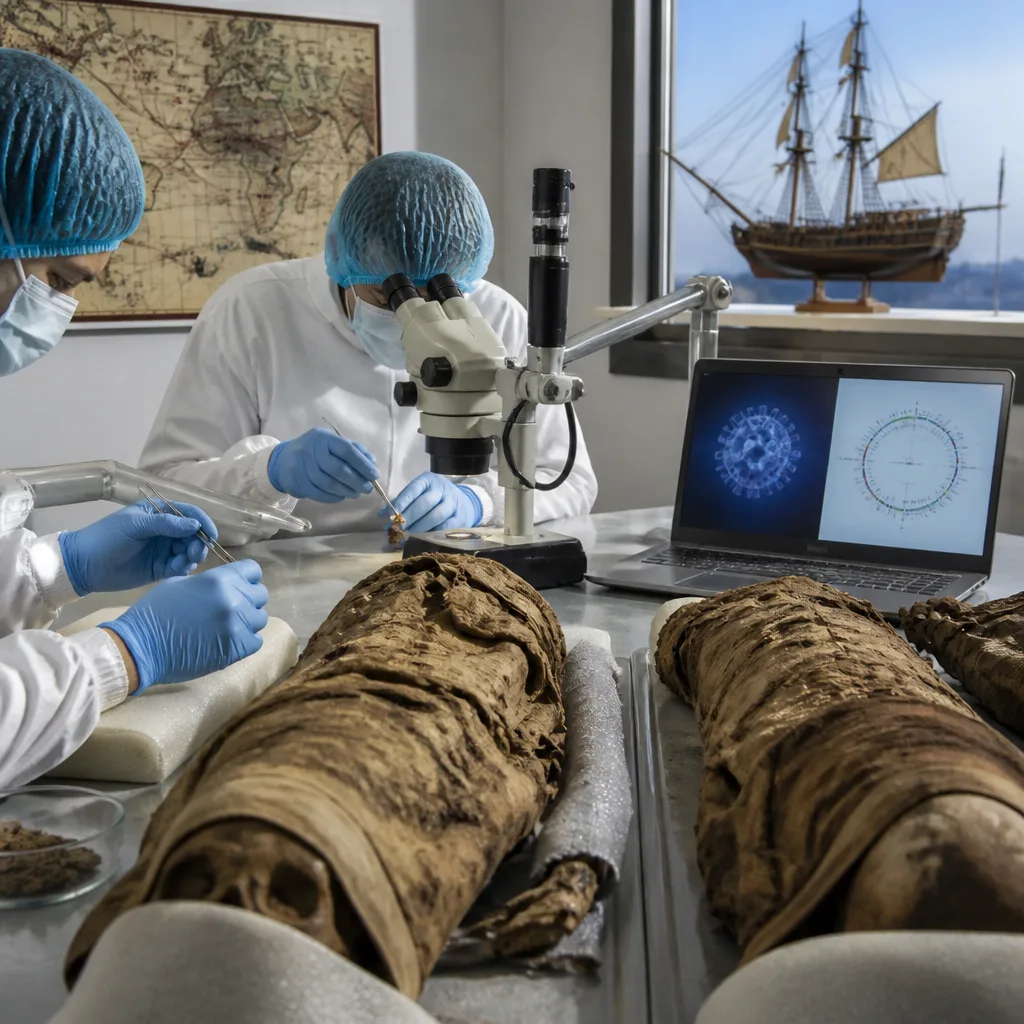
Scientists have recovered the oldest known smallpox DNA from human remains in the Americas, reporting viral traces in two Chilean mummies dated to roughly 500–600 years ago. The analysis, published in Science, indicates those viral sequences belong to an extinct branch of the variola virus that connects earlier Old World strains with the later forms responsible for large-scale epidemics.
What the genetic evidence shows
A team led by researchers at Trinity College Dublin compared the viral fragments recovered from the mummies with historical smallpox genomes. Their findings suggest that the virus underwent a prolonged period of genetic change until the 1500s, after which its genome became more stable through the 17th and 18th centuries — coinciding with the height of European colonial expansion.
“This discovery provides the first molecular confirmation that smallpox was carried to the Americas during the colonial period,” said pathogen geneticist and study co-author Shigeki Nakagome.
Microbiologist and co-author Lara Cassidy added that the observed stabilisation of the virus’s genome could reflect an evolutionary optimum that facilitated spread, particularly among populations with no prior immunity.
Historical context and human toll
Smallpox is among several infectious agents — including diphtheria, influenza, typhus and measles — that devastated Indigenous populations after European contact. Historians estimate that between 10 million and 100 million people may have died in the Americas from these epidemics over a few centuries.
The study also references 20th-century mortality figures, noting that smallpox caused between 300 and 500 deaths during that century — a statistic that underlines the disease’s long-standing impact until its global eradication.
Implications for epidemic history and pathogen evolution
By placing an extinct variola lineage in the Americas prior to large documented outbreaks, the new genomes supply molecular support for a narrative long inferred from timing and historical records: that smallpox accompanied Europeans to the New World. The genetic data show a transition from an adaptive phase to a more conserved viral genome just as colonial-era epidemics accelerated, a pattern consistent with a pathogen finding a broad pool of susceptible hosts.
- Oldest American smallpox DNA: recovered from two Chilean mummies, ~500–600 years old.
- Lineage: an extinct branch of variola that links Old World strains with later epidemic variants.
- Evolutionary pattern: long period of change until the 16th century, then relative stabilisation in the 17th–18th centuries.
The study’s genetic comparisons illuminate how the virus may have reached an evolutionary configuration that allowed efficient spread in newly exposed communities — a dynamic compounded by the lack of immunity among Indigenous peoples.
Data at a glance
| Item | Detail |
|---|---|
| Age of mummies | Approximately 500–600 years |
| Estimated deaths from colonial-era epidemics | 10–100 million (combined infectious diseases) |
| Smallpox deaths in 20th century (noted) | 300–500 |
While archaeological and historical evidence has long linked European contact with epidemic disease in the Americas, ancient pathogen genomes provide direct molecular confirmation. Such data allow researchers to trace viral lineages, estimate timing of divergence, and infer evolutionary pressures that shaped the pathogen’s spread.
Beyond settling questions of origin and timing, the findings carry wider significance for how scientists study historical pandemics: ancient DNA can reveal extinct viral branches that are absent from modern collections, helping to reconstruct the full evolutionary history of devastating pathogens.
The new sequences do not alter established facts about smallpox eradication, but they refine understanding of how the virus moved between continents and adapted during centuries of human upheaval that accompanied colonialism.
As pathogen genomics expands, collaborations between archaeologists, historians and molecular biologists are likely to produce further insights into the microbial dimensions of human history — and into the deep-time interactions between disease, migration and demographic change.