New builds aim to reverse rise in vacant, derelict properties
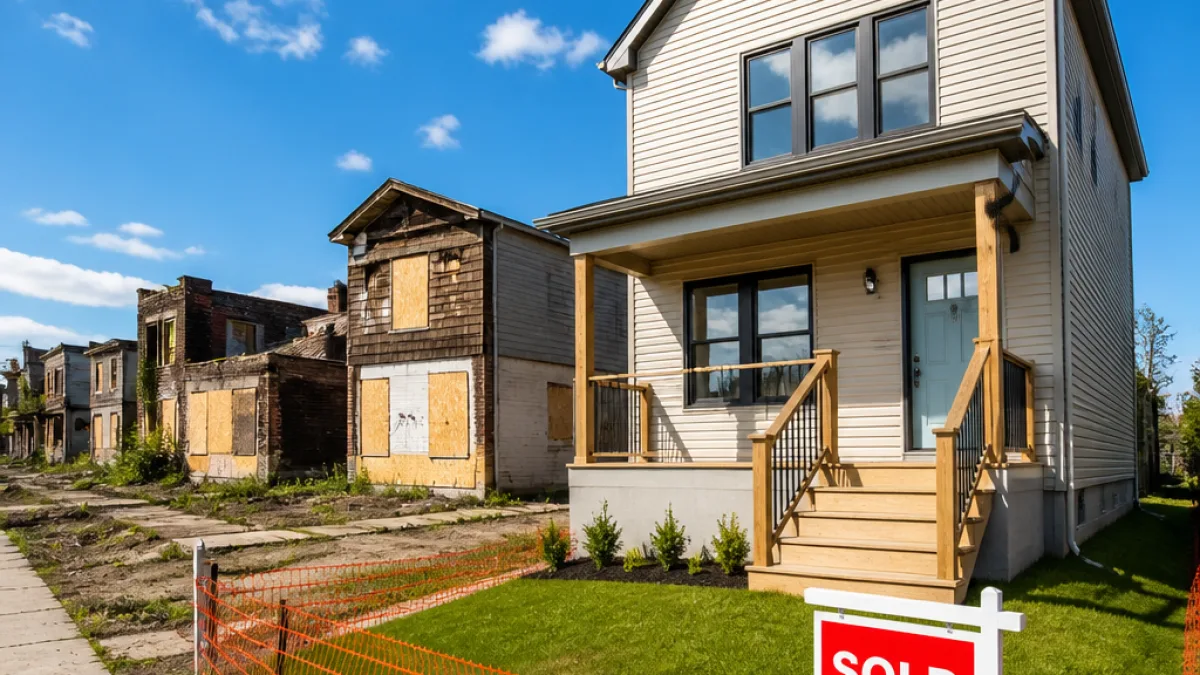
WINNIPEG — A two-storey house with fresh siding and orange construction fencing stands on a lot that until recently was burnt rubble — a visible sign of a neighbourhood trying to rebuild itself.
The home belongs to Jesse Bettcher, who bought it through a pilot project designed to create affordable home ownership in the city’s north end. The project is a collaboration among a social enterprise, local construction partners and government supports that aims to tackle a growing number of boarded-up buildings and empty lots in William Whyte.
Bettcher said the new house allowed his family to move out of a deteriorating rental and into a mortgage that, he hopes, will benefit his children over the long term. He noted that he received significant assistance to qualify for the purchase despite a credit score under 500.
“It’s surreal, it’s like an Airbnb almost,” Bettcher said, standing in his front yard. “It’s not for me. It’s for the kids.”
How the pilot works and who’s involved
The city sold the lot to Purpose Construction for one dollar. Purpose Construction partnered with Step Up Construction and Build Inc. to erect the house. Funding and support also came from provincial sources, and local leaders have been actively advocating for the initiative.
One of the pilot’s goals is visible change: replacing boarded-up or burned-out properties with new houses in the hope that neighbours will feel safer and more optimistic about staying in the area.
Local numbers show a worrying trend
William Whyte’s situation illustrates the scale of the challenge. Local advocates report the neighbourhood now has roughly 300 boarded-up buildings or empty lots, up from about 60 when work on the issue began.
| Measure | Approximate figure |
|---|---|
| Boarded-up buildings / empty lots (current) | 300 |
| Boarded-up buildings / empty lots (earlier) | 60 |
Community response and stakes
Darrell Warren, head of the William Whyte Neighbourhood Association, has been a vocal supporter of the program. He said visible renovation and new construction can change perceptions and encourage long-term residents to remain.
“If people see new houses built on these lots, they’ll notice the change, and that gives people living here hope,” Warren said.
Advocates argue that without intervention, the accumulation of derelict properties can become a self-reinforcing problem that pushes residents away and leaves neighbourhoods vulnerable to further decline.
What this means for Winnipeg
The pilot is small but symbolic. By converting formerly hazardous lots into occupied homes, city and community partners hope to demonstrate a model for neighbourhood revitalization that blends public land policy, social enterprise construction and targeted financial supports for buyers with low credit scores.
For residents like Bettcher, the change is personal: money that once went to unstable rental housing now goes toward a mortgage and, they say, an investment for the next generation. For the city, the experiment offers a potential tool to address dereliction and to stabilise neighbourhoods that have seen rising vacancy and property damage.
- Project partners: City of Winnipeg, Purpose Construction, Step Up Construction, Build Inc., provincial funding sources
- Local leaders: William Whyte Neighbourhood Association head Darrell Warren
- Main challenge: Increase in boarded-up buildings / empty lots from about 60 to roughly 300
The pilot’s longer-term impact will depend on whether the approach can be scaled, sustained funding remains available, and more families can access ownership despite financial barriers. For now, a new house on a formerly ruined lot is a small but tangible sign of change in one Winnipeg neighbourhood.