
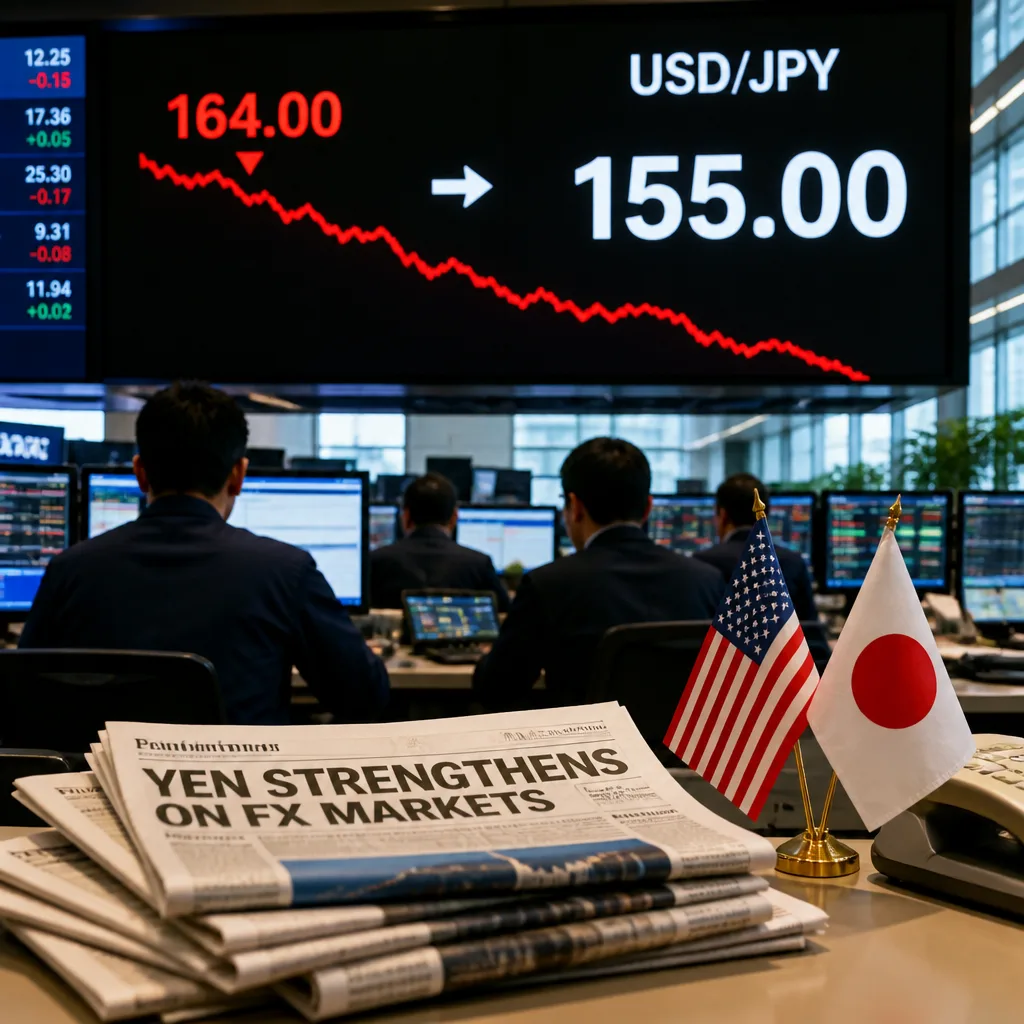
The United States and Japan conducted a coordinated intervention to support the Japanese currency, officials confirmed on Monday, after the yen slid to a multi-decade low and then rebounded to its strongest level in roughly three months.
Tokyo’s finance ministry said the two governments had carried out a joint yen-buying operation late last week and indicated they will not hesitate to take further action if needed. The move pushed the yen to about ¥155 to the U.S. dollar on Monday, up from nearly ¥164 earlier last week, when it reached what was described as a 40-year low.
What officials are saying
“They have a weakening yen, and they wanted a little bit of help. And we’re always there for Japan.”
— Donald Trump, speaking to reporters.
U.S. Treasury Secretary Scott Bessent also signalled readiness for further intervention, saying Washington “will not hesitate to participate in further joint intervention.” Reports from a recent cabinet meeting reportedly showed a note listing a potential purchase range of $5 billion–$10 billion of Japanese yen.
Market forces behind the move
The yen’s recent weakness had been driven in part by a persistent gap between Japanese borrowing costs and those in other advanced economies. That difference encouraged a carry trade strategy: investors borrowed in low-cost yen and invested proceeds in higher-yielding dollar assets. The divergence in yields amplified downward pressure on the yen and helped produce the sharp depreciation toward ¥164.
Additional downward pressure stemmed from investor worries about policy direction in Japan. The source material links the currency’s struggles to concerns over the Japanese prime minister’s outlook on fiscal stimulus and criticism of higher interest rates, factors seen as contributing to lower domestic borrowing costs relative to peers.
Analysts temper expectations
Some economic analysts cautioned that a one-off intervention might not be sufficient to reverse the broader trend. The consultancy Oxford Economics said the coordinated action reduces the near-term risk of a disorderly depreciation and may give the Bank of Japan more time to gauge how geopolitical tensions and past rate moves affect the economy — but that it may not be enough to change the underlying trend in the currency.
The firm stated it still expects the Bank of Japan to hold off on rapid tightening, projecting a likely delay until December, even as market speculation about earlier rate increases grows.
- Yen level after intervention: about ¥155 per U.S. dollar
- Low during last week: nearly ¥164 per U.S. dollar (40-year low)
- Reported U.S. potential purchase: $5 billion–$10 billion of yen
| Measure | Value |
|---|---|
| Post-intervention yen | ¥155 / US$1 |
| Recent low | ~¥164 / US$1 (40-year low) |
For Canadian investors and businesses, coordinated currency operations by two major economies are noteworthy because they can spill over into currency markets and global asset prices. A stronger yen tends to reduce import prices into Japan and can alter trade flows and capital movements — effects that ripple through international markets and investor portfolios.
While interventions can stabilise markets in the short term, economists often warn that unless domestic monetary policy and fundamentals adjust, the underlying forces that pushed a currency lower remain. In this instance, that means watching interest-rate differentials, Bank of Japan policy decisions, and developments in global geopolitical risk that the consultancy cited as part of its cautionary outlook.
Markets will now be closely watching statements from the Bank of Japan and future communications from Tokyo and Washington for signals about whether this intervention is the start of a sustained co-ordinated effort or a temporary step to calm volatility.
This report is based on official statements from Tokyo and Washington and analysis provided by market commentators and Oxford Economics.